How to Write a Generic Method in C#

A method that returns the first item of an array works the same for numbers, names or anything else. Instead of one copy per type, C# lets you write it once with a type parameter, T, that the caller fills in: First<int>, First<string>, or left to the compiler to work out.
Syntax
<ReturnType> <Name><T>(<parameters that use T>)
{
    <statements that use T>
}
| Part | What it does |
|---|---|
<T> after the name | Declares a type parameter: a placeholder for a type the caller chooses. T is the usual name. |
<parameters that use T> | Parameters typed with T, such as T[] items. |
<ReturnType> | Can be T too, so the method returns the caller's type. |
<Name><int>(...) | A call that fills in T explicitly. Leave out <int> and the compiler infers it from the arguments. |
Microsoft's generic methods guide: "A generic method is a method that is declared with type parameters". And: "You can also omit the type argument and the compiler will infer it."
The Example
A First<T> method returns the first item of an array of any type. The program calls it for an int array and a string array with the type written out, and once without it.
Prerequisites
- The .NET 10 SDK or newer, which runs a single
.csfile withdotnet run. This guide uses .NET SDK 10.0.404.
Step 1: Write the Code
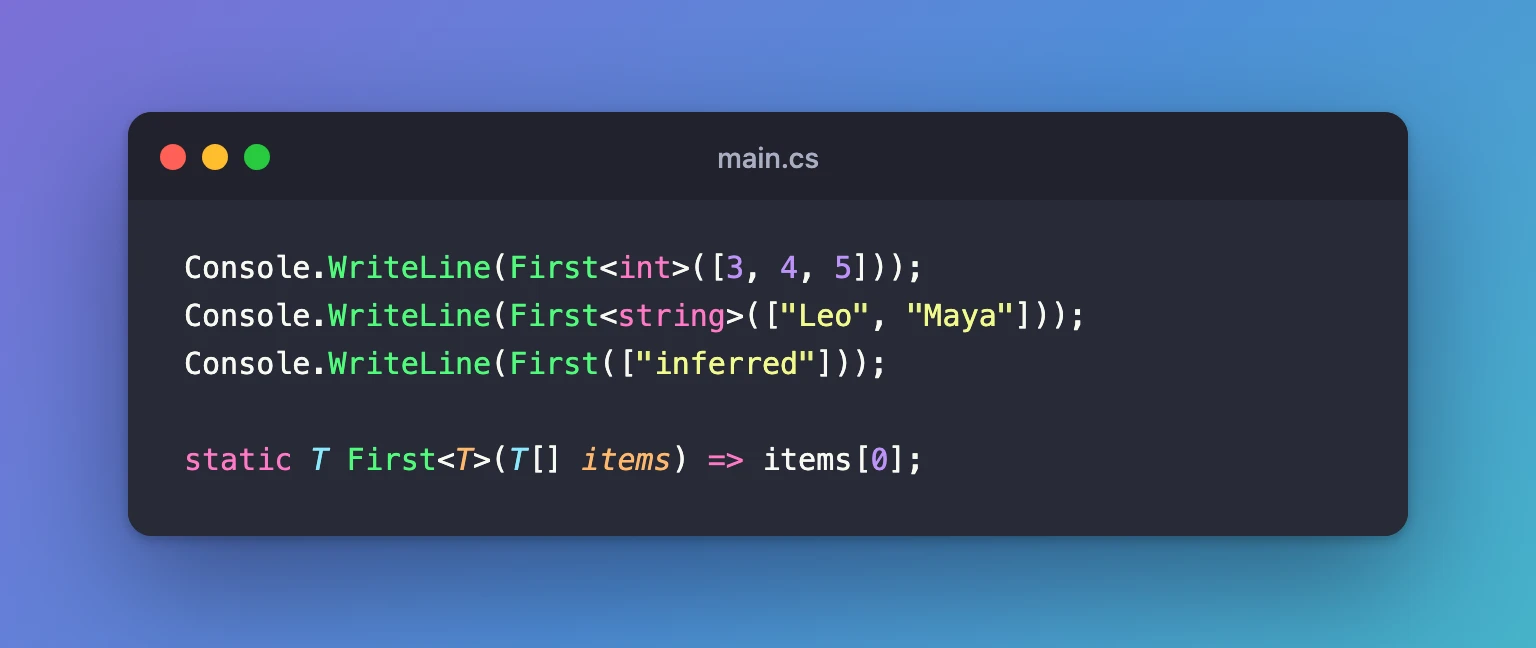
Create a file named main.cs in an empty folder:
Console.WriteLine(First<int>([3, 4, 5]));
Console.WriteLine(First<string>(["Leo", "Maya"]));
Console.WriteLine(First(["inferred"]));

static T First<T>(T[] items) => items[0];
In First<int>, every T in the method becomes int: it takes an int[] and returns an int. In the last call, the array holds a string, so the compiler infers T is string.
Step 2: Run It
dotnet run main.cs
3
Leo
inferred

One method handled numbers and strings, with and without the type written out. The command is the same in zsh, bash and PowerShell.
What Happens When the Types Don't Agree
With T set to int, the method accepts only int values:
Console.WriteLine(First<int>(["Leo"]));

static T First<T>(T[] items) => items[0];
/Users/you/demo/main.cs(1,31): error CS0029: Cannot implicitly convert type 'string' to 'int'

The build failed. Fix the build errors and run again.
The type parameter keeps the method type-safe: a string can't sneak into an int array.
What Happens When There's Nothing to Infer From
An empty collection expression gives the compiler no clue about T:
Console.WriteLine(First([]));

static T First<T>(T[] items) => items[0];
/Users/you/demo/main.cs(1,19): error CS0411: The type arguments for method 'First<T>(T[])' cannot be inferred from the usage. Try specifying the type arguments explicitly.
/Users/you/demo/main.cs(3,10): warning CS8321: The local function 'First' is declared but never used

The build failed. Fix the build errors and run again.
Write the type, as the message suggests: First<int>([]). The warning is a side effect: because the only call failed, the compiler counts the method as unused.
Common Mistakes
| Mistake | What happens | Do this instead |
|---|---|---|
Passing values of another type than the one written in <...> | error CS0029: Cannot implicitly convert type 'string' to 'int' | Match the type argument to the values, or leave it out |
Calling with nothing the compiler can infer T from | error CS0411: The type arguments for method 'First<T>(T[])' cannot be inferred from the usage. | Write the type argument: First<int>(...) |
| Writing three copies of a method for three types | The copies drift apart over time | Write one generic method |
Troubleshooting
| Symptom | Likely cause | Fix |
|---|---|---|
CS0411 | The arguments don't reveal T | Add the type argument explicitly |
CS0029 inside a generic call | The values don't fit the type argument | Change one or the other |
FAQ
When can the compiler infer T?
From the arguments only. The guide: "The compiler can infer the type parameters based on the method arguments you pass in; it cannot infer the type parameters only from a constraint or return value. Therefore type inference does not work with methods that have no parameters."
Where have I seen generic methods before?
In .NET itself. configuration.Get<string[]>() and LINQ methods such as Select are generic methods: the type in angle brackets, written or inferred, tells them what to work with.
Conclusion
Add <T> after a method's name and use T for its parameters and return type, and the method works for any type the caller chooses. Write the type argument, as in First<int>(...), or let the compiler infer it from the arguments.
Additional Resources
- Generic methods, on Microsoft Learn.
