How to Write a Constructor in C#

Some objects make no sense without certain values: an account without an owner, an order without an item. In C#, a constructor takes those values when the object is created with new, and sets the object up before any other code can use it.
Syntax
class <ClassName>
{
    public <ClassName>(<parameters>)
    {
        <PropertyName> = <parameter>;
    }
}

<ClassName> <variable> = new(<arguments>);
| Part | What it does |
|---|---|
public <ClassName>(<parameters>) | The constructor: named like the class, with no return type |
{ <PropertyName> = <parameter>; } | Sets up the new object, usually from the values passed in |
new(<arguments>) | Creates the object and runs the constructor with these values |
Microsoft's constructors guide: "A constructor is a method called by the runtime when an instance of a class or a struct is created."
The Example
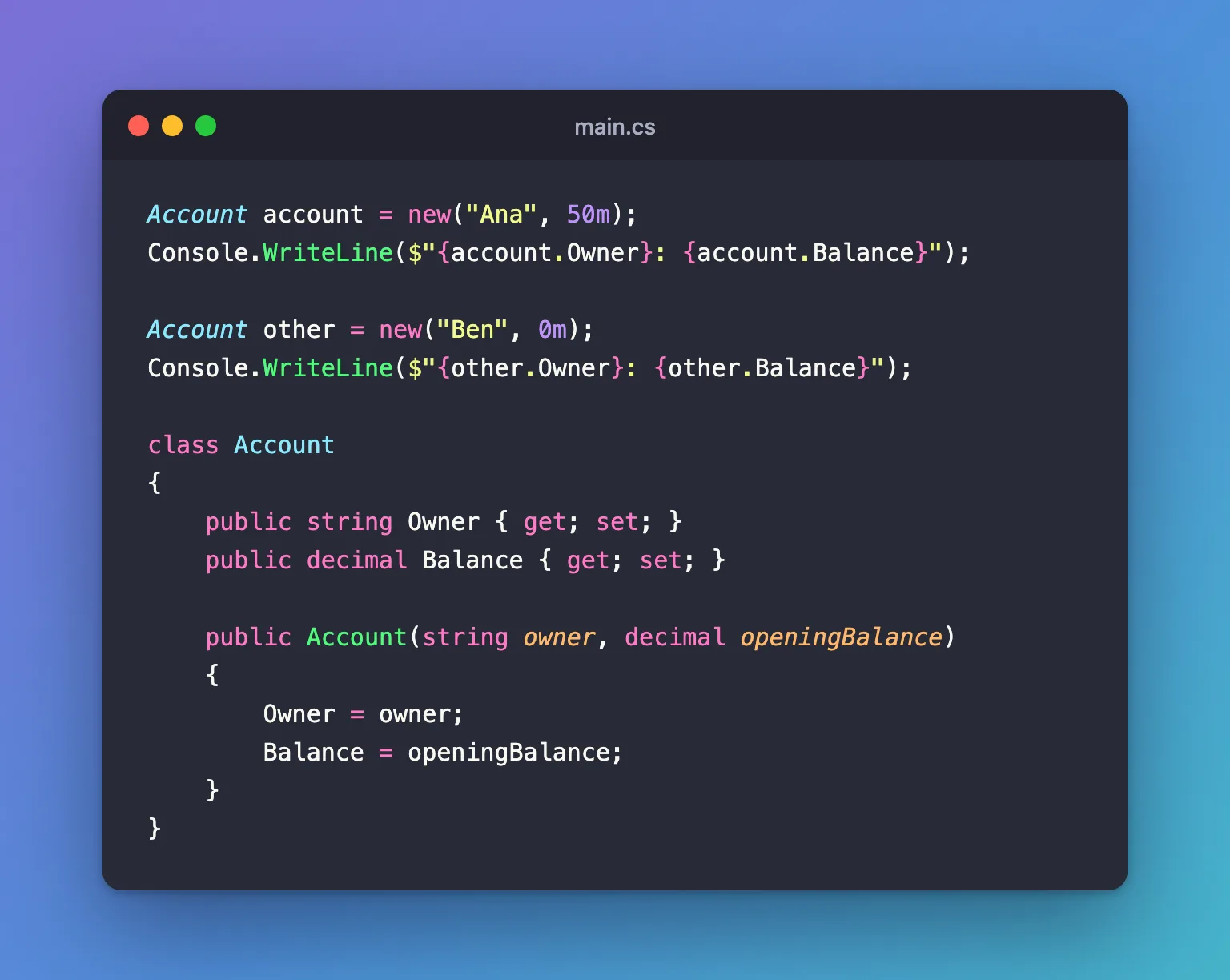
An Account needs an owner and an opening balance. Its constructor takes both, and the program opens two accounts.
Prerequisites
- The .NET 10 SDK or newer, which runs a single
.csfile withdotnet run. This guide uses .NET SDK 10.0.404.
Step 1: Write the Code
Create a file named main.cs in an empty folder:
Account account = new("Ana", 50m);
Console.WriteLine($"{account.Owner}: {account.Balance}");

Account other = new("Ben", 0m);
Console.WriteLine($"{other.Owner}: {other.Balance}");

class Account
{
    public string Owner { get; set; }
    public decimal Balance { get; set; }

    public Account(string owner, decimal openingBalance)
    {
        Owner = owner;
        Balance = openingBalance;
    }
}
The m in 50m makes the number a decimal, the type of Balance.
Step 2: Run It
dotnet run main.cs
Ana: 50
Ben: 0
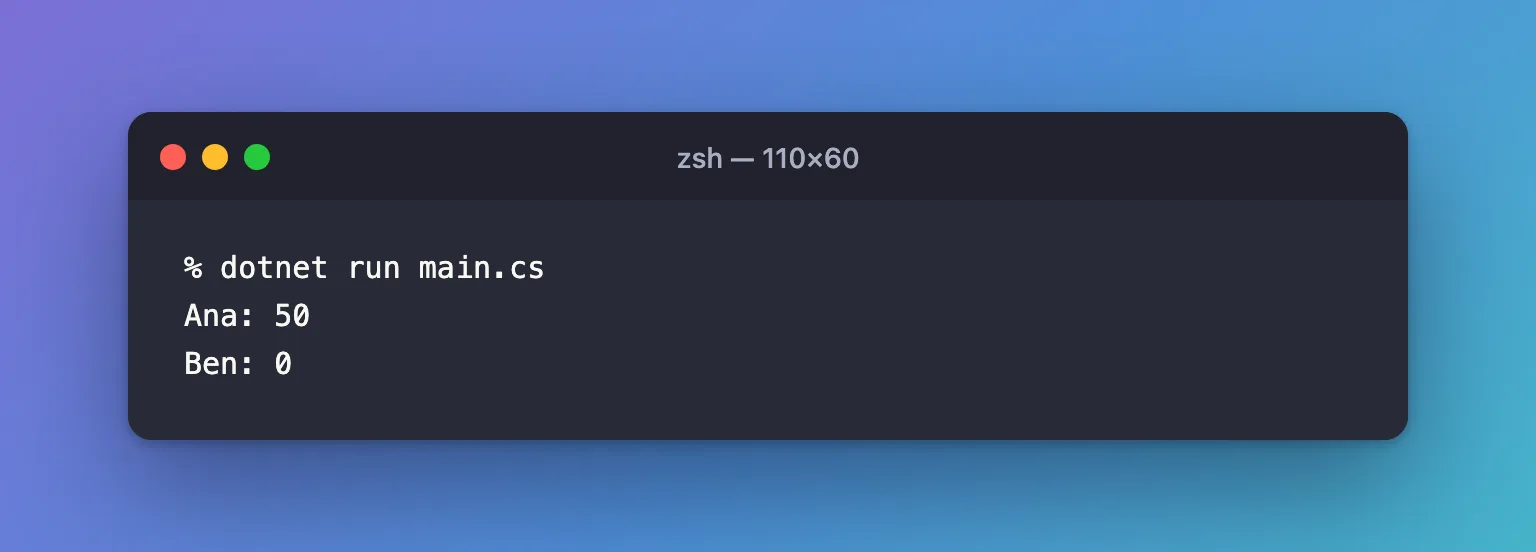
Each new(...) ran the constructor with its own values, so each account started with its own owner and balance.
The command is the same in zsh, bash and PowerShell.
new() Without the Values
Once a class has a constructor with parameters, new() without them doesn't compile:
Account account = new();

class Account
{
    public string Owner { get; set; }
    public decimal Balance { get; set; }

    public Account(string owner, decimal openingBalance)
    {
        Owner = owner;
        Balance = openingBalance;
    }
}
/Users/you/demo/main.cs(1,19): error CS7036: There is no argument given that corresponds to the required parameter 'owner' of 'Account.Account(string, decimal)'

The build failed. Fix the build errors and run again.
A class without any constructor gets a parameterless one from C#. Microsoft's instance constructors guide: "If you declare at least one instance constructor in a class, C# doesn't provide a parameterless constructor." That's the point here: an account can't be opened without an owner.
More Than One Constructor
When an object can start in more than one way, write one constructor for each. With a parameterless constructor added next to the first one, new() worked:
Account account = new();
Console.WriteLine($"{account.Owner}: {account.Balance}");

class Account
{
    public string Owner { get; set; }
    public decimal Balance { get; set; }

    public Account()
    {
        Owner = "Unknown";
    }

    public Account(string owner, decimal openingBalance)
    {
        Owner = owner;
        Balance = openingBalance;
    }
}
Unknown: 0
C# picked the constructor whose parameters match what you pass to new.
Common Mistakes
| Mistake | What happens | Do this instead |
|---|---|---|
new() when the only constructor takes parameters | error CS7036: There is no argument given that corresponds to the required parameter 'owner' | Pass the values, or add a parameterless constructor |
Giving the constructor a return type, such as public void Account(...) | error CS0542: 'Account': member names cannot be the same as their enclosing type | Leave the return type out |
| Forgetting to set a property in the constructor | It keeps its type's default: Balance stayed 0 in the parameterless constructor above | Set every property the object needs |
Troubleshooting
| Symptom | Likely cause | Fix |
|---|---|---|
CS7036 ... required parameter on a new | The arguments don't match any constructor | Pass what the constructor asks for |
CS0542: ... member names cannot be the same as their enclosing type | The constructor has a return type, such as void | Remove the return type |
A property is empty right after new | The constructor didn't set it | Set it in the constructor |
FAQ
Does every class need a constructor?
No. A class without one still gets a parameterless constructor from C#: the guide says "If a class has no explicit instance constructors, C# provides a parameterless constructor that you can use to instantiate an instance of that class". Write one when the object needs values to start with.
Constructor or property defaults?
A property default, such as = "Untitled", is the same for every object. A constructor parameter lets each new choose, like the owner of each account.
Conclusion
A constructor is a method named like the class, with no return type, that runs when new creates an object: take the values the object needs as parameters and set them. Once a class has one, C# no longer adds a parameterless constructor, so new() without arguments is error CS7036 until you write one.
Additional Resources
- Constructors, on Microsoft Learn.
- Instance constructors, on Microsoft Learn.
