How to Verify a JWT in PHP with firebase/php-jwt

JWT::decode from the firebase/php-jwt package verifies a JSON Web Token in PHP. You give it the token and a Key object that pairs the secret with the algorithm, and it returns the claims as an object, or throws an exception that says what's wrong.
Syntax
$claims = JWT::decode(<token>, new Key(<key>, '<algorithm>'));
| Part | What it does |
|---|---|
<token> | The JWT string to check. |
new Key(<key>, '<algorithm>') | The key to check the signature with, and the one algorithm it may be used with, such as 'HS256'. |
$claims | The verified claims, as a stdClass object: $claims->sub, $claims->exp and so on. |
The doc comment on JWT::decode in the php-jwt source: "Decodes a JWT string into a PHP object." Its signature is decode(string $jwt, $keyOrKeyArray, ?stdClass &$headers = null): stdClass, where the second argument is "The Key or associative array of key IDs (kid) to Key objects".
The Example
The example signs a token for the user ada with the role reader, then decodes it twice: with the key that signed it, and with a different key, the way a token from another app would arrive.
Both keys are 32 random bytes, made with openssl rand -base64 32 and written as base64. They sit in the code only so the example runs as it is. A real application loads its key from configuration and never keeps it in the source.
Prerequisites
Step 1: Create the Project
mkdir demo
cd demo
composer require firebase/php-jwt
composer require creates composer.json, downloads php-jwt, v7.2.2 here, into vendor/ and writes the autoloader.
Step 2: Write the Code
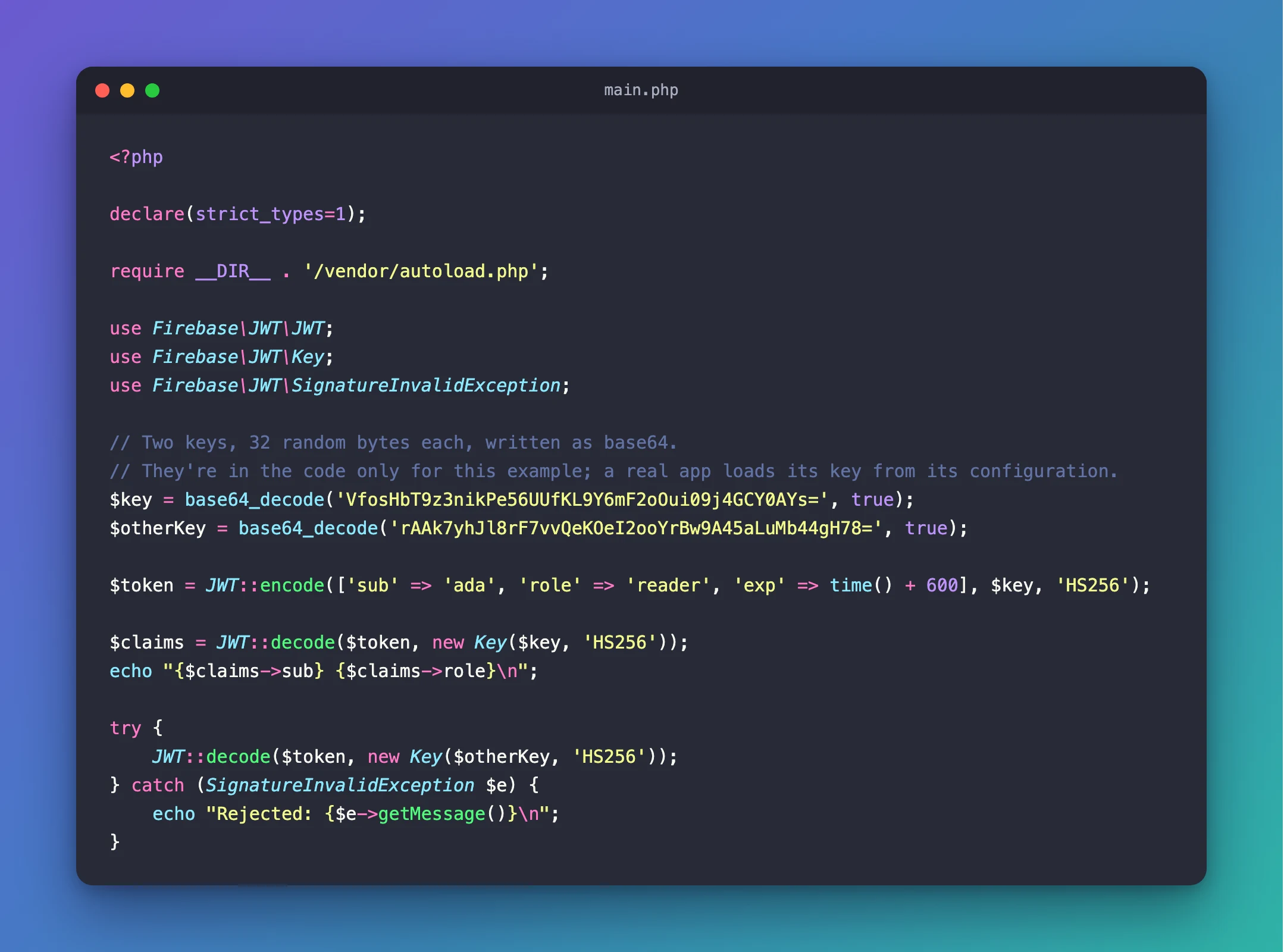
Create main.php:
<?php

declare(strict_types=1);

require __DIR__ . '/vendor/autoload.php';

use Firebase\JWT\JWT;
use Firebase\JWT\Key;
use Firebase\JWT\SignatureInvalidException;

// Two keys, 32 random bytes each, written as base64.
// They're in the code only for this example; a real app loads its key from its configuration.
$key = base64_decode('VfosHbT9z3nikPe56UUfKL9Y6mF2oOui09j4GCY0AYs=', true);
$otherKey = base64_decode('rAAk7yhJl8rF7vvQeKOeI2ooYrBw9A45aLuMb44gH78=', true);

$token = JWT::encode(['sub' => 'ada', 'role' => 'reader', 'exp' => time() + 600], $key, 'HS256');

$claims = JWT::decode($token, new Key($key, 'HS256'));
echo "{$claims->sub} {$claims->role}\n";

try {
    JWT::decode($token, new Key($otherKey, 'HS256'));
} catch (SignatureInvalidException $e) {
    echo "Rejected: {$e->getMessage()}\n";
}
The first JWT::decode gets the key that signed the token, the second $otherKey, so the signature check fails and php-jwt throws SignatureInvalidException.
Step 3: Run It
php main.php
ada reader
Rejected: Signature verification failed
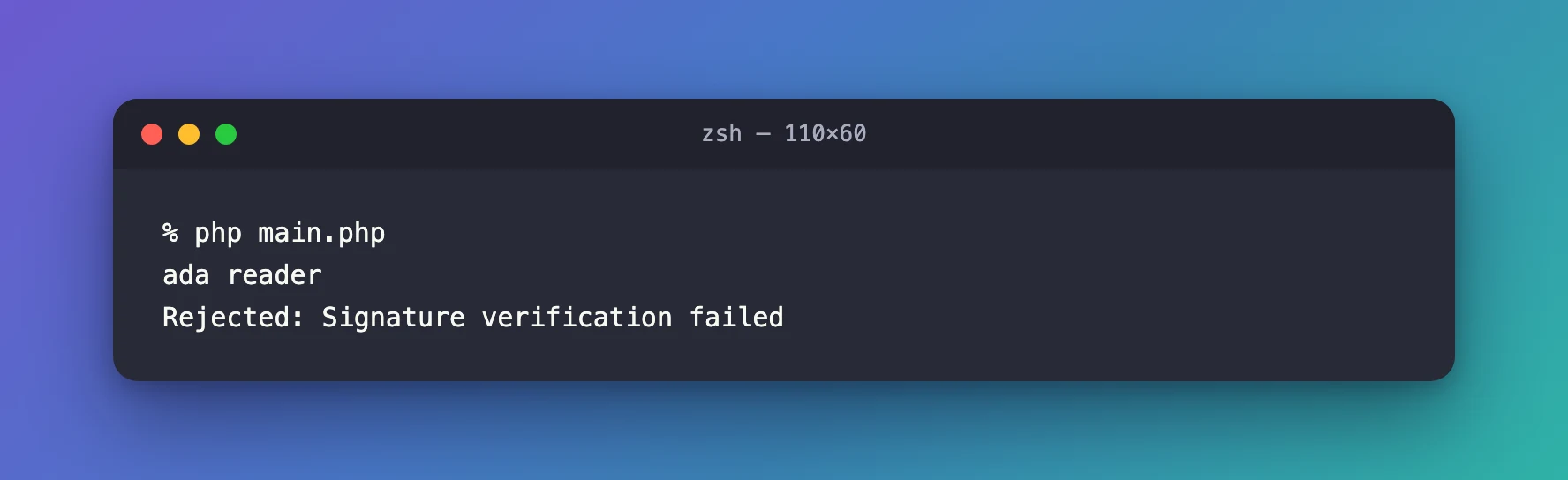
With the right key, decode checked the signature and the exp claim and returned the claims. With the other key, the signature didn't match, so it threw.
The Exceptions It Throws
These came from real runs. The first two are php-jwt's own classes, and both extend PHP's UnexpectedValueException, so one catch (UnexpectedValueException $e) covers all of them:
| What's wrong | Exception | Message |
|---|---|---|
| Signed with another key, or the payload was changed | Firebase\JWT\SignatureInvalidException | Signature verification failed |
| The token has expired | Firebase\JWT\ExpiredException | Expired token |
Signed with HS256, but the Key says 'HS512' | UnexpectedValueException | Incorrect key for this algorithm |
| Not a JWT at all | UnexpectedValueException | Wrong number of segments |
The key passed as a plain string, not a Key | UnexpectedValueException | "kid" empty, unable to lookup correct key |
Allow a Little Clock Skew
JWT::$leeway sets a margin, in seconds, for the time checks. With JWT::$leeway = 60; before decode, a token that had expired 30 seconds earlier still decoded. It's a static property, so it applies to every later decode call too.
Common Mistakes
| Mistake | What happens | Do this instead |
|---|---|---|
| Passing the secret itself as the second argument | UnexpectedValueException: "kid" empty, unable to lookup correct key | Wrap it: new Key($key, 'HS256') |
Catching only SignatureInvalidException | An expired or malformed token throws something else and stops the script | Catch UnexpectedValueException for every bad token |
| Trusting the header to pick the algorithm | php-jwt doesn't allow it: the Key fixes the algorithm | Keep the algorithm in your code, in the Key |
Troubleshooting
| Symptom | Likely cause | Fix |
|---|---|---|
Signature verification failed | Another key signed it, or it was changed | Check with the signing key; reject the token |
Expired token | The exp has passed | Get a new token, or set a small JWT::$leeway |
Incorrect key for this algorithm | The token's algorithm differs from the Key's | Sign and verify with the same algorithm |
FAQ
Why does decode return an object, not an array?
It decodes the JSON payload into a stdClass, which is what PHP's JSON decoding gives for objects. Read claims as properties, $claims->sub.
Can I read the header without verifying?
The README says no: "Decoding the JWT headers without verifying the JWT first is NOT recommended, and is not supported by this library." To get the header, pass a stdClass object as the third argument, $headers = new stdClass();, and read it after decode returns: it held {"typ":"JWT","alg":"HS256","kid":"key-2026-11"} for a token with a key ID. A null variable stays null.
Conclusion
JWT::decode($token, new Key($key, 'HS256')) verifies the signature and the time claims and returns the claims as an object. The Key pins the algorithm, and one catch (UnexpectedValueException $e) rejects every bad token.
