How to Verify a JWT in Java with the JJWT Parser

JJWT verifies JSON Web Tokens in Java with a parser: Jwts.parser() starts it, verifyWith(key) sets the key, build() makes the parser, and parseSignedClaims(token) checks the token and returns its claims, or throws an exception that says what's wrong.
Syntax
Claims claims = Jwts.parser()
        .verifyWith(<key>)
        .build()
        .parseSignedClaims(<token>)
        .getPayload();
| Part | What it does |
|---|---|
Jwts.parser() | Starts a parser builder. |
.verifyWith(<key>) | Sets the key that checks signatures: for HS256, the same SecretKey that signed the token. |
.build() | Makes the parser, which you can keep and reuse. |
.parseSignedClaims(<token>) | Checks the signature and the time claims, and returns the signed token. |
.getPayload() | The verified claims, as a Claims object. |
From the JJWT Javadoc: parseSignedClaims "Parses the jws argument, expected to be a cryptographically-signed Claims JWS", and on the parser builder, verifyWith(SecretKey key) "Sets the signature verification SecretKey used to verify all encountered JWS signatures."
The Example
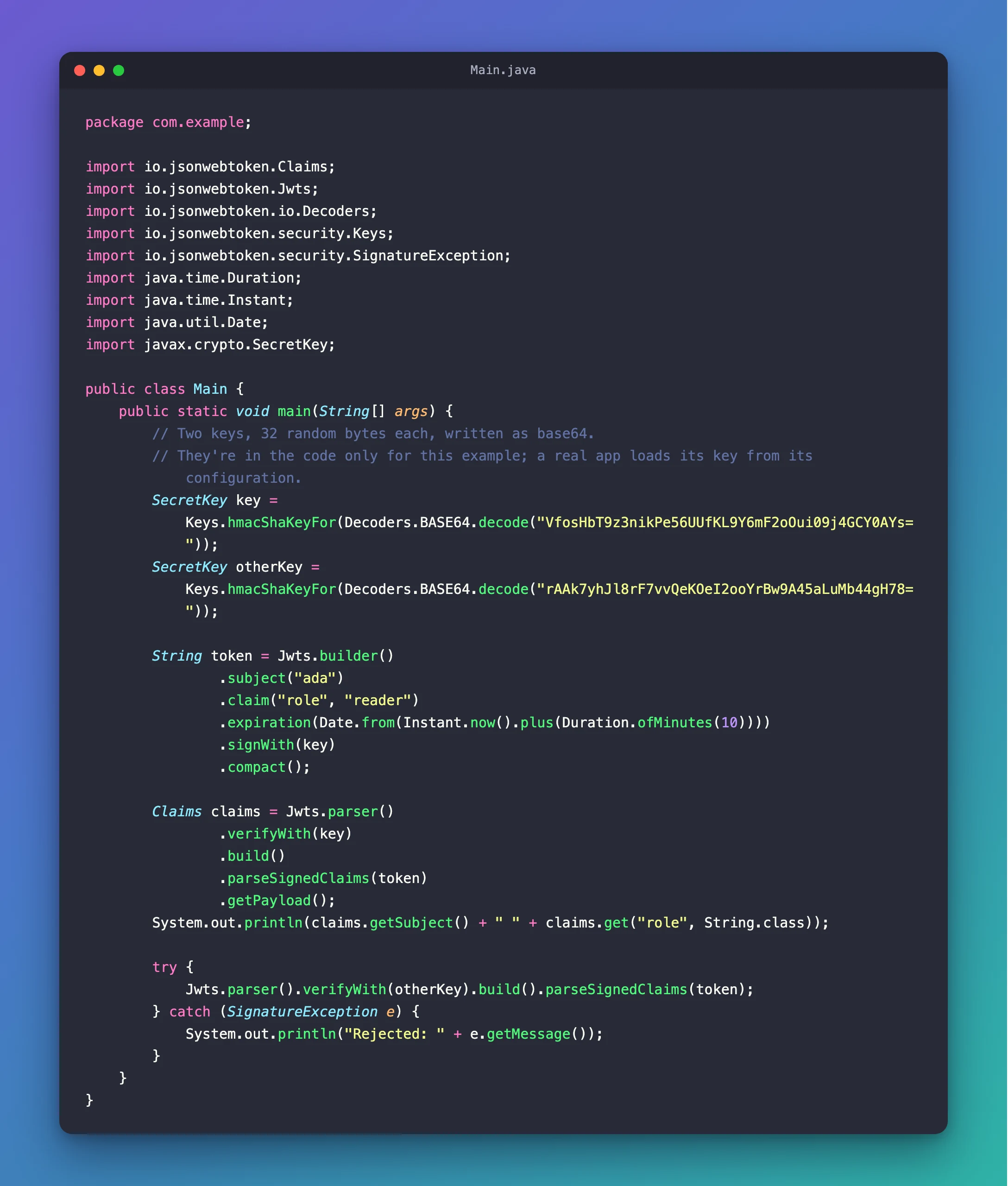
The example signs a token for the user ada with the role reader, then parses it twice: with the key that signed it, and with a different key, the way a token from another app would arrive.
Both keys are 32 random bytes, made with openssl rand -base64 32 and written as base64. They sit in the code only so the example runs as it is. A real application loads its key from configuration and never keeps it in the source.
Prerequisites
- A JDK and Maven. This guide uses JDK 25.0.5.1 and Maven 3.10.2.
Step 1: Create the Project
JJWT comes as three parts: jjwt-api, which your code uses, and jjwt-impl and jjwt-jackson, which it needs at run time. Create a folder named demo with this pom.xml in it:
<?xml version="1.0" encoding="UTF-8"?>
<project xmlns="http://maven.apache.org/POM/4.0.0"
         xmlns:xsi="http://www.w3.org/2001/XMLSchema-instance"
         xsi:schemaLocation="http://maven.apache.org/POM/4.0.0 https://maven.apache.org/xsd/maven-4.0.0.xsd">
  <modelVersion>4.0.0</modelVersion>
  <groupId>com.example</groupId>
  <artifactId>demo</artifactId>
  <version>1.0.0</version>
  <properties>
    <maven.compiler.release>25</maven.compiler.release>
    <project.build.sourceEncoding>UTF-8</project.build.sourceEncoding>
    <jjwt.version>0.13.0</jjwt.version>
  </properties>
  <dependencyManagement>
    <dependencies>
      <!-- jjwt-jackson asks for Jackson 2.12.7.1. This makes Maven use the newest Jackson 2 instead. -->
      <dependency>
        <groupId>com.fasterxml.jackson</groupId>
        <artifactId>jackson-bom</artifactId>
        <version>2.23.0</version>
        <type>pom</type>
        <scope>import</scope>
      </dependency>
    </dependencies>
  </dependencyManagement>
  <dependencies>
    <dependency>
      <groupId>io.jsonwebtoken</groupId>
      <artifactId>jjwt-api</artifactId>
      <version>${jjwt.version}</version>
    </dependency>
    <dependency>
      <groupId>io.jsonwebtoken</groupId>
      <artifactId>jjwt-impl</artifactId>
      <version>${jjwt.version}</version>
      <scope>runtime</scope>
    </dependency>
    <dependency>
      <groupId>io.jsonwebtoken</groupId>
      <artifactId>jjwt-jackson</artifactId>
      <version>${jjwt.version}</version>
      <scope>runtime</scope>
    </dependency>
  </dependencies>
  <build>
    <plugins>
      <plugin>
        <groupId>org.codehaus.mojo</groupId>
        <artifactId>exec-maven-plugin</artifactId>
        <version>3.7.0</version>
        <configuration>
          <mainClass>com.example.Main</mainClass>
        </configuration>
      </plugin>
    </plugins>
  </build>
</project>
jackson-bom makes Maven use the newest Jackson 2 release, because the version jjwt-jackson asks for is old. exec-maven-plugin runs the com.example.Main class.
Step 2: Write the Code
Inside demo, create the folders src/main/java/com/example and save this as Main.java there:
package com.example;

import io.jsonwebtoken.Claims;
import io.jsonwebtoken.Jwts;
import io.jsonwebtoken.io.Decoders;
import io.jsonwebtoken.security.Keys;
import io.jsonwebtoken.security.SignatureException;
import java.time.Duration;
import java.time.Instant;
import java.util.Date;
import javax.crypto.SecretKey;

public class Main {
    public static void main(String[] args) {
        // Two keys, 32 random bytes each, written as base64.
        // They're in the code only for this example; a real app loads its key from its configuration.
        SecretKey key = Keys.hmacShaKeyFor(Decoders.BASE64.decode("VfosHbT9z3nikPe56UUfKL9Y6mF2oOui09j4GCY0AYs="));
        SecretKey otherKey = Keys.hmacShaKeyFor(Decoders.BASE64.decode("rAAk7yhJl8rF7vvQeKOeI2ooYrBw9A45aLuMb44gH78="));

        String token = Jwts.builder()
                .subject("ada")
                .claim("role", "reader")
                .expiration(Date.from(Instant.now().plus(Duration.ofMinutes(10))))
                .signWith(key)
                .compact();

        Claims claims = Jwts.parser()
                .verifyWith(key)
                .build()
                .parseSignedClaims(token)
                .getPayload();
        System.out.println(claims.getSubject() + " " + claims.get("role", String.class));

        try {
            Jwts.parser().verifyWith(otherKey).build().parseSignedClaims(token);
        } catch (SignatureException e) {
            System.out.println("Rejected: " + e.getMessage());
        }
    }
}
claims.getSubject() reads sub, and claims.get("role", String.class) reads a custom claim as a String. The SignatureException caught here is the one in io.jsonwebtoken.security.
Step 3: Run It
From the demo folder:
mvn -q compile exec:java
ada reader
Rejected: JWT signature does not match locally computed signature. JWT validity cannot be asserted and should not be trusted.
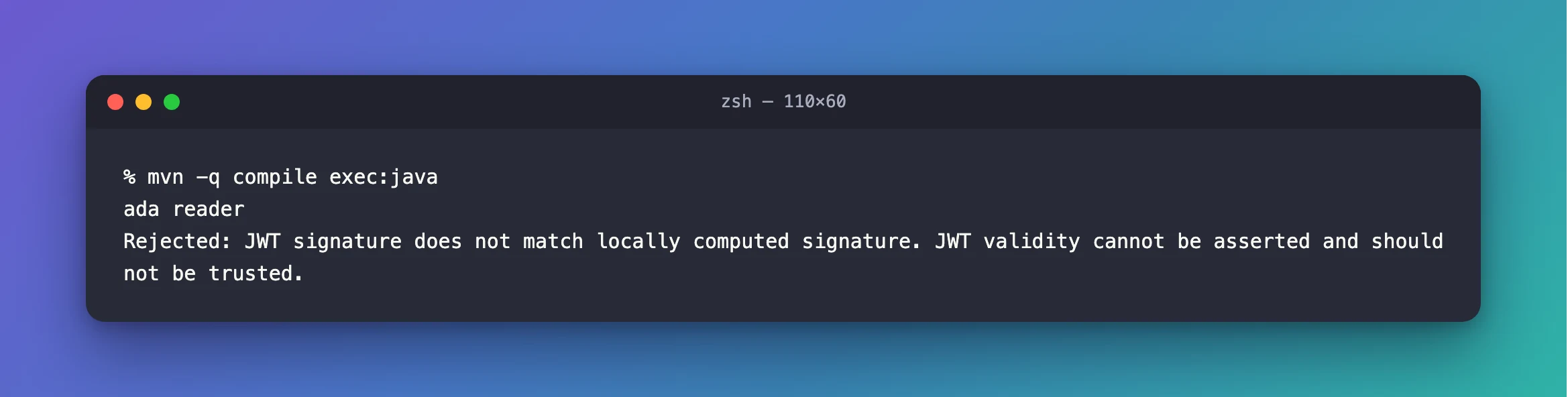
mvn -q compile exec:java compiles the code and runs it, and -q hides Maven's own messages. With the right key, the parser checked the signature and the expiry and returned the claims. With the other key, the signature didn't match, so it threw.
The Exceptions It Throws
These came from real runs:
| What's wrong | Exception | Message |
|---|---|---|
| Signed with another key, or the payload was changed | io.jsonwebtoken.security.SignatureException | JWT signature does not match locally computed signature. JWT validity cannot be asserted and should not be trusted. |
| The token has expired | ExpiredJwtException | JWT expired 60900 milliseconds ago at 2026-11-26T08:44:12.000Z. Current time: 2026-11-26T08:45:12.900Z. Allowed clock skew: 0 milliseconds. |
requireSubject("ada"), but the subject is grace | IncorrectClaimException | Expected sub claim to be: ada, but was: grace. |
| Not a JWT at all | MalformedJwtException | Invalid compact JWT string: Compact JWSs must contain exactly 2 period characters, and compact JWEs must contain exactly 4. Found: 0 |
An unsigned token, "alg":"none" | UnsupportedJwtException | Unsecured JWSs (those with an 'alg' (Algorithm) header value of 'none') are disallowed by default … |
Allow a Little Clock Skew
The expired-token message shows that the parser allows no clock skew by default. clockSkewSeconds sets it on the parser builder, which "Sets the amount of clock skew in seconds to tolerate when verifying the local time against the exp and nbf claims": with .clockSkewSeconds(60), a token that had expired 30 seconds earlier still parsed.
Common Mistakes
| Mistake | What happens | Do this instead |
|---|---|---|
Wildcard imports of both io.jsonwebtoken.* and io.jsonwebtoken.security.* | reference to SignatureException is ambiguous: both packages have one | Import io.jsonwebtoken.security.SignatureException by name |
Reading a claim as the wrong type, get("level", String.class) on a number | RequiredTypeException: Cannot convert existing claim value of type 'class java.lang.Integer' to desired type 'class java.lang.String'. … | Ask for the type the claim holds, such as Integer.class |
Expecting get to fail for a missing claim | It returns null | Check for null, or use require… on the parser |
Troubleshooting
| Symptom | Likely cause | Fix |
|---|---|---|
JWT signature does not match locally computed signature | Another key signed it, or it was changed | Verify with the signing key; reject the token |
JWT expired … ago | The token's exp has passed | Get a new token, or allow some clockSkewSeconds |
Compact JWSs must contain exactly 2 period characters | The string isn't a JWT | Check what's being passed in |
FAQ
Can I reuse the parser?
Yes. build() makes a parser you can keep for every token, as long as the key stays the same.
Does the parser check the expiry?
Yes, whenever the token has an exp claim, with no clock skew unless you set one.
Conclusion
Jwts.parser().verifyWith(key).build().parseSignedClaims(token).getPayload() returns a token's claims only after its signature and time claims check out. Catch the specific exceptions when you answer each failure differently, and import SignatureException from io.jsonwebtoken.security.
Additional Resources
- JwtParser and JwtParserBuilder, in the JJWT Javadoc.
- JJWT README, on GitHub.
