How to Use the Question Mark (?) Operator in Rust

Rust's ? operator unwraps a Result inside a function that returns one. On Ok you get the value; on Err the function returns that error to its caller at once. It does the work of a whole match in one character.
Syntax
fn <name>(<parameters>) -> Result<T, E> {
    let <value> = <expression>?;
    Ok(<result>)
}
| Part | What it does |
|---|---|
<expression>? | If <expression> is Ok(v), the whole thing is v. If it's Err(e), the function returns Err with that error. |
-> Result<T, E> | ? on a Result only works in a function that returns a Result (or another type that accepts it). |
E | The function's error type. The error ? meets is converted into it with From. |
The Rust Reference on the try propagation expression "uses the value of the inner expression and the Try trait to decide whether to produce a value, and if so, what value to produce, or whether to return a value to the caller, and if so, what value to return." For a Result, "Result::Ok(val) evaluates to val" and "Result::Err(e) returns Result::Err(From::from(e))". It adds: "The try propagation operator is sometimes called the question mark operator, the ? operator, or the try operator."
The Example
The example's double function reads a number from text and doubles it. parse can fail, so double passes its error on with ? instead of handling it.
Prerequisites
- Rust, installed with rustup, which comes with Cargo. This guide uses Rust 1.100.0.
Step 1: Create a Project
cargo new demo
cd demo
    Creating binary (application) `demo` package
note: see more `Cargo.toml` keys and their definitions at https://doc.rust-lang.org/cargo/reference/manifest.html
cargo new demo creates a folder named demo with a Cargo.toml file, which describes the project, and src/main.rs, which holds the code. cd demo moves into it.
Step 2: Write the Code
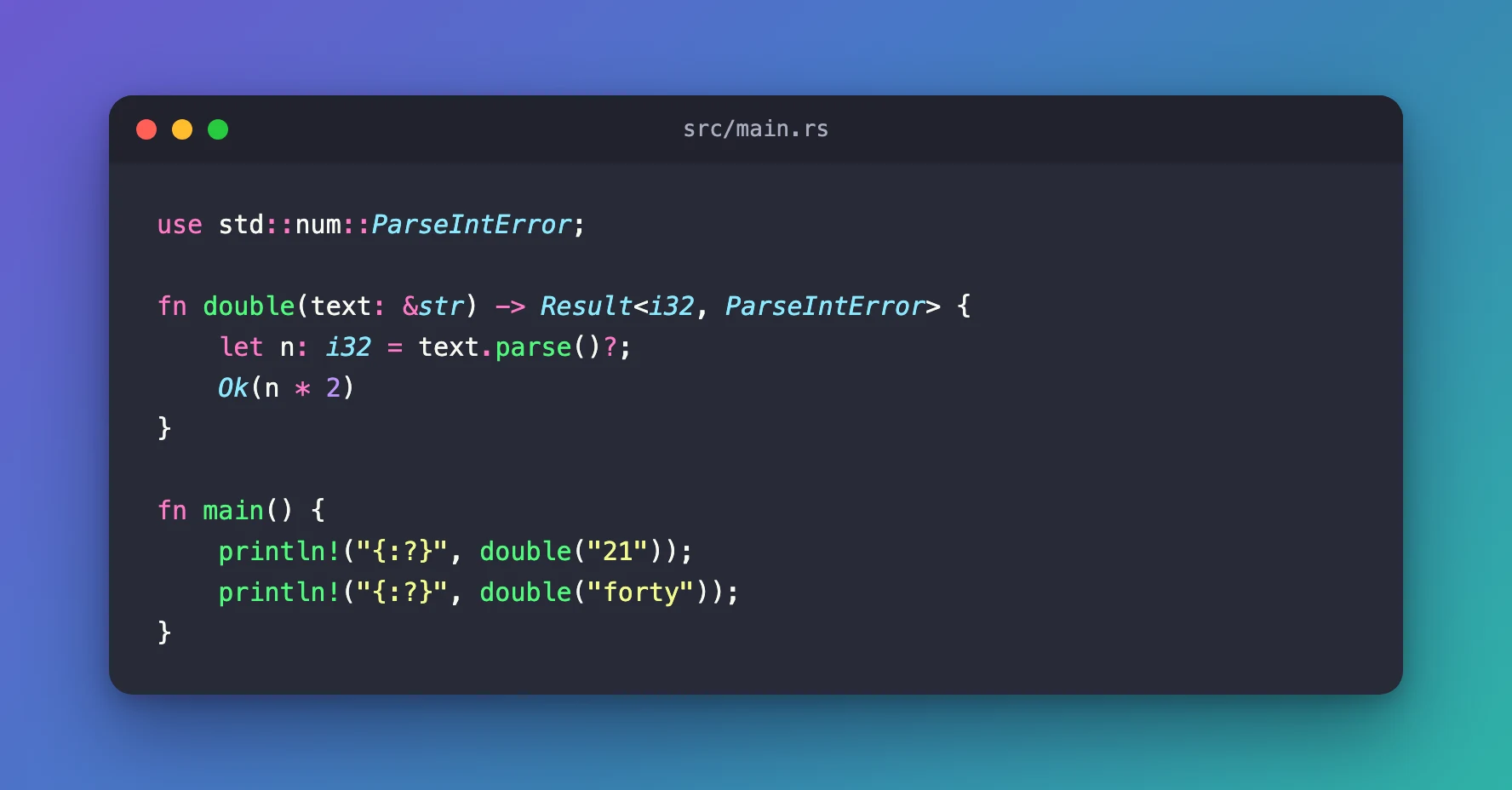
Replace the contents of src/main.rs with:
use std::num::ParseIntError;

fn double(text: &str) -> Result<i32, ParseIntError> {
    let n: i32 = text.parse()?;
    Ok(n * 2)
}

fn main() {
    println!("{:?}", double("21"));
    println!("{:?}", double("forty"));
}
text.parse() returns Result<i32, ParseIntError>. The ? after it either gives n the number or returns the ParseIntError from double, which is why double declares that error type.
Step 3: Run It
cargo run -q
Ok(42)
Err(ParseIntError { kind: InvalidDigit })
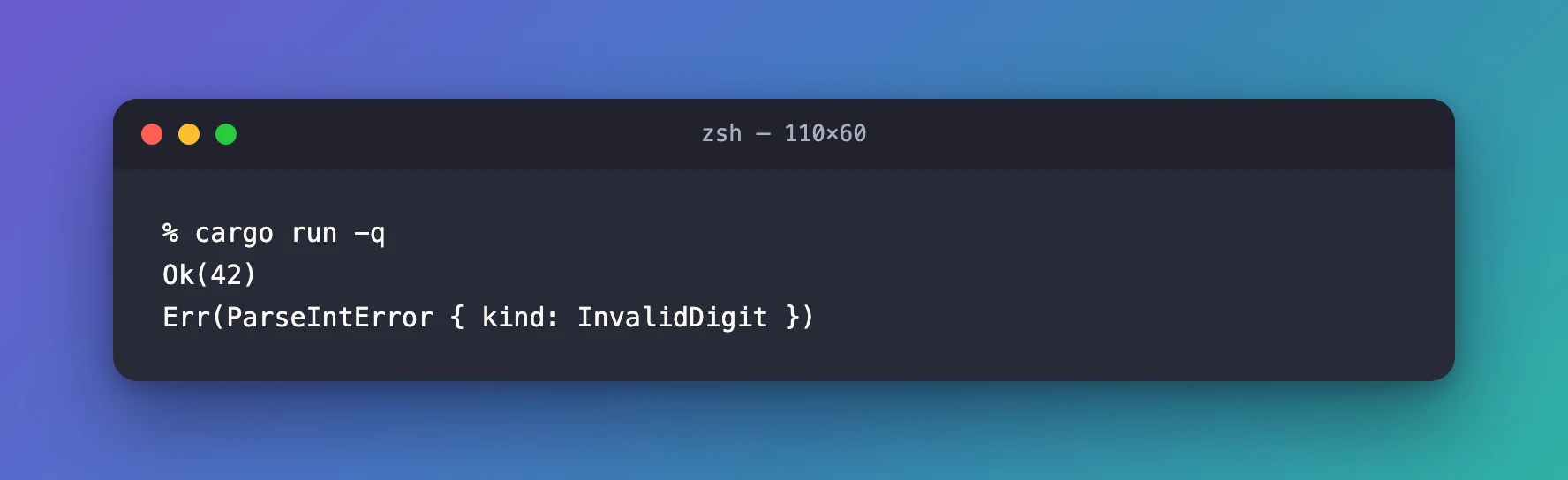
cargo run compiles the program and runs it, and -q hides Cargo's own status lines. "21" parsed, so double reached Ok(n * 2). "forty" didn't, so ? returned the parse error and the multiplication never ran.
Return Your Own Error with map_err
? converts the error only when the function's error type knows how to be made from it. A String doesn't, so this function stops the build:
fn double(text: &str) -> Result<i32, String> {
    let n: i32 = text.parse()?;
    Ok(n * 2)
}
error[E0277]: `?` couldn't convert the error to `String`
map_err turns the error into a String first, so ? has nothing left to convert:
fn double(text: &str) -> Result<i32, String> {
    let n: i32 = text.parse().map_err(|e| format!("bad number: {e}"))?;
    Ok(n * 2)
}
Err("bad number: invalid digit found in string")
Use ? on an Option
In a function that returns an Option, ? works on an Option the same way: Some(v) gives v, and None returns None.
fn first_char_upper(text: &str) -> Option<char> {
    let c = text.chars().next()?;
    Some(c.to_ascii_uppercase())
}

fn main() {
    println!("{:?}", first_char_upper("ada"));
    println!("{:?}", first_char_upper(""));
}
Some('A')
None
Common Mistakes
| Mistake | What happens | Do this instead |
|---|---|---|
Using ? in a function that returns nothing, such as a plain fn main() | error[E0277]: the `?` operator can only be used in a function that returns `Result` or `Option` (or another type that implements `FromResidual`) | Give the function a Result return type, or handle the error with match |
An error type that the ? error can't convert into | error[E0277]: `?` couldn't convert the error to `String` | Convert it first with map_err |
Forgetting Ok(…) around the final value | error[E0308]: mismatched types | End with Ok(value) |
Troubleshooting
| Symptom | Likely cause | Fix |
|---|---|---|
cannot use the `?` operator in a function that returns `()` | ? in a function without a Result return type | Change the return type; the compiler's help shows one |
the trait `From<ParseIntError>` is not implemented for `String` | The error types don't match | Use map_err, or return the original error type |
FAQ
Can I use ? in main?
Yes, when main returns a Result, such as fn main() -> Result<(), ParseIntError>. When main returns an Err, Rust prints Error: and the error, and the program exits with code 1.
Is ? the same as unwrap?
No. unwrap stops the whole program on an Err. ? hands the error to the caller, which can still handle it.
Conclusion
Put ? after an expression that returns a Result to keep the Ok value and return any Err from the function at once. Use map_err when the function's error type differs, and ? on an Option in functions that return one.
Additional Resources
- The try propagation expression, in the Rust Reference.
- A Shortcut for Propagating Errors: the ? Operator, in the Rust Book.
