How to Use the Conditional Operator ?: in C#

When a value depends on a condition, such as "Good morning" before noon and "Good afternoon" after, an if and else that each assign a variable takes six lines. The conditional operator, condition ? a : b, picks the value in one expression.
Syntax
<Type> <result> = <condition> ? <valueIfTrue> : <valueIfFalse>;
| Part | What it does |
|---|---|
<condition> | A bool expression, such as hour < 12. |
? <valueIfTrue> | The result when the condition is true. |
: <valueIfFalse> | The result when the condition is false. |
Microsoft's conditional operator reference: "The conditional operator ?:, also known as the ternary conditional operator, evaluates a Boolean expression and returns the result of one of the two expressions, depending on whether the Boolean expression evaluates to true or false". Only the chosen value is worked out at all; the reference: "Only consequent or alternative is evaluated."
The Example
The example greets someone depending on the hour, which is 14, and then greets a person whose name may be missing, inside an interpolated string.
Prerequisites
- The .NET 10 SDK or newer, which runs a single
.csfile withdotnet run. This guide uses .NET SDK 10.0.404.
Step 1: Write the Code
Create a file named main.cs in an empty folder:
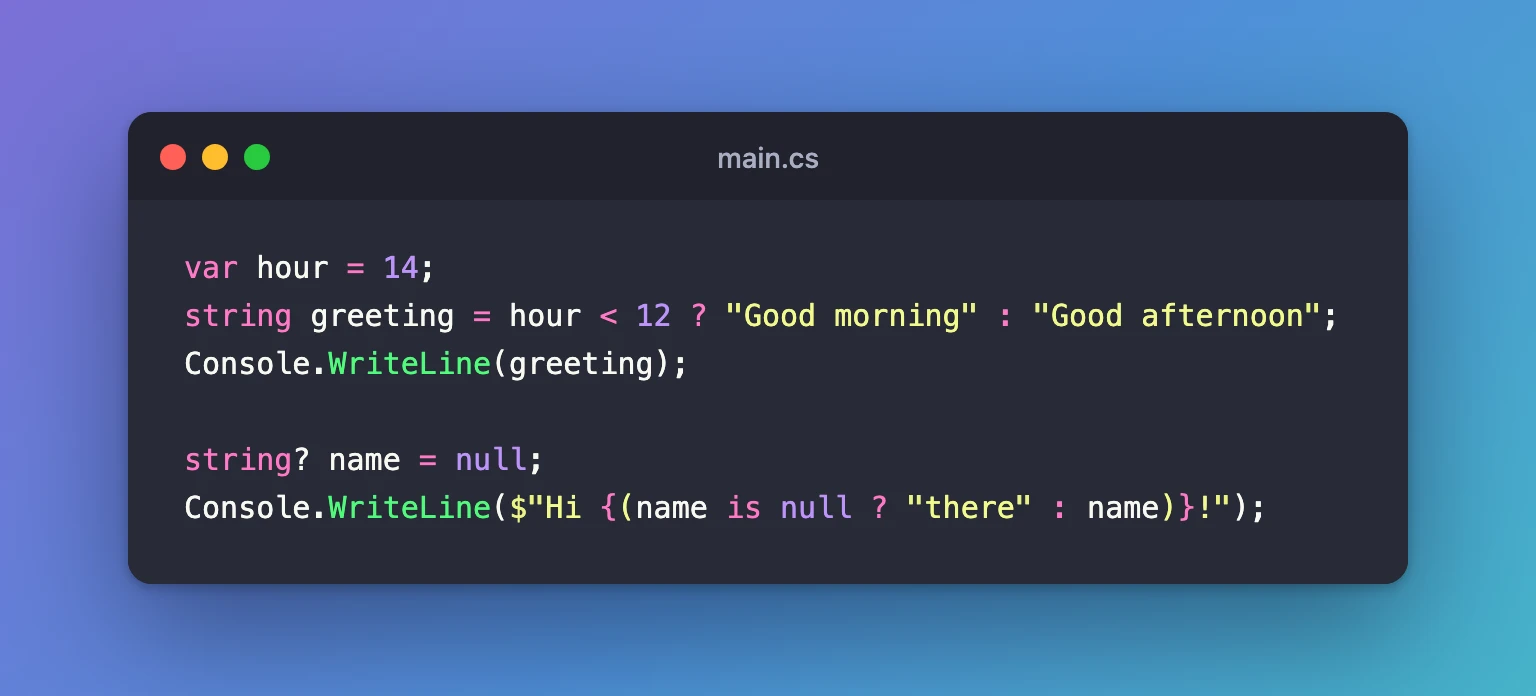
var hour = 14;
string greeting = hour < 12 ? "Good morning" : "Good afternoon";
Console.WriteLine(greeting);

string? name = null;
Console.WriteLine($"Hi {(name is null ? "there" : name)}!");
Inside an interpolated string, the conditional operator goes in parentheses, because a colon there would otherwise start a format string.
Step 2: Run It
dotnet run main.cs
Good afternoon
Hi there!
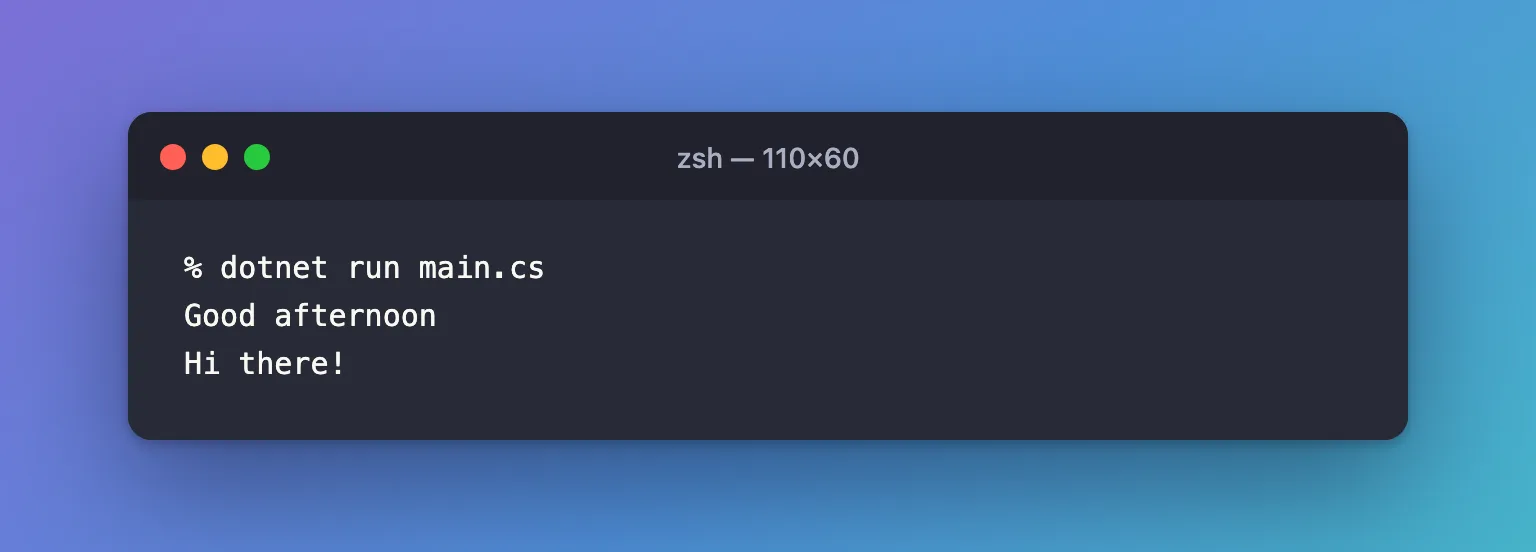
14 < 12 is false, so the operator returned the value after the colon, Good afternoon. name is null was true, so the second line used there. The command is the same in zsh, bash and PowerShell.
What Happens When the Types Don't Match
Both values must be able to become one type. A number and a string can't:
bool useNumber = true;
var label = useNumber ? 1 : "one";
Console.WriteLine(label);
/Users/you/demo/main.cs(2,13): error CS0173: Type of conditional expression cannot be determined because there is no implicit conversion between 'int' and 'string'

The build failed. Fix the build errors and run again.
var gives the result no type to aim for, so C# needs the two values to share one. Make both values the same type, such as "1" and "one". Or declare the type both values convert to: object label = useNumber ? 1 : "one"; compiles and prints 1, because, as the reference puts it, "Conditional expressions are target-typed."
Common Mistakes
| Mistake | What happens | Do this instead |
|---|---|---|
| Returning values of unrelated types | error CS0173: Type of conditional expression cannot be determined because there is no implicit conversion between 'int' and 'string' | Give both values the same type |
Writing the operator inside {...} of an interpolated string without parentheses | The colon is read as the start of a format string | Wrap it: {(name is null ? "there" : name)} |
| Nesting several conditional operators on one line | The line is hard to read and easy to get wrong | Use if and else, or a switch expression |
Troubleshooting
| Symptom | Likely cause | Fix |
|---|---|---|
CS0173 | The two values have different types | Convert one so both match |
| The wrong value comes back | The condition is reversed | Read it as "if condition, then the first value, else the second" |
FAQ
Can I nest conditional operators?
Yes. The reference: "The conditional operator is right-associative", so a ? b : c ? d : e is evaluated as a ? b : (c ? d : e). Two or three levels quickly get hard to read, though.
When should I use if instead?
When each branch does something, such as calling methods or printing, rather than producing a value. The conditional operator is for choosing a value.
Conclusion
condition ? valueIfTrue : valueIfFalse chooses between two values in one expression. Keep the two values the same type, put the operator in parentheses inside interpolated strings, and switch to if when the branches do more than pick a value.
Additional Resources
- The ?: operator, on Microsoft Learn.
