How to Use Savepoints in EF Core

A savepoint lets part of a transaction fail while the rest carries on. In EF Core, you create one with CreateSavepointAsync, and EF Core also creates its own around each SaveChanges inside a transaction. If you've seen __EFSavePoint in MySQL's log, that's where it comes from.
Prerequisites
- A transaction. How to Use a Transaction in EF Core with BeginTransactionAsync. I used EF Core 10.0.14 and MySQL 9.7.4.
- What a savepoint does in MySQL. How to Use Savepoints in MySQL.
Step 1: Create One, and Roll Back to It
This saves one category, then marks a savepoint, then tries a second that fails on the unique index. The first category should survive:
g.MapPost("/savepoint", async (InventoryDbContext db, TimeProvider clock, ILogger<InventoryDbContext> log, CancellationToken cancellationToken) =>
{
    var strategy = db.Database.CreateExecutionStrategy();
    var now = clock.GetUtcNow().UtcDateTime;

    return await strategy.ExecuteAsync(
        async ct =>
        {
            db.ChangeTracker.Clear();

            await using var transaction = await db.Database.BeginTransactionAsync(ct);

            db.Categories.Add(new Category { Name = "Stands", CreatedAtUtc = now });
            await db.SaveChangesAsync(ct);

            await transaction.CreateSavepointAsync("BeforeMounts", ct);

            try
            {
                db.Categories.Add(new Category { Name = "Cables", CreatedAtUtc = now }); // This name already exists.
                await db.SaveChangesAsync(ct);
            }
            catch (DbUpdateException exception) when (exception.IsDuplicateKey())
            {
                await transaction.RollbackToSavepointAsync("BeforeMounts", ct);
                db.ChangeTracker.Clear();
            }

            await transaction.CommitAsync(ct);

            return Results.Ok(new { supportsSavepoints = transaction.SupportsSavepoints });
        },
        cancellationToken);
});
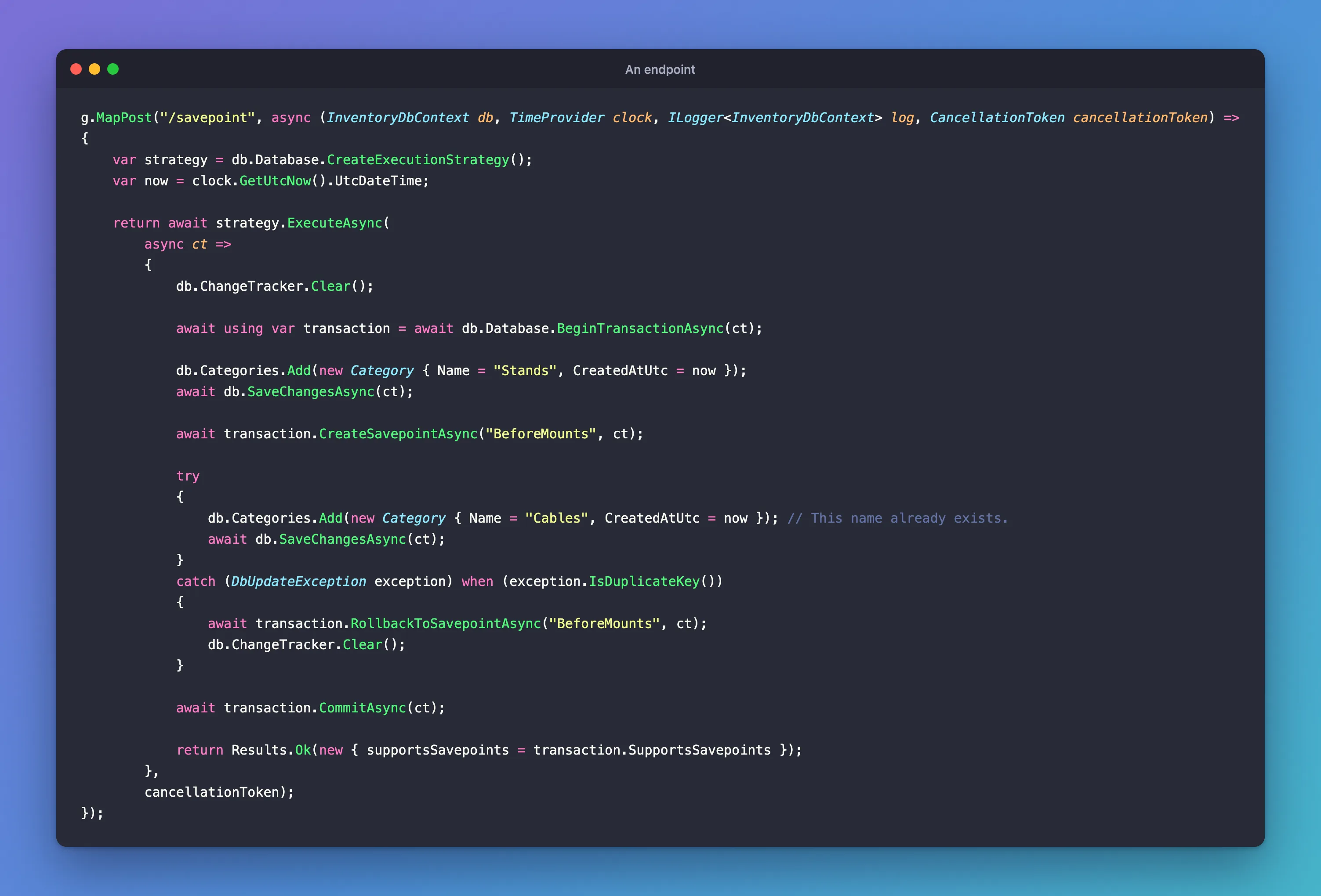
ChangeTracker.Clear()in thecatchremoves the failed entity. Otherwise, the next save tries it again.SupportsSavepointsistruefor this driver, as the response shows.
{
  "supportsSavepoints": true
}
Step 2: See What MySQL Got
+--------------------------------------------------------------+
| statement                                                    |
+--------------------------------------------------------------+
| SET TRANSACTION ISOLATION LEVEL REPEATABLE READ              |
| BEGIN                                                        |
| SAVEPOINT `__EFSavePoint`                                    |
| INSERT INTO `categories` (`CreatedAtUtc`, `Name`) VALUES (ti |
| SELECT `Id` FROM `categories` WHERE ROW_COUNT() = 1 AND `Id` |
| RELEASE SAVEPOINT `__EFSavePoint`                            |
| SAVEPOINT `BeforeMounts`                                     |
| SAVEPOINT `__EFSavePoint`                                    |
| INSERT INTO `categories` (`CreatedAtUtc`, `Name`) VALUES (ti |
| ROLLBACK TO `__EFSavePoint`                                  |
| RELEASE SAVEPOINT `__EFSavePoint`                            |
| ROLLBACK TO `BeforeMounts`                                   |
| COMMIT                                                       |
+--------------------------------------------------------------+
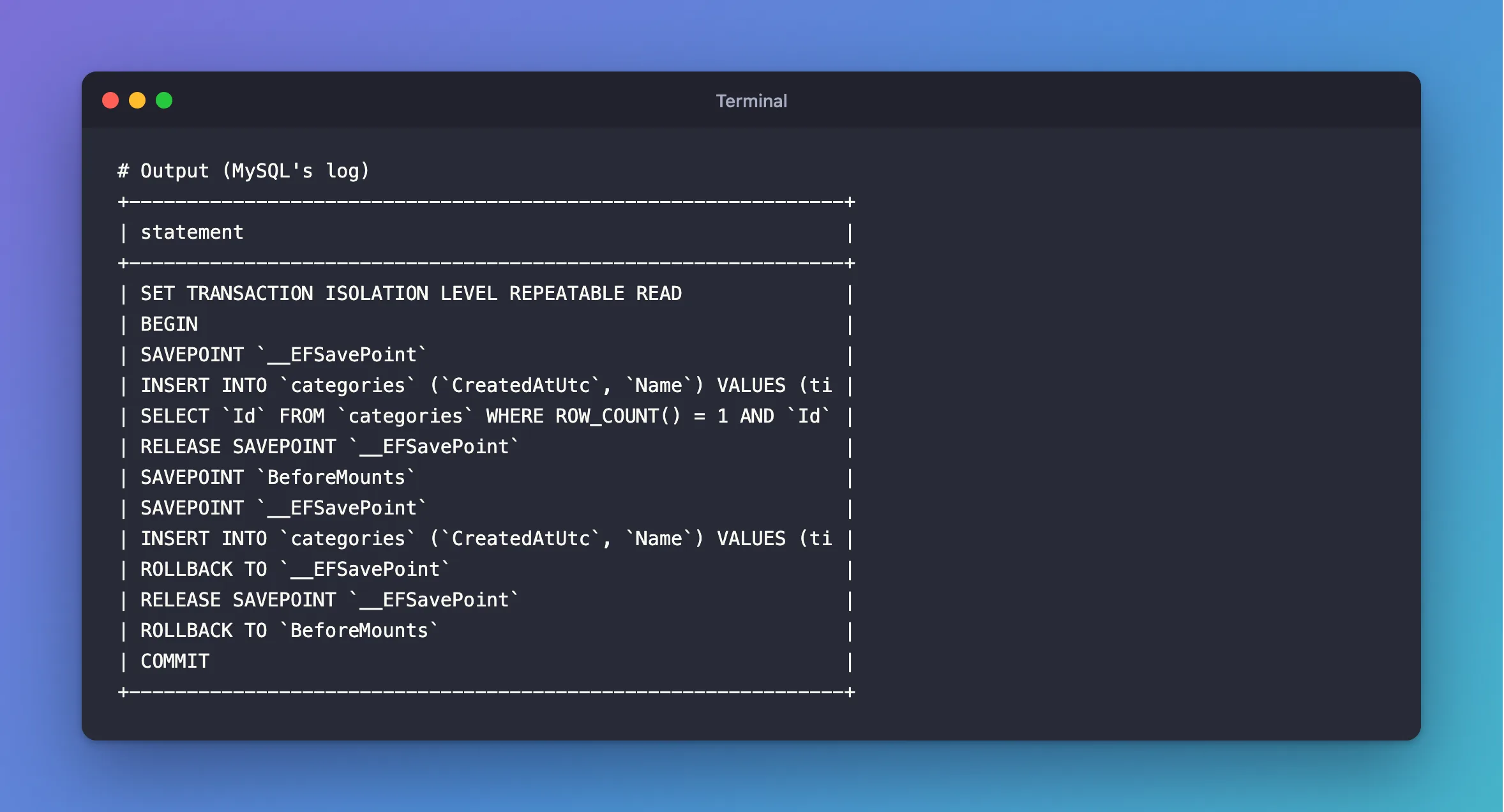
My savepoint is the `BeforeMounts` one. All the `__EFSavePoint` lines are EF Core's own.
Step 3: Understand the Automatic Ones
The EF Core docs explain: "When SaveChanges is invoked and a transaction is already in progress on the context, EF automatically creates a savepoint before saving any data." If the save fails, "it automatically rolls the transaction back to the savepoint, leaving the transaction in the same state as if it had never started."
You can see that in the log: ROLLBACK TO __EFSavePoint came first, from EF Core, and then ROLLBACK TO BeforeMounts, from my catch.
To turn them off:
db.Database.AutoSavepointsEnabled = false;
+--------------------------------------------------------------+
| statement                                                    |
+--------------------------------------------------------------+
| SET TRANSACTION ISOLATION LEVEL REPEATABLE READ              |
| BEGIN                                                        |
| INSERT INTO `categories` (`CreatedAtUtc`, `Name`) VALUES (ti |
| SELECT `Id` FROM `categories` WHERE ROW_COUNT() = 1 AND `Id` |
| ROLLBACK                                                     |
+--------------------------------------------------------------+
There's rarely a reason to, except to save the round trips in a tight loop.
Step 4: Remember That Locks Stay
Rolling back to a savepoint undoes the changes, but MySQL doesn't release locks taken before it. So it isn't a way out of a lock conflict.
Common Mistakes
| Mistake | What happens | Do this instead |
|---|---|---|
| Using one to fake a nested transaction | It's one transaction, and a later failure loses everything | Keep them for partial retries |
| Forgetting to clear the tracker | The next save tries the failed entity again | Clear it, or detach it |
| Rolling back to a name that doesn't exist | MySQL raises an error | Check the name |
Troubleshooting
| Symptom | Likely cause | Fix |
|---|---|---|
__EFSavePoint in the log | A SaveChanges inside a transaction | That's normal |
| The same failure again on the next save | The entity's still in the tracker | Clear it |
| Row locks remain after the rollback | They do, until the commit | Keep transactions short |
Conclusion
Use CreateSavepointAsync and RollbackToSavepointAsync when part of a transaction may fail and the rest should still commit. Clear the tracker after rolling back, and don't be surprised by EF Core's own __EFSavePoint.
Additional Resources
- Using Transactions — savepoints in EF Core.
- SAVEPOINT, ROLLBACK TO SAVEPOINT, and RELEASE SAVEPOINT — MySQL's side.
