How to Unwrap a Result with expect in Rust

expect takes the value out of a Result or an Option when it's there, and stops the program with your message when it isn't. It suits errors that shouldn't happen, where a clear message is worth more than handling the case.
Syntax
let <value> = <result_or_option>.expect("<message>");
| Part | What it does |
|---|---|
<result_or_option> | A Result or an Option. |
.expect("<message>") | Gives back the value inside Ok or Some. On Err or None the program panics: it prints <message> and stops. |
The standard library's documentation for Result::expect: "Returns the contained Ok value, consuming the self value." It "Panics if the value is an Err, with a panic message including the passed message, and the content of the Err."
The Example
The example turns two pieces of text into numbers with parse: "42", which works, and "forty-two", which doesn't.
Prerequisites
- Rust, installed with rustup, which comes with Cargo. This guide uses Rust 1.100.0.
Step 1: Create a Project
cargo new demo
cd demo
    Creating binary (application) `demo` package
note: see more `Cargo.toml` keys and their definitions at https://doc.rust-lang.org/cargo/reference/manifest.html
cargo new demo creates a folder named demo with a Cargo.toml file, which describes the project, and src/main.rs, which holds the code. cd demo moves into it.
Step 2: Write the Code
Replace the contents of src/main.rs with:
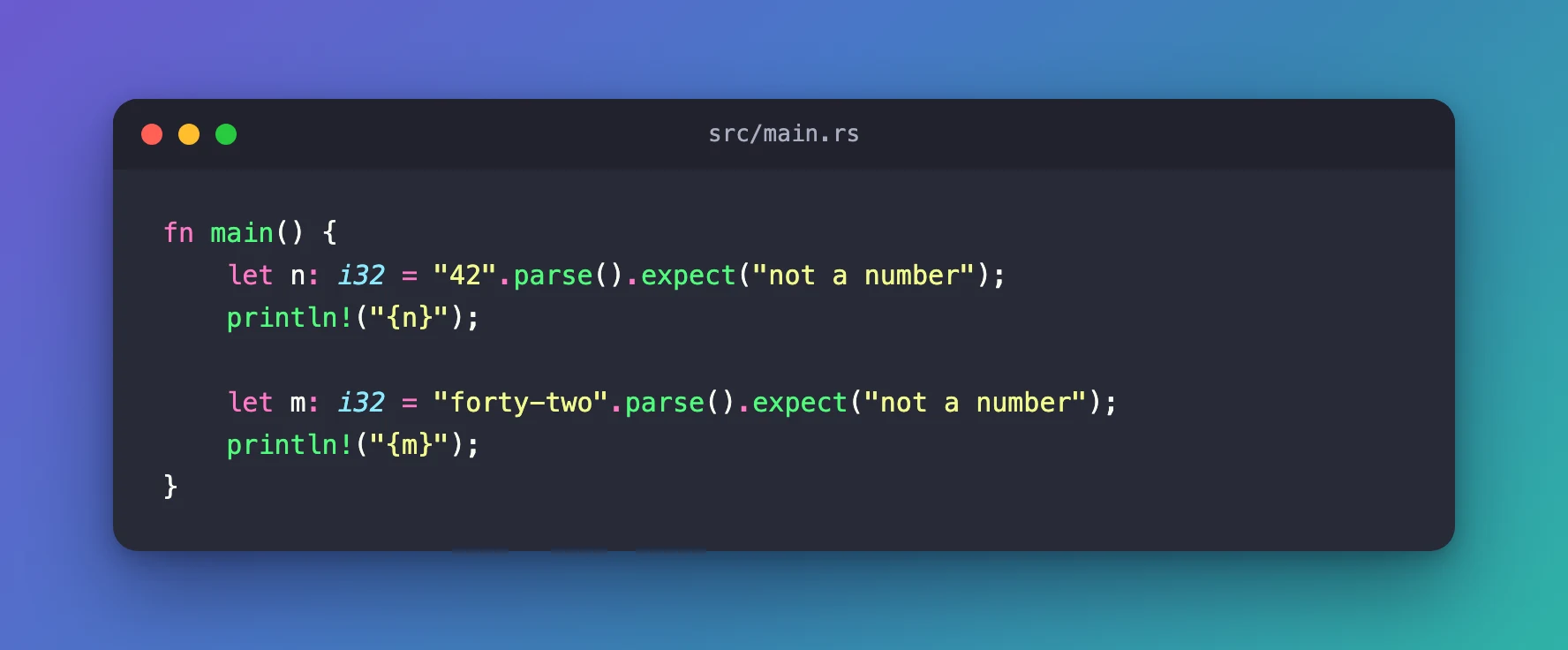
fn main() {
    let n: i32 = "42".parse().expect("not a number");
    println!("{n}");

    let m: i32 = "forty-two".parse().expect("not a number");
    println!("{m}");
}
parse returns a Result: Ok with the number, or Err with a ParseIntError. expect unwraps the first one and panics on the second.
Step 3: Run It
cargo run -q
42

thread 'main' (1667552) panicked at src/main.rs:5:38:
not a number: ParseIntError { kind: InvalidDigit }
note: run with `RUST_BACKTRACE=1` environment variable to display a backtrace
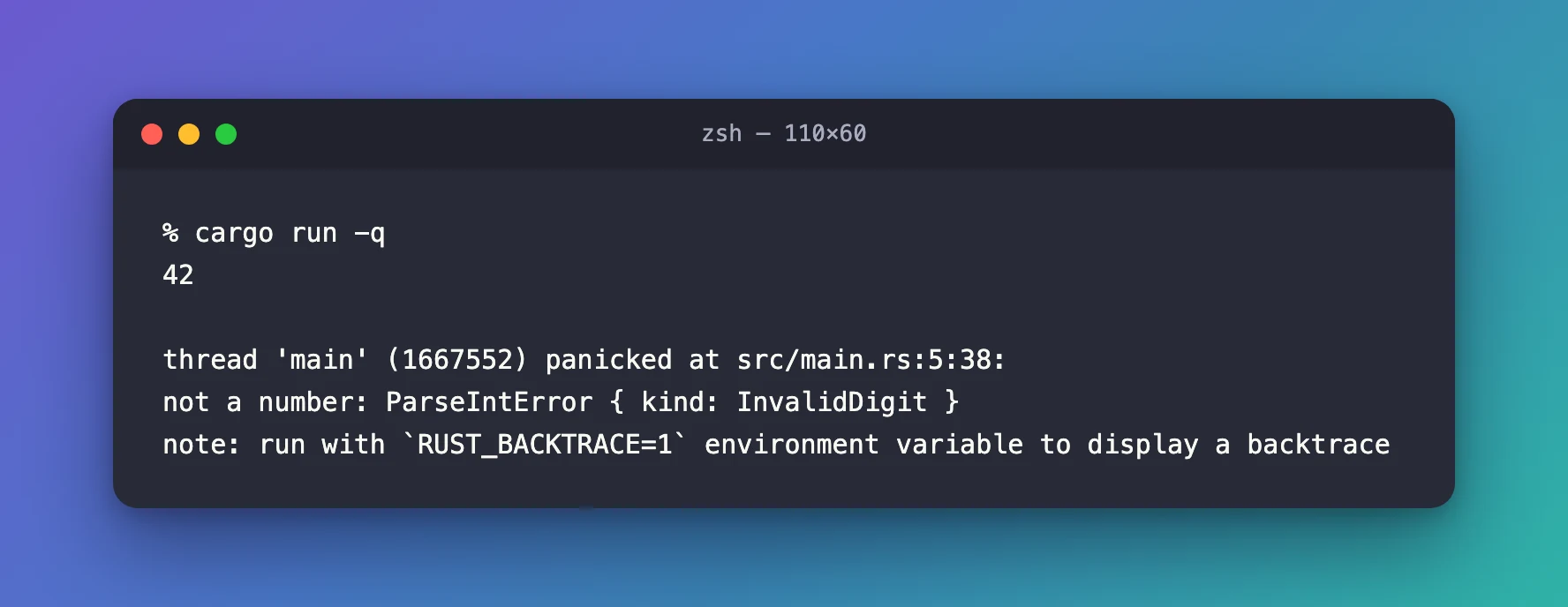
cargo run compiles the program and runs it, and -q hides Cargo's own status lines. The first expect gave back 42. The second panicked, and the panic message has three parts:
| Line | What it means |
|---|---|
thread 'main' (1667552) panicked at src/main.rs:5:38: | The thread that panicked, its operating-system thread ID, which changes on every run, and the file, line and column of the expect call. |
not a number: ParseIntError { kind: InvalidDigit } | Your message, a colon, and the error inside the Err. |
note: run with `RUST_BACKTRACE=1` … | Set that environment variable to see the chain of function calls that led there. |
The last println! never ran, and the program exited with code 101, the code Rust uses for a panic.
expect or unwrap?
unwrap() does the same without a message of your own. With "forty-two".parse().unwrap(), the second line of the panic is:
called `Result::unwrap()` on an `Err` value: ParseIntError { kind: InvalidDigit }
expect is the better habit, because the message says what you expected. The documentation recommends this style: "We recommend that expect messages are used to describe the reason you expect the Result should be Ok."
On an Option, expect panics on None with just your message. names.first().expect("the list is empty") on an empty list printed:
the list is empty
Common Mistakes
| Mistake | What happens | Do this instead |
|---|---|---|
Using expect on input that can really be wrong, such as a user's typing | One bad value stops the whole program | Handle the Err with match, or pass it on with ? |
A message that repeats the error, such as "error" | The panic tells you nothing new | Say what you expected: "the config file should exist" |
| Reading only the message | The location line already points at the failing call | Open the file at the line and column shown |
Troubleshooting
| Symptom | Likely cause | Fix |
|---|---|---|
thread 'main' (…) panicked at src/main.rs:… | An expect or unwrap met an Err or None | Fix the input, or handle the error |
| Exit code 101 | The program panicked | Read the panic message above it |
FAQ
What's the number after 'main'?
The operating-system ID of the thread that panicked. The standard library prints it from thread::current_os_id(), so it differs on every run: the run above showed 1667552, the next one 1677845.
Is a panic the same as an exception?
No. The Rust Book's chapter on error handling puts it this way: "Rust doesn’t have exceptions. Instead, it has the type Result<T, E> for recoverable errors and the panic! macro that stops execution when the program encounters an unrecoverable error." expect turns a recoverable error into an unrecoverable one.
Conclusion
.expect("message") gives you the value inside Ok or Some, and turns an Err or None into a panic with your message, the error and the exact location, exiting with code 101. Keep it for cases that shouldn't happen, and handle real errors with match or ?.
Additional Resources
- Result::expect, in the standard library documentation.
- Option::expect, in the standard library documentation.
