How to Throw an Exception in C#

Some methods can't return a sensible result for some inputs: the average of no numbers at all, for example. In C#, such a method stops with throw, which hands an exception, with a message saying what went wrong, to whoever called it.
Syntax
throw new <ExceptionType>("<message>");
| Part | What it does |
|---|---|
throw | Stops the method at once and passes the exception to the caller. Nothing after it in the method runs. |
new <ExceptionType>(...) | Creates the exception, such as InvalidOperationException or ArgumentException. |
"<message>" | Says what went wrong. Callers can read it from the exception's Message. |
Microsoft's exception-handling statements reference: "Use the throw statement to throw an exception." The InvalidOperationException reference: "The exception that is thrown when a method call is invalid for the object's current state."
The Example
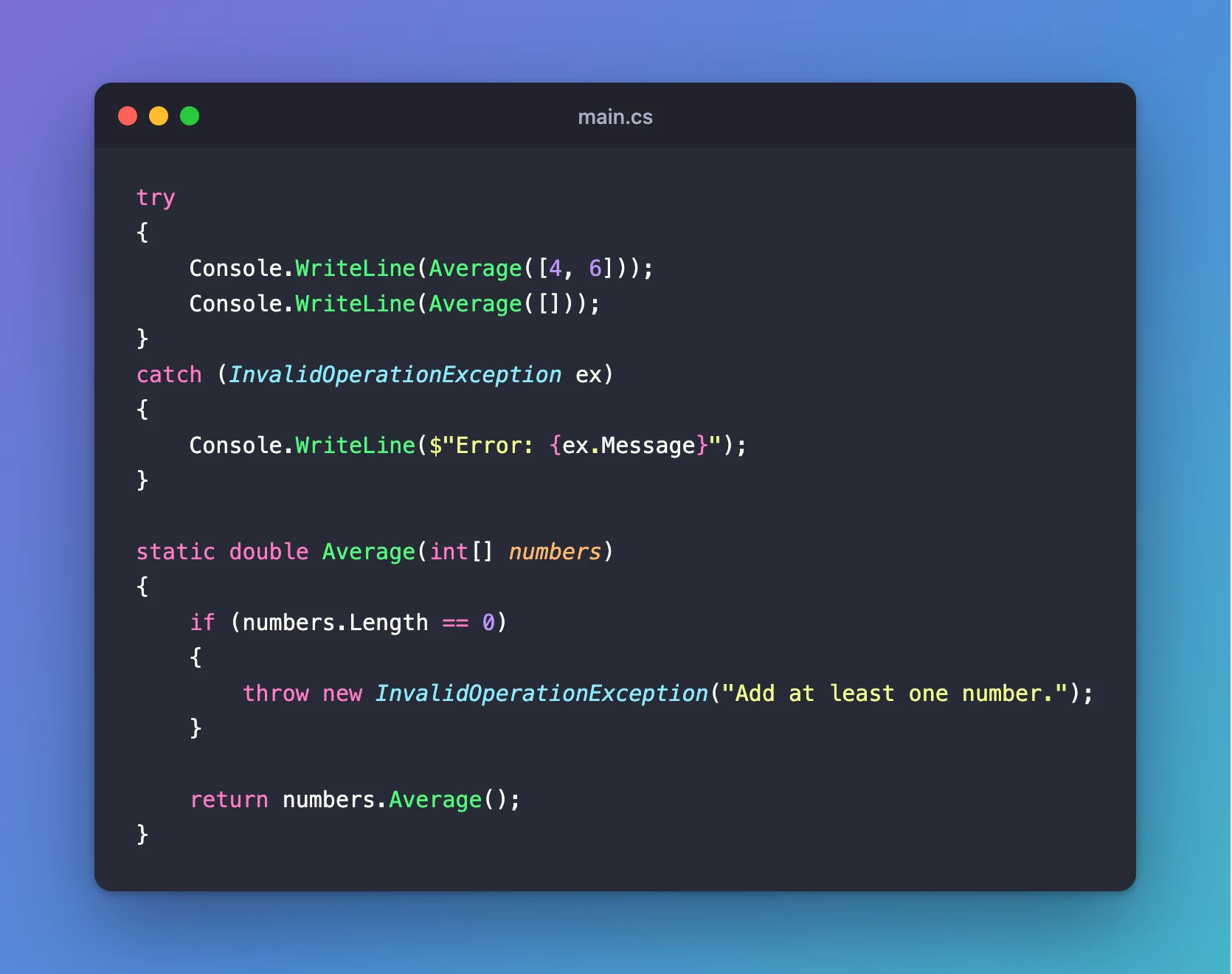
An Average method works out the average of some numbers, and throws when it gets none. The program calls it twice, once with 4 and 6 and once with an empty array, inside a try block that catches the exception.
Prerequisites
- The .NET 10 SDK or newer, which runs a single
.csfile withdotnet run. This guide uses .NET SDK 10.0.404.
Step 1: Write the Code
Create a file named main.cs in an empty folder:
try
{
    Console.WriteLine(Average([4, 6]));
    Console.WriteLine(Average([]));
}
catch (InvalidOperationException ex)
{
    Console.WriteLine($"Error: {ex.Message}");
}

static double Average(int[] numbers)
{
    if (numbers.Length == 0)
    {
        throw new InvalidOperationException("Add at least one number.");
    }

    return numbers.Average();
}
Average checks its input first and throws before doing any work. The catch block receives the exception as ex and prints its Message.
Step 2: Run It
dotnet run main.cs
5
Error: Add at least one number.
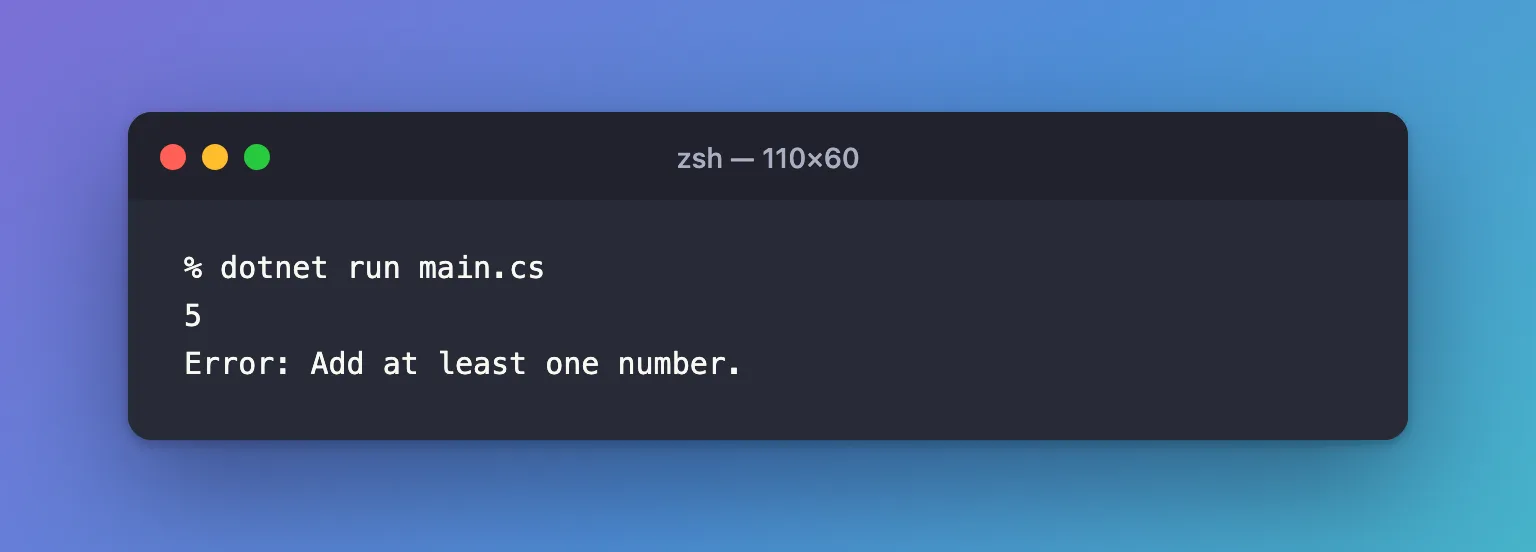
The average of 4 and 6 is 5. The second call threw, so Average returned nothing; the rest of the try block was skipped, and the catch printed the message. The command is the same in zsh, bash and PowerShell.
What Happens When Nobody Catches It
Without try and catch, the exception reaches the top of the program:
Console.WriteLine(Average([]));

static double Average(int[] numbers)
{
    if (numbers.Length == 0)
    {
        throw new InvalidOperationException("Add at least one number.");
    }

    return numbers.Average();
}
Unhandled exception. System.InvalidOperationException: Add at least one number.
   at Program.<<Main>$>g__Average|0_0(Int32[] numbers) in /Users/you/demo/main.cs:line 7
   at Program.<Main>$(String[] args) in /Users/you/demo/main.cs:line 1
The program stopped and printed the exception's type, its message and where it was thrown: line 7, inside Average, called from line 1. Microsoft's exceptions overview: "If no exception handler for a given exception is present, the program stops executing with an error message."
Common Mistakes
| Mistake | What happens | Do this instead |
|---|---|---|
Throwing without a message, as in throw new InvalidOperationException(); | The caller gets a generic message that doesn't say what to fix | Say what went wrong and how to fix it |
Catching Exception everywhere | Unrelated bugs are swallowed along with the expected failure | Catch the specific type you expect |
Writing throw ex; to pass on a caught exception | The original stack trace is replaced | Write throw; inside the catch block |
Troubleshooting
| Symptom | Likely cause | Fix |
|---|---|---|
Unhandled exception. and the program stops | Nothing catches the exception | Add a try and catch where the program can recover |
The catch block never runs | It catches a different exception type | Catch the type that's thrown, or a base type of it |
FAQ
Which exception type should I throw?
Pick the most specific built-in one that fits. Use ArgumentException, or ArgumentNullException and ArgumentOutOfRangeException, when the caller passed a bad argument. Use InvalidOperationException when the call doesn't make sense in the current state. An empty input sits between the two; the example follows .NET's own LINQ Average(), which throws InvalidOperationException: Sequence contains no elements for an empty array.
How do I pass on an exception I caught?
Write throw; on its own inside the catch block. The reference: "throw; preserves the original stack trace of the exception, which is stored in the Exception.StackTrace property. In contrast, throw e; updates the StackTrace property of e."
Conclusion
throw new InvalidOperationException("Add at least one number."); stops the method and hands the problem to its caller, with a message that says what to fix. Catch it where the program can recover, keep throw; for passing it on, and expect the program to stop when nobody catches it.
Additional Resources
- The throw statement, on Microsoft Learn.
- Exceptions and exception handling, on Microsoft Learn.
