How to Split a String in Rust with split

A string's split method cuts it into pieces at a separator, such as '-' or ",". It gives you the pieces one at a time; collect them into a Vec to keep them all.
Syntax
let pieces: Vec<&str> = text.split(separator).collect();
let pieces: Vec<&str> = text.splitn(n, separator).collect();
| Part | What it does |
|---|---|
text | The string to split, a &str or a String. |
separator | Where to cut: a character such as '-', a string such as "::", or a slice of characters. |
split(separator) | Returns an iterator over the pieces between the separators. |
splitn(n, separator) | The same, but it stops at n pieces: the last piece holds the rest of the text. |
.collect() | Gathers the pieces into a collection. |
Vec<&str> | The collection to build: a list of string slices that point into text. |
The documentation for str::split: "Returns an iterator over substrings of this string slice, separated by characters matched by a pattern." And: "If a string contains multiple contiguous separators, you will end up with empty strings in the output". The one for str::splitn says it is "restricted to returning at most n items. If n substrings are returned, the last substring (the nth substring) will contain the remainder of the string."
The Example
The example splits the date 2026-11-28 at each -, splits it into only two pieces with splitn, and splits a,b,,c, which has two commas in a row, at each ,. Last, it takes only the first piece of the date.
Prerequisites
- Rust, installed with rustup, which comes with Cargo. This guide uses Rust 1.100.1.
Step 1: Create a Project
cargo new demo
cd demo
    Creating binary (application) `demo` package
note: see more `Cargo.toml` keys and their definitions at https://doc.rust-lang.org/cargo/reference/manifest.html
cargo new demo creates a folder named demo with a Cargo.toml file, which describes the project, and src/main.rs, which holds the code. cd demo moves into it.
Step 2: Write the Code
Replace the contents of src/main.rs with:
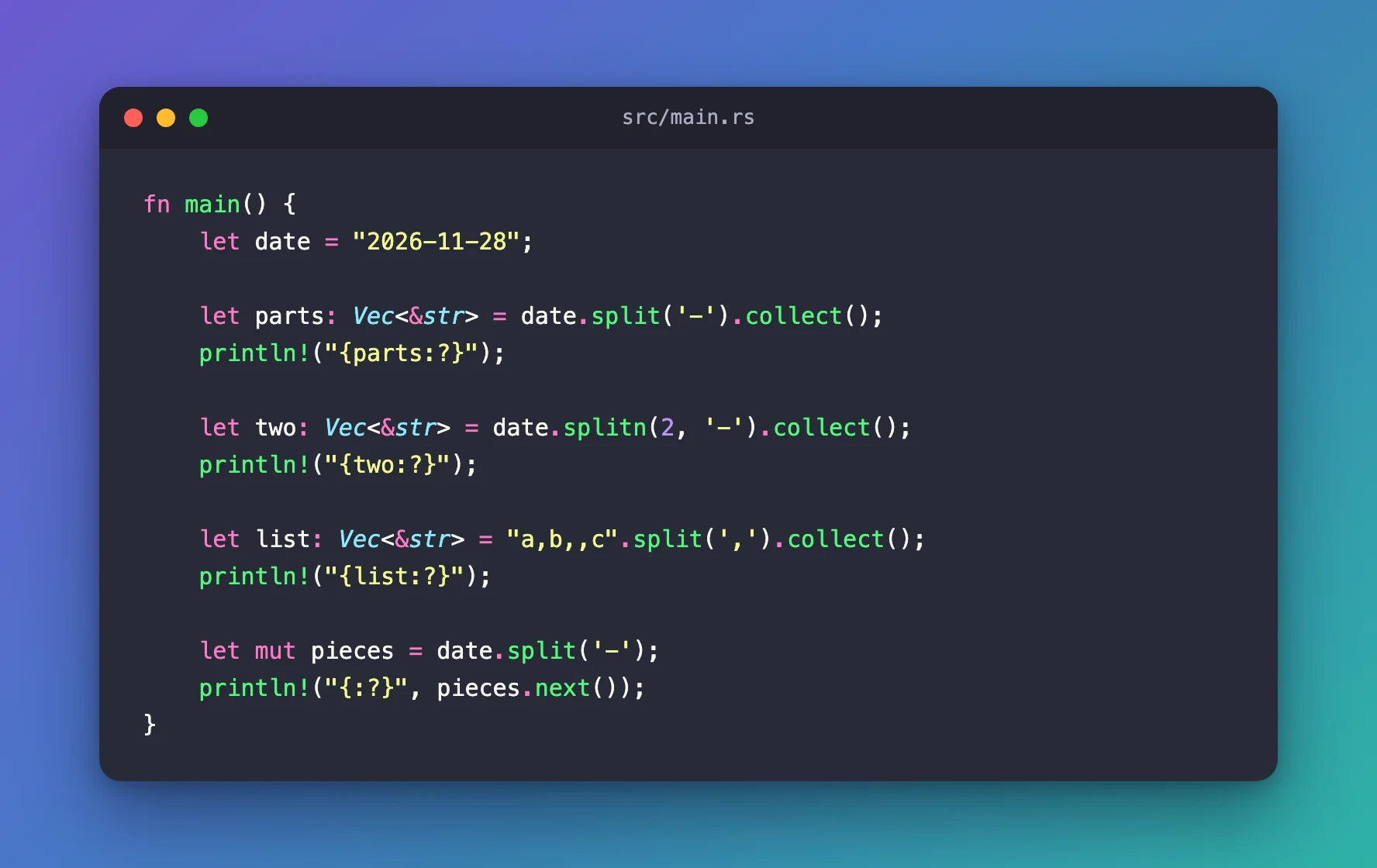
fn main() {
    let date = "2026-11-28";

    let parts: Vec<&str> = date.split('-').collect();
    println!("{parts:?}");

    let two: Vec<&str> = date.splitn(2, '-').collect();
    println!("{two:?}");

    let list: Vec<&str> = "a,b,,c".split(',').collect();
    println!("{list:?}");

    let mut pieces = date.split('-');
    println!("{:?}", pieces.next());
}
date.split('-')cuts the date at each-, and.collect()gathers the pieces intoparts. The type,Vec<&str>, tellscollectwhat to build.{parts:?}prints theVecin its debug format, with each piece in quotes.date.splitn(2, '-')stops after two pieces.pieceskeeps the iterator itself, without collecting it.next()returns its next piece, the first one here. The iterator ismutbecausenext()moves it forward.
Step 3: Run It
cargo run -q
["2026", "11", "28"]
["2026", "11-28"]
["a", "b", "", "c"]
Some("2026")
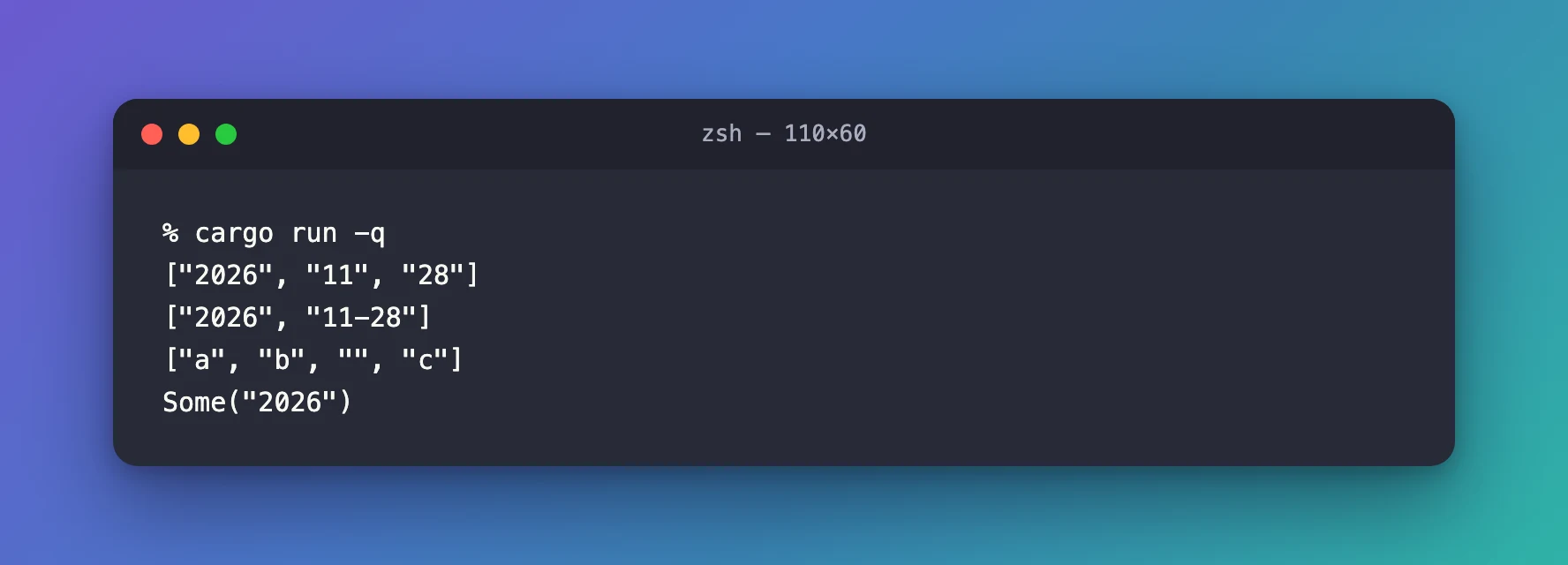
cargo run compiles the program and runs it, and -q hides Cargo's own status lines.
What Happened
split('-')gave the three pieces of the date.splitn(2, '-')stopped at two pieces, so the second one kept the rest of the text:"11-28".- The two commas in a row in
a,b,,chad nothing between them, so that piece is an empty string,"". next()returnedSome("2026"). It wraps the piece inSomebecause an iterator can run out: once there are no pieces left,next()returnsNone.
Common Mistakes
| Mistake | What happens | Do this instead |
|---|---|---|
Taking a piece by index straight from split, as in text.split('-')[0] | error[E0608]: cannot index into a value of type `std::str::Split<'_, char>` | Collect into a Vec first, or call .next() |
Printing the iterator, println!("{p:?}") | It prints Split(SplitInternal { start: 0, end: 3, ... instead of the pieces | Collect it, then print the Vec |
Collecting the pieces into Vec<String> | error[E0277]: a value of type `Vec<String>` cannot be built from an iterator over elements of type `&str` | Collect into Vec<&str>, or add .map(String::from) before .collect() |
Splitting text with several spaces in a row on ' ' | Empty pieces: "a b" gave ["a", "", "b"] | Use split_whitespace(), which gave ["a", "b"] |
Troubleshooting
| Symptom | Likely cause | Fix |
|---|---|---|
cannot index into a value of type `std::str::Split<'_, char>` | split returns an iterator, not a list | .collect() into a Vec<&str> |
| Empty strings in the result | Two separators in a row, or one at the start or end | Expected; drop them with .filter(|s| !s.is_empty()) |
FAQ
Why are the pieces &str and not String?
Each piece is a slice of the original text, so splitting copies nothing. To own the pieces, .map(String::from) before .collect() turned "a b" into a Vec<String>, ["a", "b"].
Can I split on a word or on several characters?
Yes. "a::b".split("::") gave ["a", "b"], and a slice of characters splits at any of them: "2026-11-28 10:45".split(&['-', ' ', ':'][..]) gave ["2026", "11", "28", "10", "45"].
What does split("") do?
It cuts between every character, and at the start and end: "abc".split("") gave ["", "a", "b", "c", ""].
Conclusion
text.split(separator) cuts a string at each separator and returns the pieces as an iterator. Collect them into a Vec<&str> to keep them, use splitn to stop at a number of pieces, and next() to take just the first.
Additional Resources
- str::split, str::splitn and str::split_whitespace, in the standard library documentation.
