How to Return a Result from main in Rust

Rust's main can return a Result. Then the ? operator works in main too, and when main returns an error, Rust prints it and exits with code 1, so scripts and CI see the failure.
Syntax
fn main() -> Result<(), <ErrorType>> {
    // statements that can use ?
    Ok(())
}
| Part | What it does |
|---|---|
Result<(), <ErrorType>> | main returns nothing useful on success, (), or an error of <ErrorType>. |
? | Inside main, returns the error from main when an expression fails. |
Ok(()) | The last expression: everything worked. |
The Rust Book: "When a main function returns a Result<(), E>, the executable will exit with a value of 0 if main returns Ok(()) and will exit with a nonzero value if main returns an Err value." The Rust Reference allows any return type that implements the Termination trait, "A trait for implementing arbitrary return types in the main function."
The Example
The example parses two pieces of text into numbers with ?: "42", which works, and "forty-two", which makes main return the error.
Prerequisites
- Rust, installed with rustup, which comes with Cargo. This guide uses Rust 1.100.0.
Step 1: Create a Project
cargo new demo
cd demo
    Creating binary (application) `demo` package
note: see more `Cargo.toml` keys and their definitions at https://doc.rust-lang.org/cargo/reference/manifest.html
cargo new demo creates a folder named demo with a Cargo.toml file, which describes the project, and src/main.rs, which holds the code. cd demo moves into it.
Step 2: Write the Code
Replace the contents of src/main.rs with:
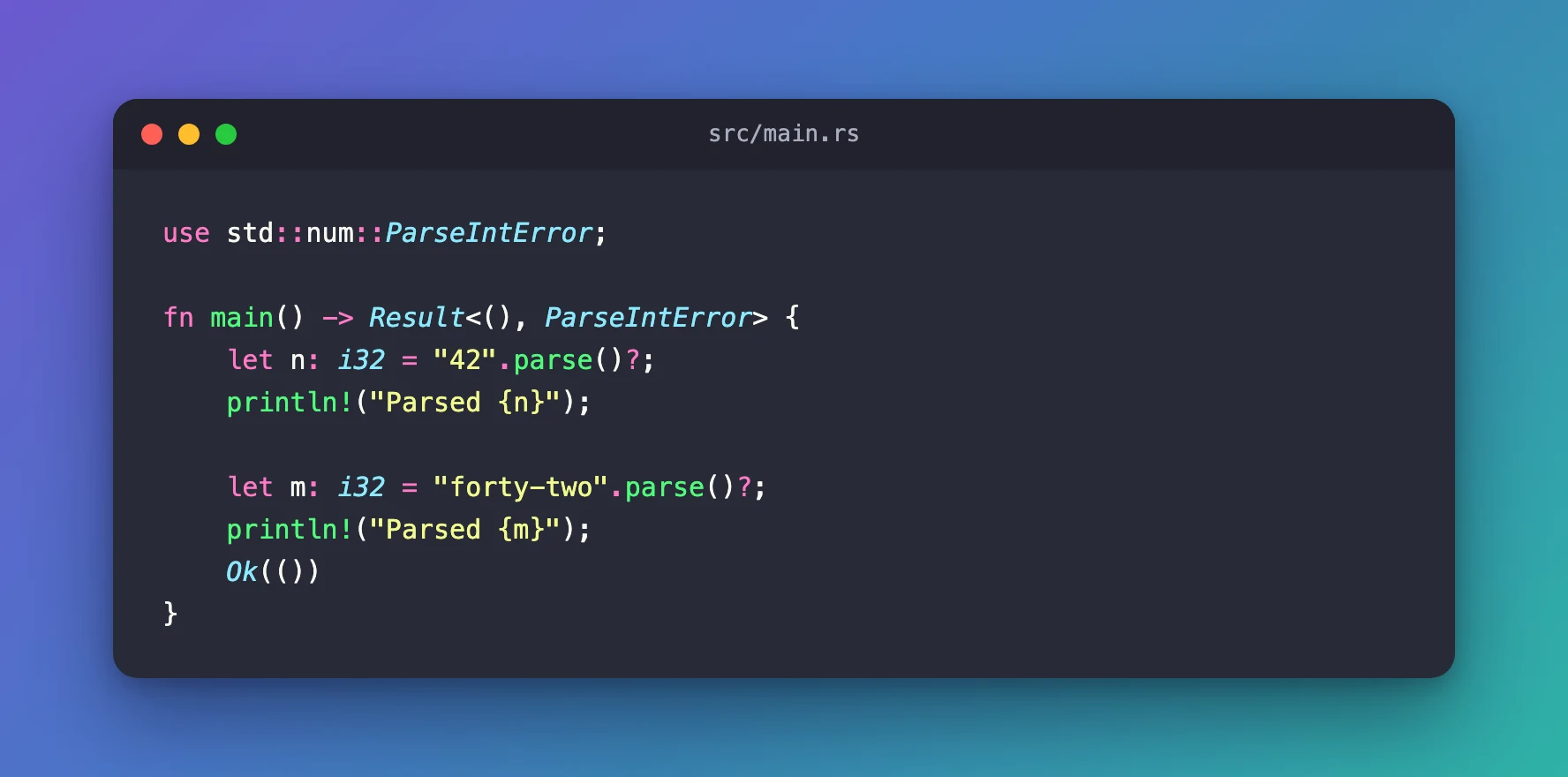
use std::num::ParseIntError;

fn main() -> Result<(), ParseIntError> {
    let n: i32 = "42".parse()?;
    println!("Parsed {n}");

    let m: i32 = "forty-two".parse()?;
    println!("Parsed {m}");
    Ok(())
}
parse returns a Result with a ParseIntError on failure, so that's the error type main declares.
Step 3: Run It and Check the Exit Code
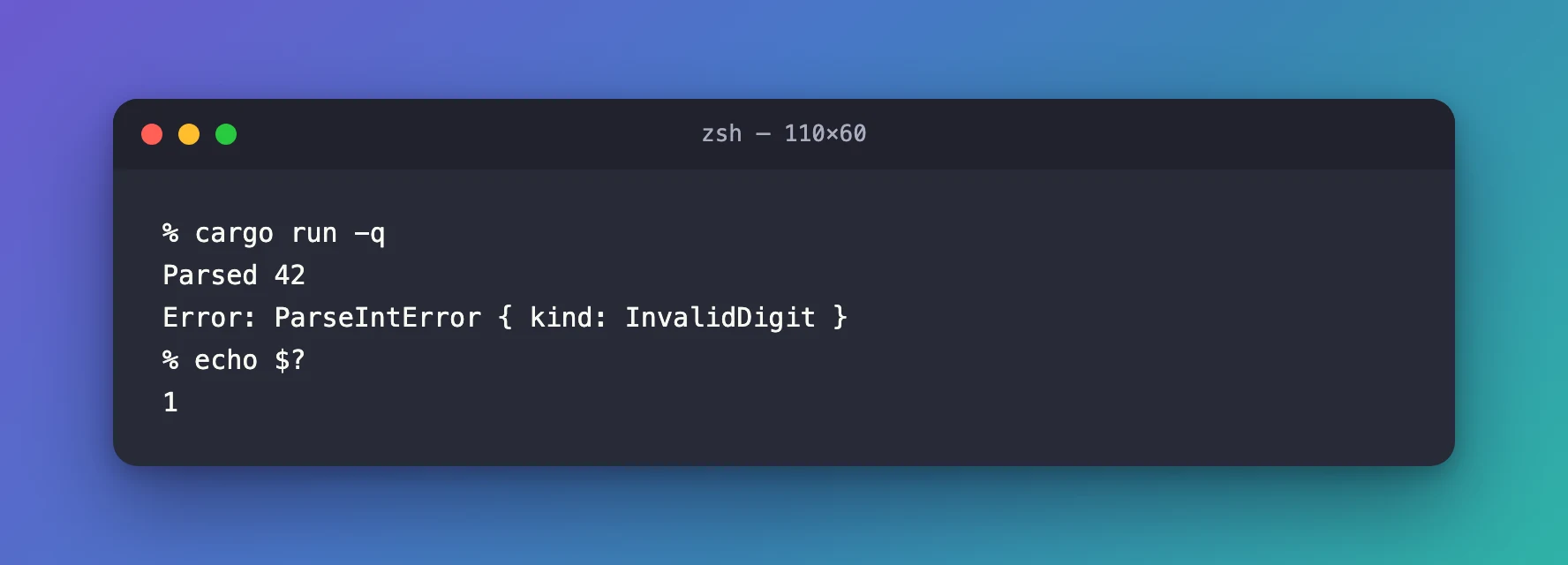
Run the program, then print the exit code of the last command:
- macOS / Linux
- Windows (PowerShell)
cargo run -q
echo $?
cargo run -q
$LASTEXITCODE
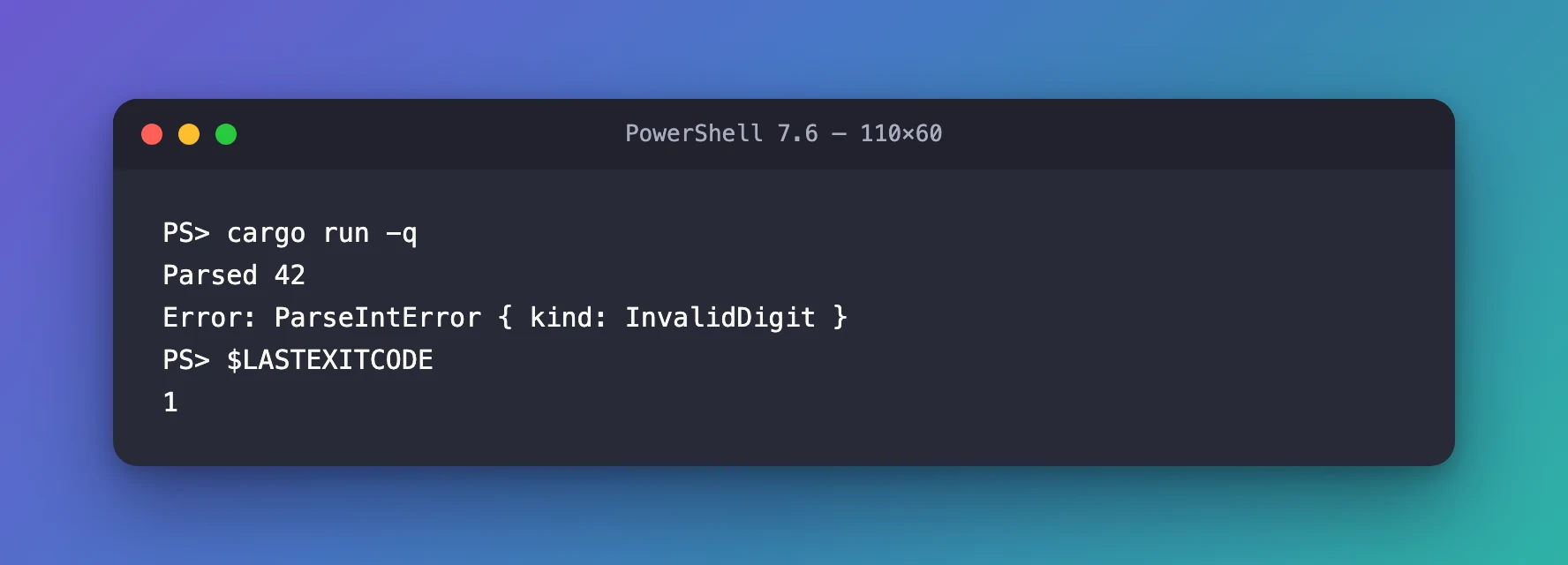
Parsed 42
Error: ParseIntError { kind: InvalidDigit }
1
cargo run compiles the program and runs it, and -q hides Cargo's own status lines. The first parse worked. The second failed, so ? returned the error from main, and Rust printed Error: with the error in its debug format, on standard error, and exited with code 1. Parsed for the second number never printed.
Mixed Error Types with Box<dyn Error>
When main calls things that fail with different error types, declare Box<dyn Error>, which accepts any of them:
use std::error::Error;

fn main() -> Result<(), Box<dyn Error>> {
    let n: i32 = "42".parse()?;
    println!("Parsed {n}");
    let m: f64 = "x".parse()?;
    println!("Parsed {m}");
    Ok(())
}
Parsed 42
Error: ParseFloatError { kind: Invalid }
The first ? met a ParseIntError type, the second a ParseFloatError, and both fit. This program exited with code 1 as well.
A String Error Prints in Quotes
The error is printed with its debug format, so a String error keeps its quotes:
fn main() -> Result<(), String> {
    Err(String::from("config file is missing"))
}
Error: "config file is missing"
Common Mistakes
| Mistake | What happens | Do this instead |
|---|---|---|
Forgetting Ok(()) at the end | error[E0308]: mismatched types: expected `Result<(), ParseIntError>`, found `()` | End main with Ok(()) |
Using ? in a main without a return type | error[E0277]: the `?` operator can only be used in a function that returns `Result` or `Option` … | Add the return type; the compiler's help suggests Result<(), Box<dyn std::error::Error>> |
| Expecting a friendly message | Rust prints the error's debug format, such as ParseIntError { kind: InvalidDigit } | Print your own message with eprintln! and return an ExitCode when users see it |
Troubleshooting
| Symptom | Likely cause | Fix |
|---|---|---|
implicitly returns `()` as its body has no tail or `return` expression | No Ok(()) at the end | Add it |
Exit code 1 with an Error: line | main returned an Err | Read the error after Error: |
FAQ
What exit code does main give on Ok(())?
0, as the Rust Book's quote above says.
Why not unwrap everything in main?
unwrap turns an error into a panic, exit code 101, with a message about a thread and a source line. Returning the error gives a shorter Error: line and exit code 1.
Conclusion
Declare fn main() -> Result<(), E>, use ? freely, and end with Ok(()). An error then reaches the shell as an Error: line on standard error and exit code 1. Use Box<dyn Error> when several error types meet in main.
Additional Resources
- Recoverable Errors with Result, in the Rust Book.
- Main functions, in the Rust Reference.
- std::process::Termination, in the standard library documentation.
