How to Return a Result from a Function in Rust

In Rust, a function that can fail says so in its return type, Result<T, E>. It returns Ok(value) when it works and Err(error) when it doesn't, and the code that calls it decides what to do with each.
Syntax
fn <name>(<parameters>) -> Result<T, E> {
    if <failure> {
        return Err(<error>);
    }
    Ok(<value>)
}
| Part | What it does |
|---|---|
Result<T, E> | The return type: T is the type of the value on success, E the type of the error. |
return Err(<error>); | Leaves the function at once with an error of type E. |
Ok(<value>) | The last expression, without a semicolon: the successful result, of type T. |
The standard library's documentation for Result: "Result<T, E> is the type used for returning and propagating errors. It is an enum with the variants, Ok(T), representing success and containing a value, and Err(E), representing error and containing an error value."
The Example
The example's divide function refuses to divide by zero: it returns an Err with a message instead of a number. The program calls it once with a valid divisor and once with zero.
Prerequisites
- Rust, installed with rustup, which comes with Cargo. This guide uses Rust 1.100.0.
Step 1: Create a Project
cargo new demo
cd demo
    Creating binary (application) `demo` package
note: see more `Cargo.toml` keys and their definitions at https://doc.rust-lang.org/cargo/reference/manifest.html
cargo new demo creates a folder named demo with a Cargo.toml file, which describes the project, and src/main.rs, which holds the code. cd demo moves into it.
Step 2: Write the Code
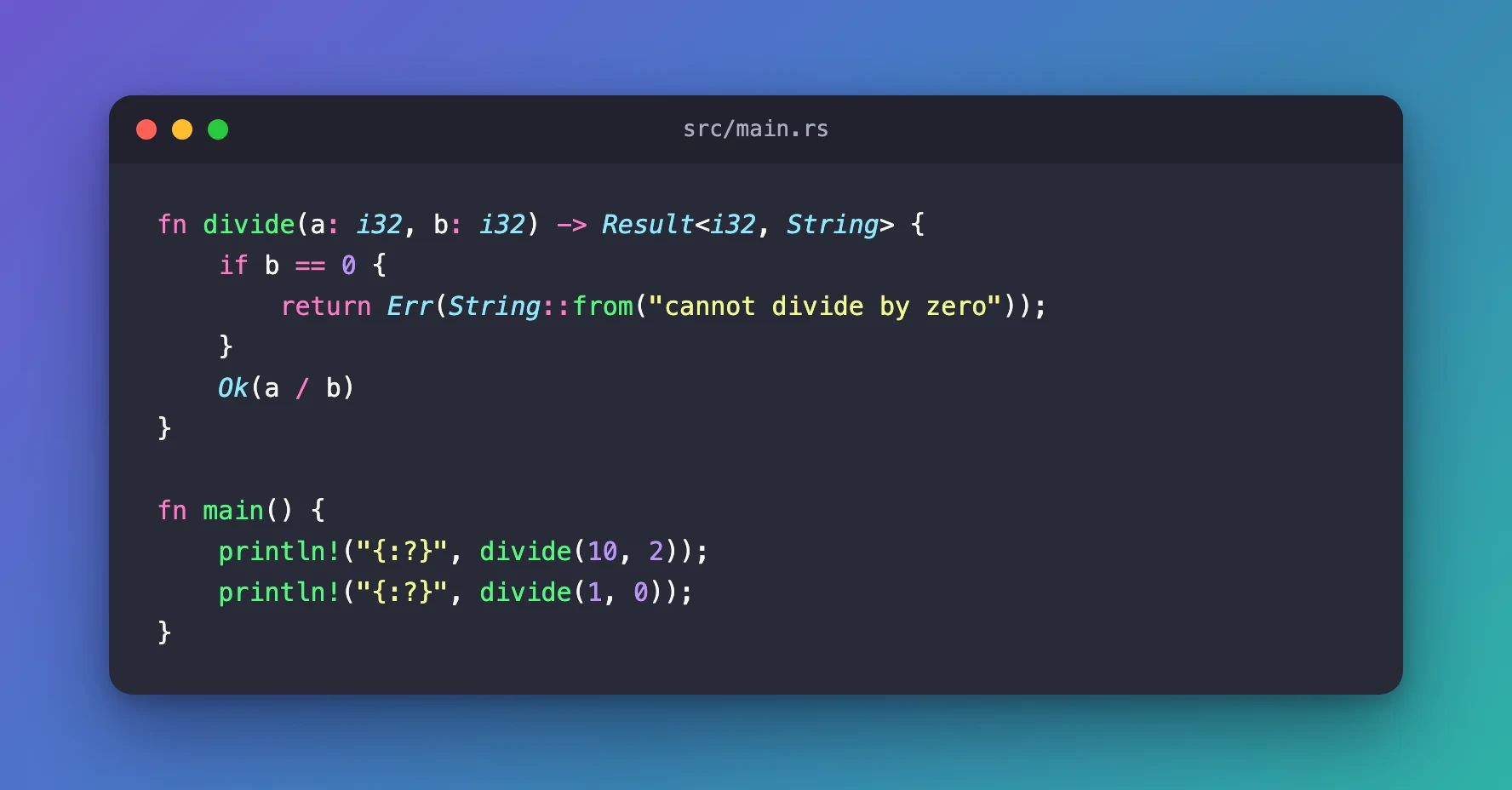
Replace the contents of src/main.rs with:
fn divide(a: i32, b: i32) -> Result<i32, String> {
    if b == 0 {
        return Err(String::from("cannot divide by zero"));
    }
    Ok(a / b)
}

fn main() {
    println!("{:?}", divide(10, 2));
    println!("{:?}", divide(1, 0));
}
Result<i32, String> says the function gives back an i32 on success or a String describing the error. {:?} prints the whole Result, so you can see which variant came back.
Step 3: Run It
cargo run -q
Ok(5)
Err("cannot divide by zero")
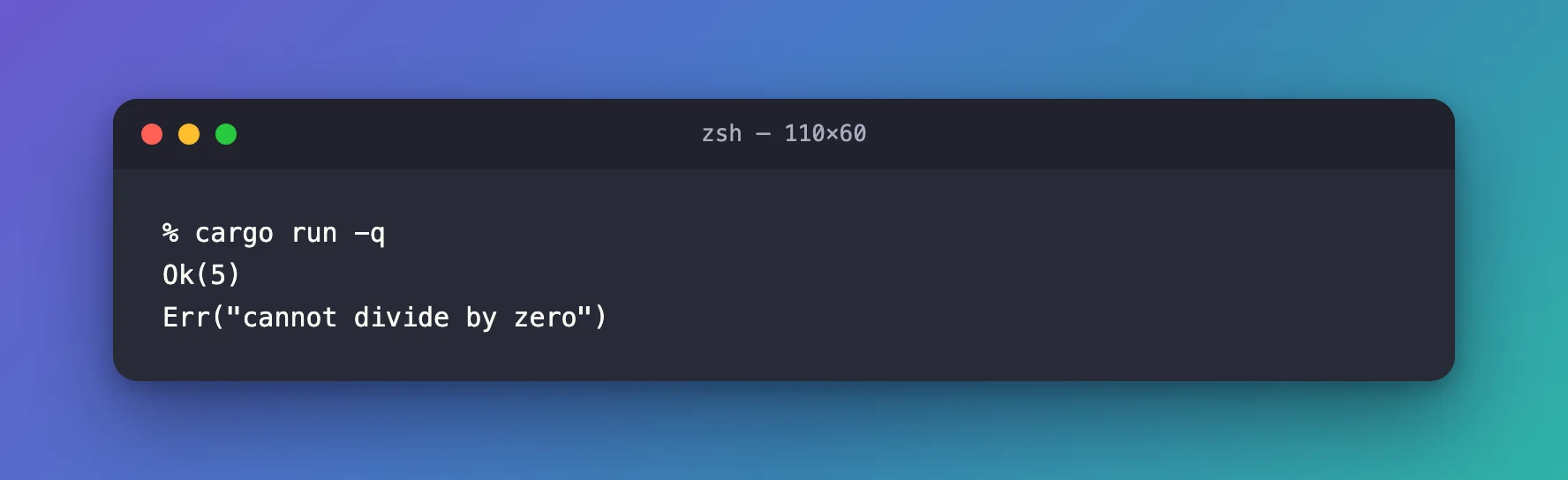
cargo run compiles the program and runs it, and -q hides Cargo's own status lines. Ten divided by two came back as Ok(5), and the division by zero as Err with the message.
Handle Both Cases with match
A caller usually takes the Result apart with match, which runs one arm for Ok and another for Err. Replace main with:
fn main() {
    match divide(1, 0) {
        Ok(n) => println!("{n}"),
        Err(e) => println!("Error: {e}"),
    }
}
Error: cannot divide by zero
Ok(n) and Err(e) give the value inside each variant a name for that arm.
Common Mistakes
| Mistake | What happens | Do this instead |
|---|---|---|
Calling the function and ignoring what it returns, as in divide(1, 0); | warning: unused `Result` that must be used: the error goes unnoticed | Handle it with match, if let or ? |
Returning the plain value, a / b, at the end | error[E0308]: mismatched types, with expected `Result<i32, String>`, found `i32` | Wrap it: Ok(a / b), as the compiler's help line suggests |
A semicolon after Ok(a / b) | error[E0308]: mismatched types, expected `Result<i32, String>`, found `()` , with the help remove this semicolon to return this value | Leave the last expression without a semicolon |
Troubleshooting
| Symptom | Likely cause | Fix |
|---|---|---|
expected `Result<…>`, found `…` | A path returns the plain value | Wrap it in Ok(…) |
unused `Result` that must be used | The caller drops the Result | Handle both cases |
FAQ
What type should the error be?
A String is the simplest, as in the example. Standard library functions return their own error types: "forty".parse::<i32>() returns a ParseIntError, for example.
Why not stop the program on an error?
Because the caller may know what to do: show a message, try again or use a default. The Rust Book calls these recoverable errors and uses Result for them.
Conclusion
Give a function that can fail the return type Result<T, E>, return Err(…) on failure and Ok(…) on success, and let the caller handle both with match.
Additional Resources
- std::result, in the standard library documentation.
- Recoverable Errors with Result, in the Rust Book.
