How to Pass a Reference to a Function in Rust

Passing a String to a Rust function moves it: the function becomes its owner, and the caller can't use it anymore. Pass a reference with & instead, and the function only borrows the value, so it's still yours afterwards.
Syntax
fn <name>(<param>: &<Type>) { … }
fn <name>(<param>: &mut <Type>) { … }

<name>(&<value>);
<name>(&mut <value>);
| Part | What it does |
|---|---|
& before the parameter's type | The parameter is a shared reference: the function can read the value but not change it. |
&mut before the parameter's type | The parameter is a mutable reference: the function can change the value. |
& before the argument | Creates a reference to the value, lending it to the function. |
&mut before the argument | Creates a mutable reference. The value must be declared with let mut. |
The Rust Book's chapter on references and borrowing: "A reference is like a pointer in that it’s an address we can follow to access the data stored at that address; that data is owned by some other variable." And: "We call the action of creating a reference borrowing."
The Example
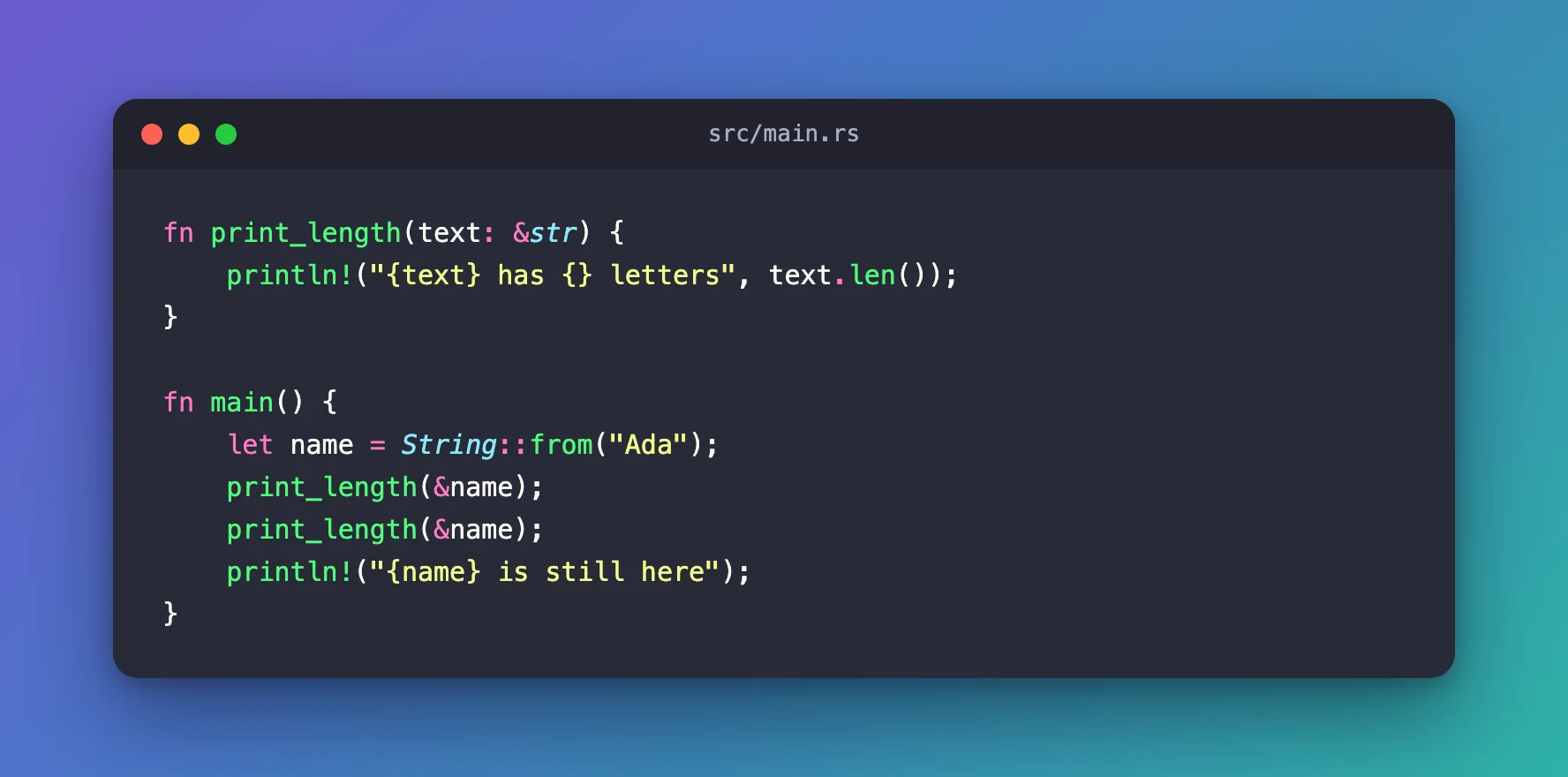
The example's print_length function prints a name and its number of letters. main lends it the same String twice, then still prints the name itself.
Prerequisites
- Rust, installed with rustup, which comes with Cargo. This guide uses Rust 1.100.0.
Step 1: Create a Project
cargo new demo
cd demo
    Creating binary (application) `demo` package
note: see more `Cargo.toml` keys and their definitions at https://doc.rust-lang.org/cargo/reference/manifest.html
cargo new demo creates a folder named demo with a Cargo.toml file, which describes the project, and src/main.rs, which holds the code. cd demo moves into it.
Step 2: Write the Code
Replace the contents of src/main.rs with:
fn print_length(text: &str) {
    println!("{text} has {} letters", text.len());
}

fn main() {
    let name = String::from("Ada");
    print_length(&name);
    print_length(&name);
    println!("{name} is still here");
}
text: &str means print_length borrows the text instead of taking it. &name lends the String for the length of the call. &name is a &String, and Rust turns it into the &str the function asks for, a conversion the Rust Book calls deref coercion.
Step 3: Run It
cargo run -q
Ada has 3 letters
Ada has 3 letters
Ada is still here
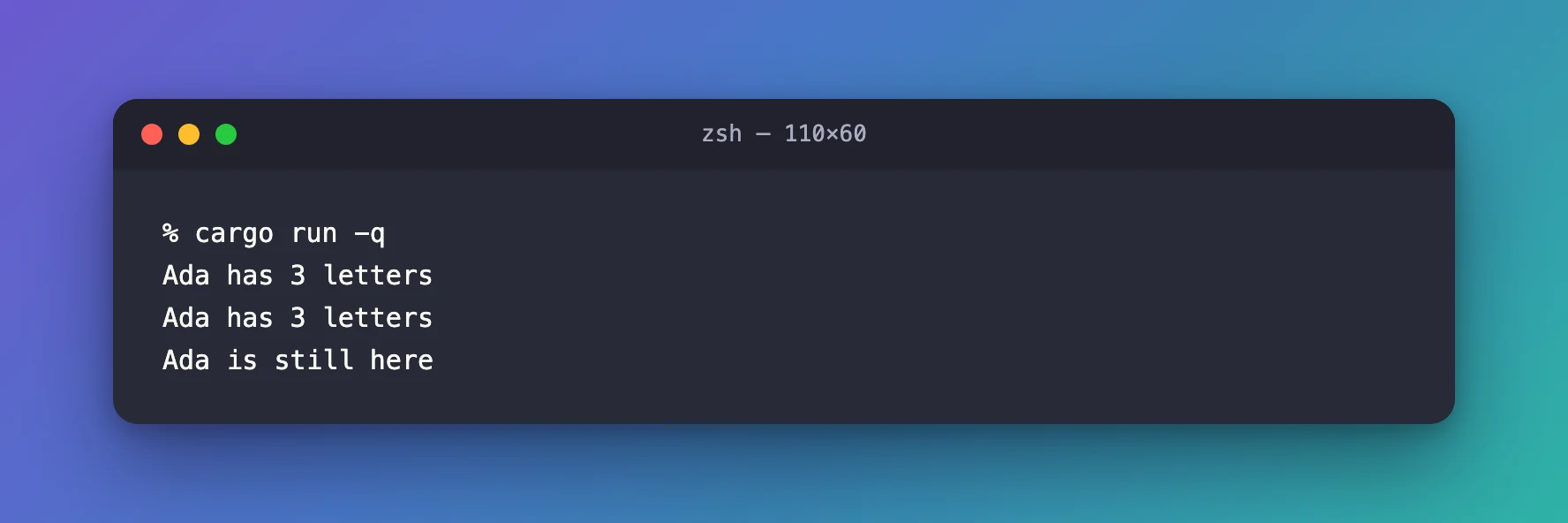
cargo run compiles the program and runs it, and -q hides Cargo's own status lines. Each call borrowed name and gave it back, so main could lend it a second time and print it at the end.
Without the &
Here print_length takes a String and main passes name itself, once:
fn print_length(text: String) {
    println!("{text} has {} letters", text.len());
}

fn main() {
    let name = String::from("Ada");
    print_length(name);
    println!("{name} is still here");
}
The call moves the String into the function, so the build stops at the last line, which uses name after the move:
error[E0382]: borrow of moved value: `name`
 --> src/main.rs:8:16
  |
6 |     let name = String::from("Ada");
  |         ---- move occurs because `name` has type `String`, which does not implement the `Copy` trait
7 |     print_length(name);
  |                  ---- value moved here
8 |     println!("{name} is still here");
  |                ^^^^ value borrowed here after move
  |
note: consider changing this parameter type in function `print_length` to borrow instead if owning the value isn't necessary
 --> src/main.rs:1:23
  |
1 | fn print_length(text: String) {
  |    ------------       ^^^^^^ this parameter takes ownership of the value
  |    |
  |    in this function
help: consider cloning the value if the performance cost is acceptable
  |
7 |     print_length(name.clone());
  |                      ++++++++

For more information about this error, try `rustc --explain E0382`.
error: could not compile `demo` (bin "demo") due to 1 previous error
The compiler's note points at the fix this guide uses: make the parameter borrow.
Change a Value Through &mut
A mutable reference lets a function change the caller's value:
fn add_title(text: &mut String) {
    text.insert_str(0, "Dr. ");
}

fn main() {
    let mut name = String::from("Ada");
    add_title(&mut name);
    println!("{name}");
}
Dr. Ada
insert_str(0, "Dr. ") adds the text at the start, and the change shows in main because the function worked on main's own String.
Common Mistakes
| Mistake | What happens | Do this instead |
|---|---|---|
Passing name to a function that takes &str | error[E0308]: mismatched types, expected `&str`, found `String` , with the help consider borrowing here | Pass &name |
Passing a String by value and using it afterwards | error[E0382]: borrow of moved value: `name` | Make the parameter a reference |
&mut on a variable declared without mut | error[E0596]: cannot borrow `name` as mutable, as it is not declared as mutable | Declare it with let mut |
Troubleshooting
| Symptom | Likely cause | Fix |
|---|---|---|
value borrowed here after move | The value moved into an earlier call | Pass a reference with & |
expected `&str`, found `String` | The & is missing in the call | Add & before the argument |
FAQ
How many references can I have at once?
The Book's rule: "At any given time, you can have either one mutable reference or any number of immutable references." The compiler checks it for you.
Does a reference copy the String?
No. It's an address of the existing value, so lending a large String costs no copy.
Conclusion
Put & before a parameter type to borrow instead of taking ownership, and & before the argument to lend it. Use &mut when the function has to change the value, and keep using the value afterwards in either case.
Additional Resources
- References and Borrowing, in the Rust Book.
- What Is Ownership?, in the Rust Book.
- Implicit Deref Coercions with Functions and Methods, in the Rust Book: "deref coercion can convert &String to &str".
