How to Inherit from a Class in Python

When a new class is a special kind of an existing one, it can inherit everything the existing class has and change only what's different. A Cat is an Animal, but it speaks its own way. This guide builds both classes, with real output from Python 3.15.2.
Syntax
class <ChildClass>(<ParentClass>):
    def <method>(self):
        ...  # replaces the parent's method of the same name
| Part | What it means |
|---|---|
(<ParentClass>) | The class to inherit from. The child gets all of its methods |
| A method with the parent's name | Overrides it: objects of the child class use this one |
The Python tutorial: "Derived classes may override methods of their base classes."
Prerequisites
- uv and Python 3. This guide uses uv 0.13.10 with Python 3.15.2, in a project made with
uv init.
Step 1: Write the Script
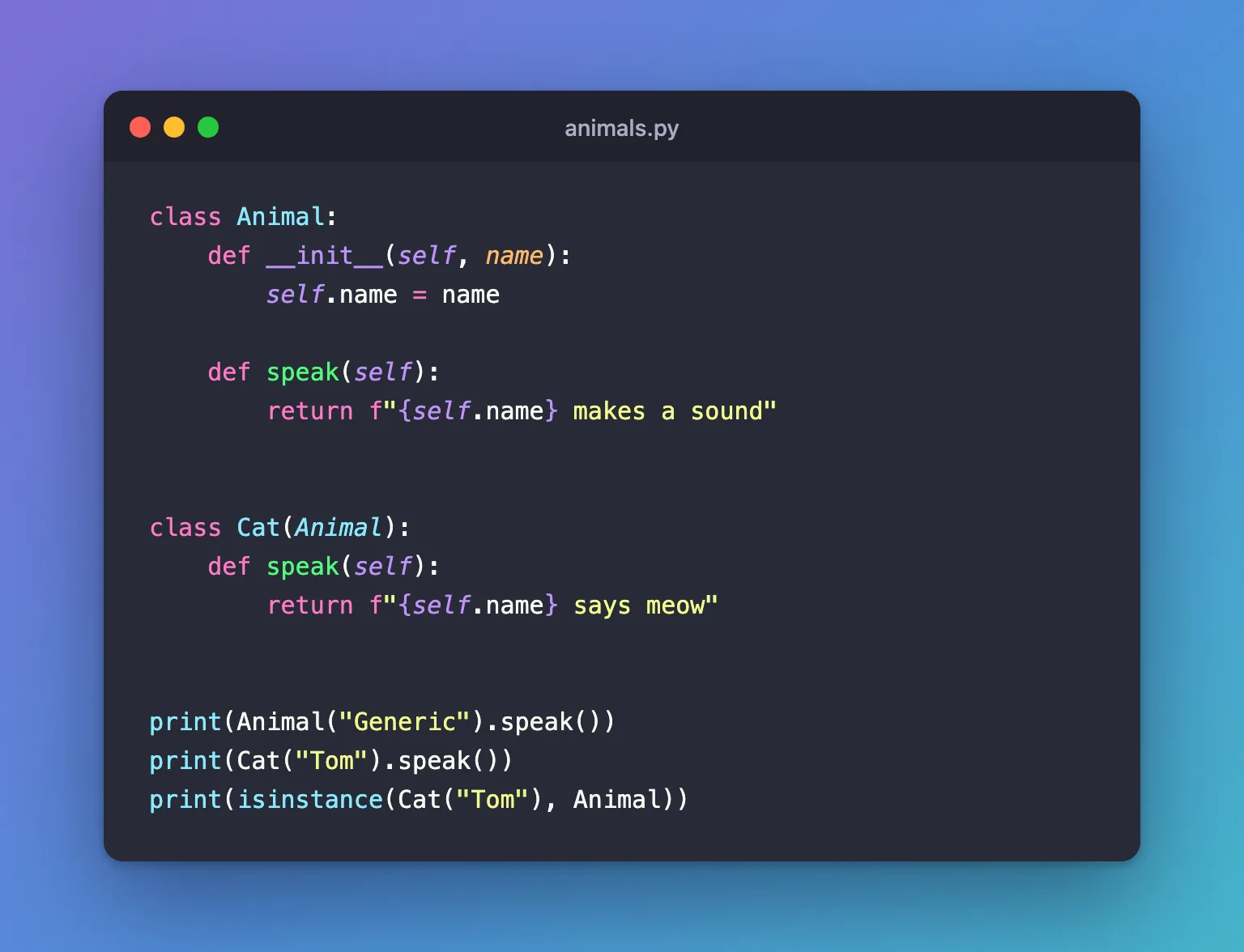
Cat inherits __init__ from Animal and replaces only speak.
class Animal:
    def __init__(self, name):
        self.name = name

    def speak(self):
        return f"{self.name} makes a sound"


class Cat(Animal):
    def speak(self):
        return f"{self.name} says meow"


print(Animal("Generic").speak())
print(Cat("Tom").speak())
print(isinstance(Cat("Tom"), Animal))
Step 2: Run It
uv run python animals.py
Generic makes a sound
Tom says meow
True
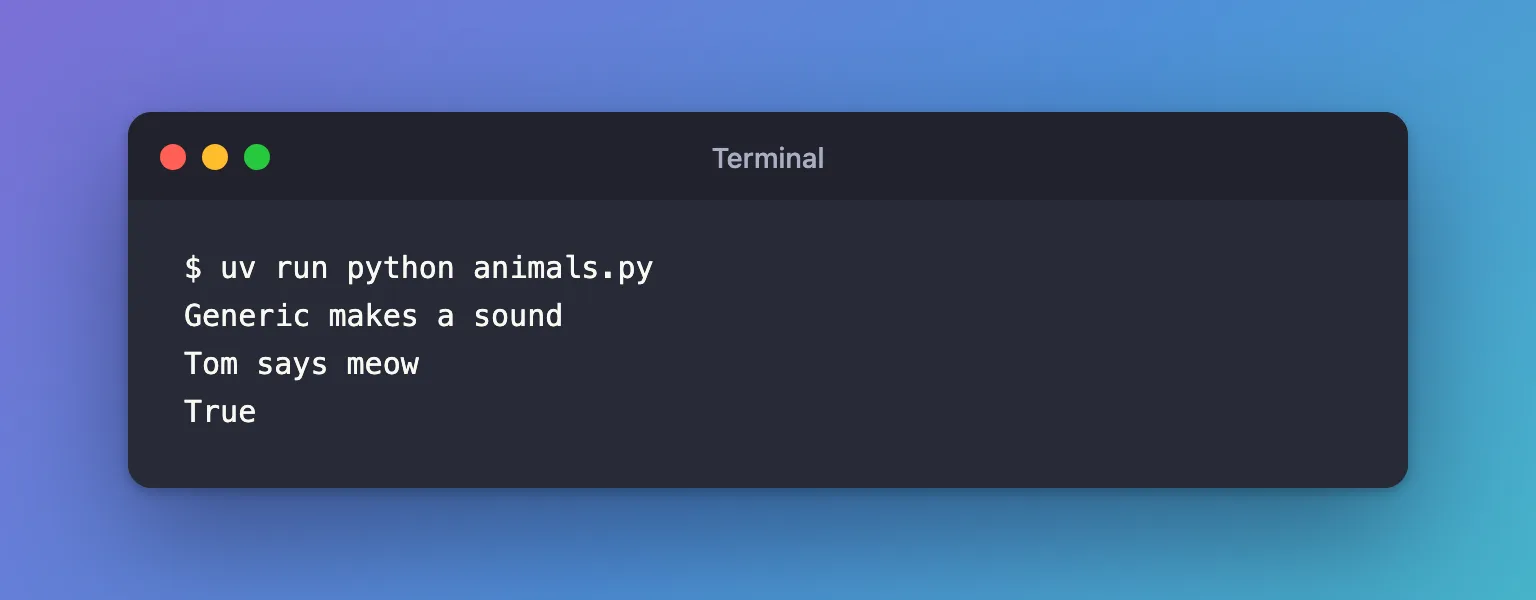
Cat("Tom") got its name from Animal's __init__ and spoke with its own speak. isinstance confirms a cat is also an animal.
Common Mistakes
| Mistake | What happens | Do this instead |
|---|---|---|
A child __init__ that doesn't call the parent's | The parent's setup never runs: tom.name raised AttributeError: 'Cat' object has no attribute 'name' | Call super().__init__(name) in the child's __init__ |
| Repeating the parent's code in the child | Two copies to keep in step | Inherit it, and override only what differs |
Troubleshooting
| Symptom | Likely cause | Fix |
|---|---|---|
AttributeError: '...' object has no attribute ... on a child object | The child's __init__ replaced the parent's without calling it | Add super().__init__(...) |
FAQ
How does the child add its own data?
Give it an __init__ that calls the parent's first. With super().__init__(name) and self.indoor = indoor, Cat("Tom", indoor=True) had both: tom.name, tom.indoor printed Tom True.
What does super() return?
The reference: "Return a proxy object that delegates method calls to a parent or sibling class of type." In practice, it lets the child call the parent's version of a method.
Conclusion
class Cat(Animal) inherited Animal's __init__ and overrode speak, so Cat("Tom").speak() said Tom says meow. When the child needs its own __init__, call super().__init__(...) in it.
Additional Resources
- Inheritance — the tutorial's section.
- super() — calling the parent class's methods.
