How to Give a Function Parameter a Default Value in Python

Some function arguments have a value that's right most of the time. Give that parameter a default in the def line, and callers can leave it out or pass their own value. This guide writes a greeting function with a default greeting, with real output from Python 3.15.2.
Syntax
def <function>(<parameter>, <parameter with default>=<default value>):
    ...
| Part | What it means |
|---|---|
<parameter> | Required: every call must pass it |
<parameter with default>=<default value> | Optional: when a call leaves it out, it gets <default value>. Parameters with defaults come after the ones without |
The Python tutorial: "The most useful form is to specify a default value for one or more arguments. This creates a function that can be called with fewer arguments than it is defined to allow."
Prerequisites
- uv and Python 3. This guide uses uv 0.13.10 with Python 3.15.2, in a project made with
uv init.
Step 1: Write the Script
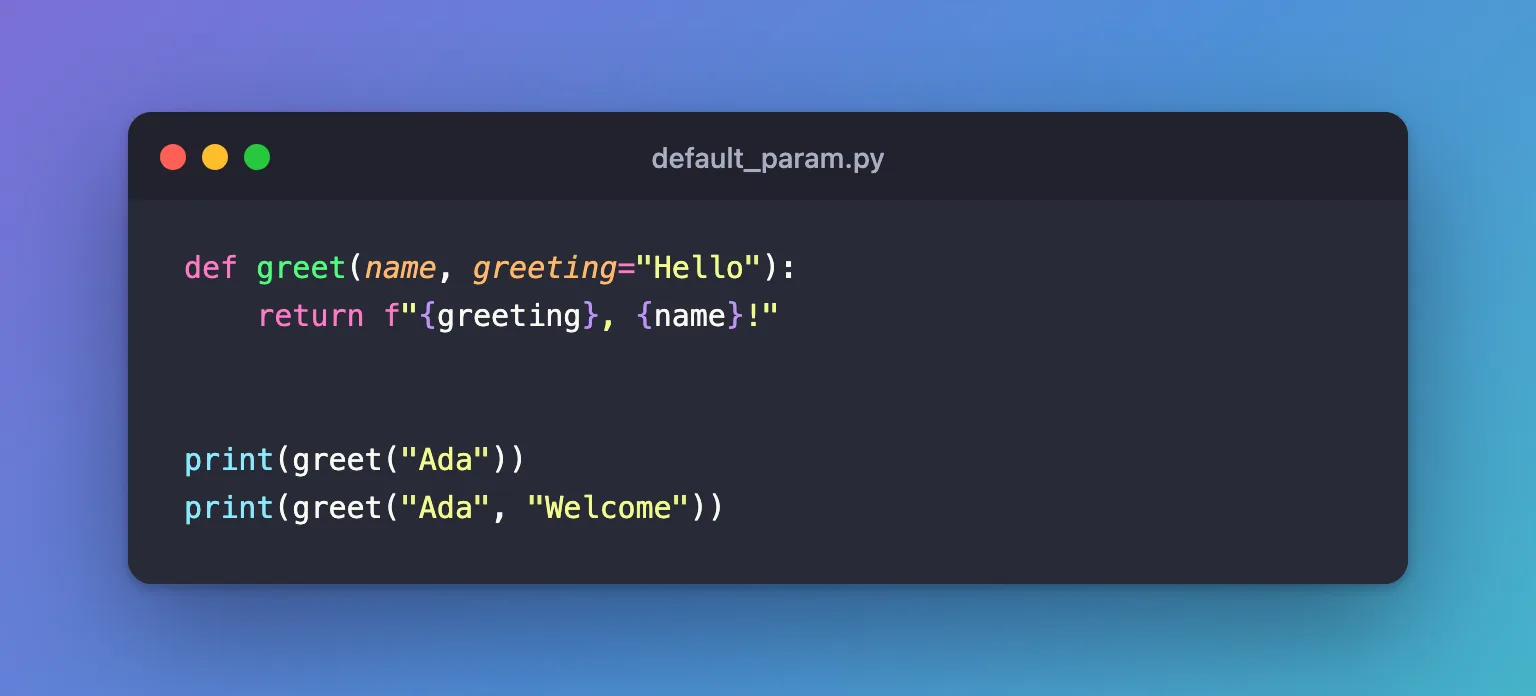
def greet(name, greeting="Hello"):
    return f"{greeting}, {name}!"


print(greet("Ada"))
print(greet("Ada", "Welcome"))
Step 2: Run It
uv run python default_param.py
Hello, Ada!
Welcome, Ada!
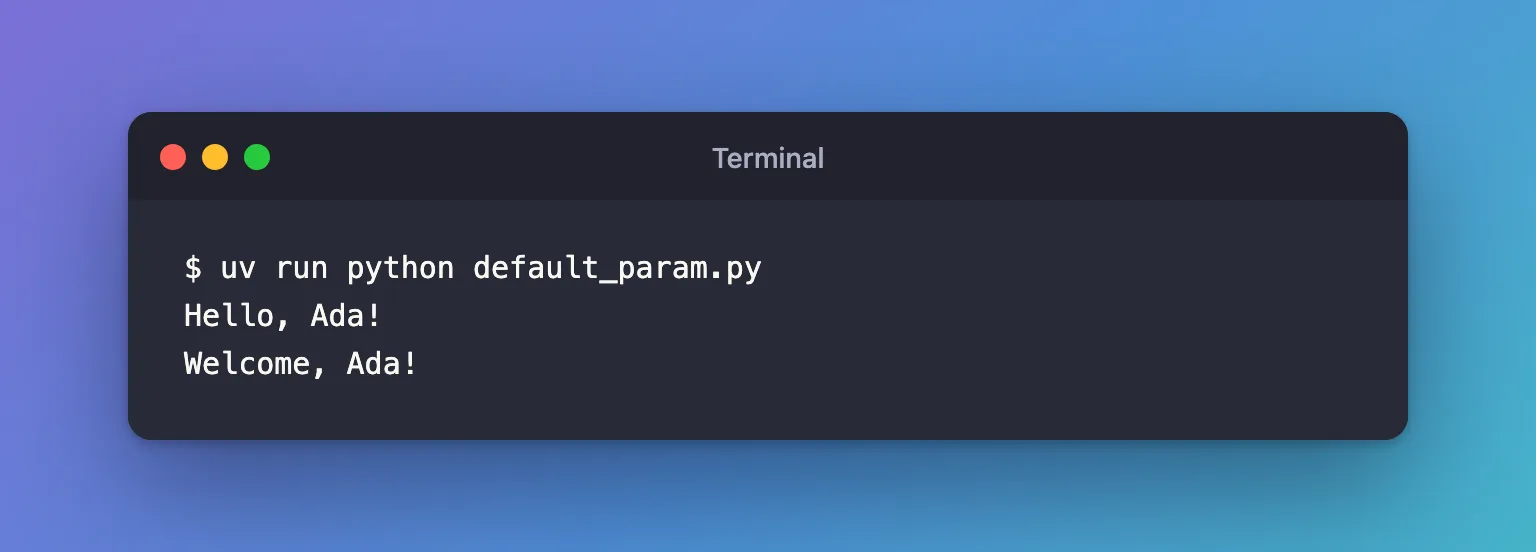
The first call left greeting out and got "Hello"; the second passed "Welcome" instead.
Common Mistakes
| Mistake | What happens | Do this instead |
|---|---|---|
| A parameter without a default after one with it | def greet(greeting="Hello", name): raised SyntaxError: parameter without a default follows parameter with a default | Put the required parameters first |
| A list as the default | One list is shared by every call: add_item("apple") gave ['apple'], then add_item("pear") gave ['apple', 'pear'] | Default to None and make the list inside: the same calls gave ['apple'] and ['pear'] |
Troubleshooting
| Symptom | Likely cause | Fix |
|---|---|---|
| A default list or dictionary keeps values from earlier calls | The default is made once, when the function is defined | Use None as the default and create the list in the function |
FAQ
When is the default value made?
Once, when Python runs the def line. The tutorial: "Important warning: The default value is evaluated only once. This makes a difference when the default is a mutable object such as a list, dictionary, or instances of most classes."
Can a call name the parameter?
Yes: greet("Ada", greeting="Welcome") passes it by name, which reads clearly when a function has several defaults.
Conclusion
greeting="Hello" made the second parameter optional: greet("Ada") said Hello, Ada! and greet("Ada", "Welcome") said Welcome, Ada!. Keep required parameters first, and use None instead of a list as a default.
Additional Resources
- Default argument values — the tutorial's section, with the warning about shared defaults.
- Function definitions — the language reference.
