How to Get Unix Seconds from a time.Time in Go

Unix time counts the seconds since 1 January 1970 UTC, and many formats store times that way. In Go, t.Unix() turns a time.Time into that number, and time.Unix(seconds, 0) turns it back.
Syntax
<seconds> := <t>.Unix()
<milliseconds> := <t>.UnixMilli()
<t> := time.Unix(<seconds>, <nanoseconds>)
| Part | What it does |
|---|---|
<t>.Unix() | The seconds since 1970-01-01 00:00:00 UTC, as an int64. |
<t>.UnixMilli() | The same moment in milliseconds. |
time.Unix(<s>, <ns>) | Builds a time.Time from seconds and extra nanoseconds. |
The time documentation: "Unix returns t as a Unix time, the number of seconds elapsed since January 1, 1970 UTC. The result does not depend on the location associated with t."
The Example
The example takes 09:30 UTC on 26 November 2026, prints it as Unix seconds and milliseconds, and turns the seconds back into a time.
Prerequisites
- Go.
go runcompiles and runs a single file. This guide uses Go 1.27.4.
Step 1: Write the Code
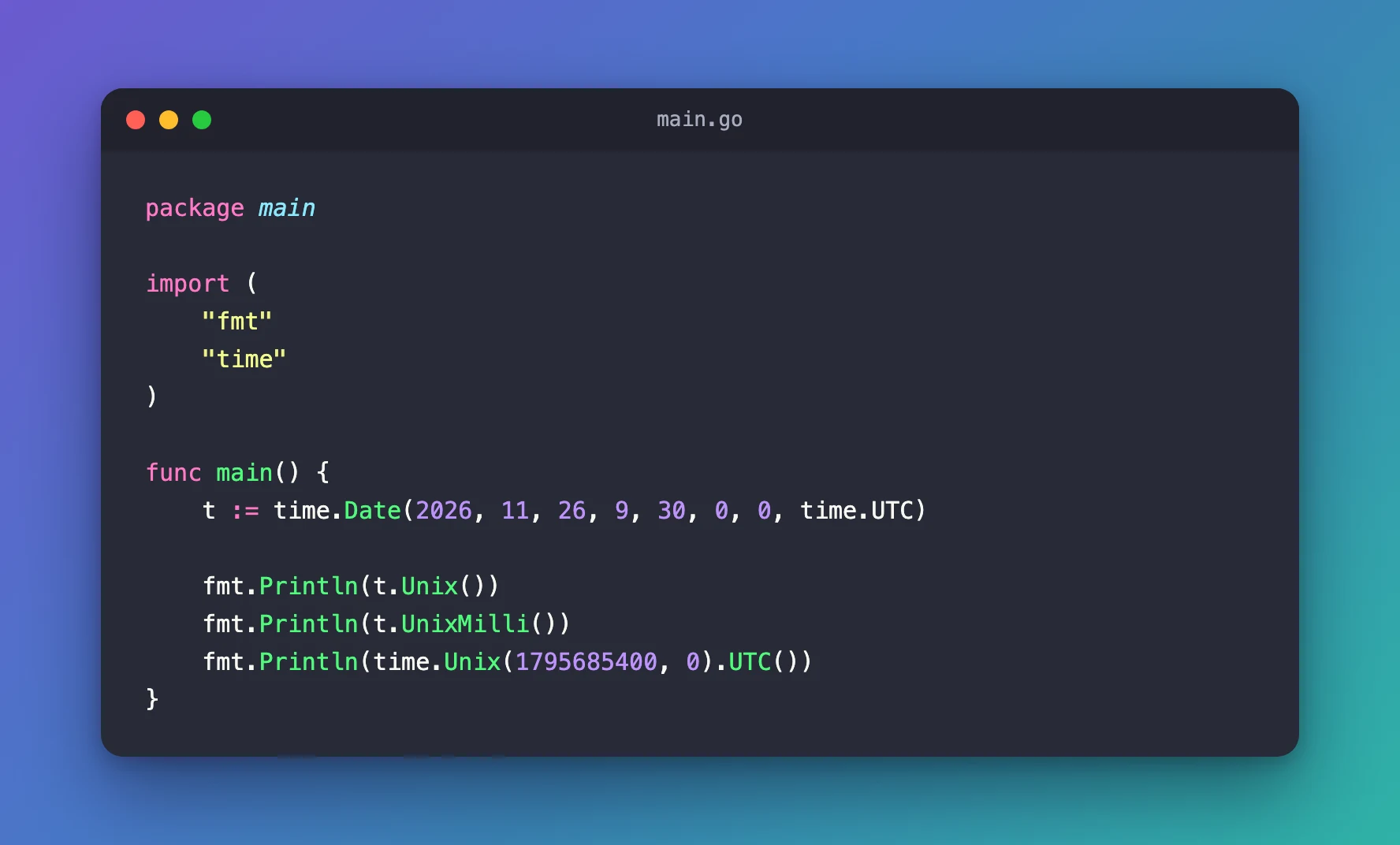
Create a file named main.go:
package main

import (
	"fmt"
	"time"
)

func main() {
	t := time.Date(2026, 11, 26, 9, 30, 0, 0, time.UTC)

	fmt.Println(t.Unix())
	fmt.Println(t.UnixMilli())
	fmt.Println(time.Unix(1795685400, 0).UTC())
}
.UTC() shows the converted time in UTC; without it, Go would show it in the computer's local time zone.
Step 2: Run It
go run main.go
1795685400
1795685400000
2026-11-26 09:30:00 +0000 UTC
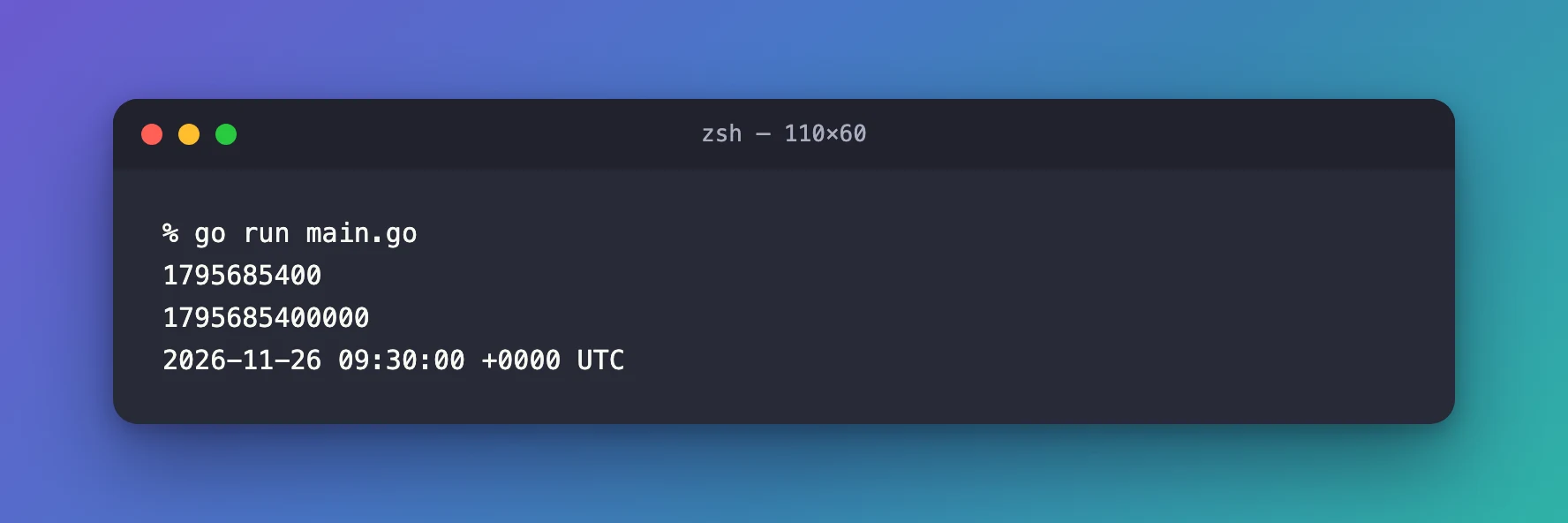
The milliseconds are the seconds with three more digits. The command is the same in zsh, bash and PowerShell.
Common Mistakes
| Mistake | What happens | Do this instead |
|---|---|---|
Using UnixMilli() where seconds are expected | The value is 1,000 times too big | Use Unix() |
Printing time.Unix(...) and reading it as UTC | It's shown in the local time zone | Call .UTC() before printing |
Storing the result in an int32 | It overflows in 2038 | Keep the int64 that Unix() returns |
Troubleshooting
| Symptom | Likely cause | Fix |
|---|---|---|
| A date shows up thousands of years ahead | Milliseconds were read as seconds | Divide by 1,000, or use Unix() |
| A converted time is hours off | It printed in local time | Add .UTC() |
FAQ
How do I get the current Unix time?
time.Now().Unix().
Does the time zone change the number?
No. As the documentation says, the result doesn't depend on the time's location: the same moment gives the same seconds everywhere.
Conclusion
t.Unix() gives the seconds since 1970 UTC and t.UnixMilli() the milliseconds; time.Unix(seconds, 0) goes back. Call .UTC() when you print a converted time.
Additional Resources
- time.Time.Unix, in the Go standard library documentation.
- time.Unix, in the Go standard library documentation.
