How to Get an Element from a Slice by Its Index in Go

Each element of a Go slice has a position, its index, and you read an element by putting its index in square brackets after the slice. Counting starts at 0, so colors[0] is the first element and colors[len(colors)-1] the last.
Syntax
<element> := <slice>[<index>]
<count> := len(<slice>)
| Part | What it does |
|---|---|
<slice>[<index>] | The element at <index>, counting from 0. |
len(<slice>) | How many elements the slice has. The last index is one less. |
The Go language specification on index expressions says the index x is in range if 0 <= x < len(a), otherwise it is out of range, and: "if x is out of range at run time, a run-time panic occurs".
The Example
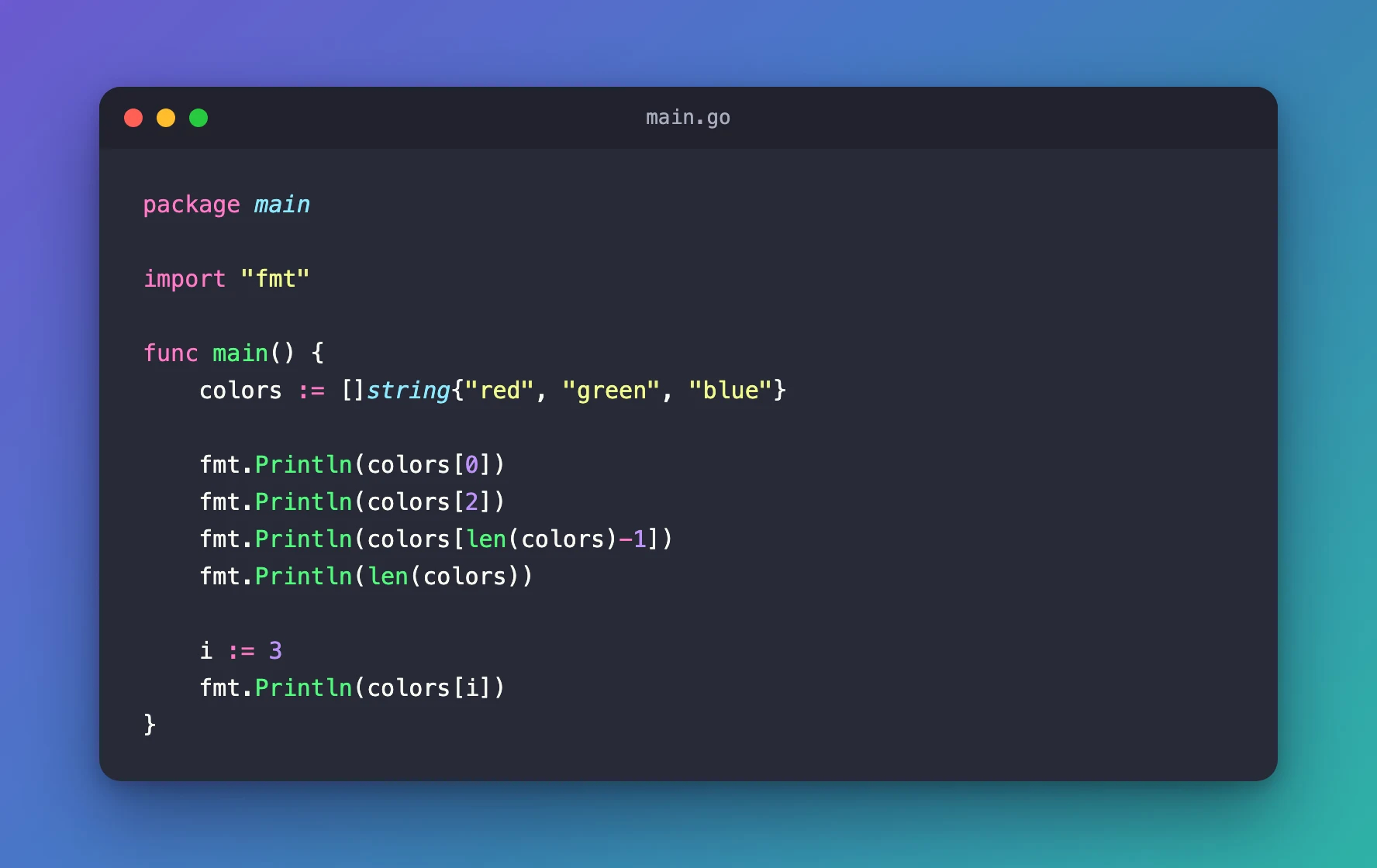
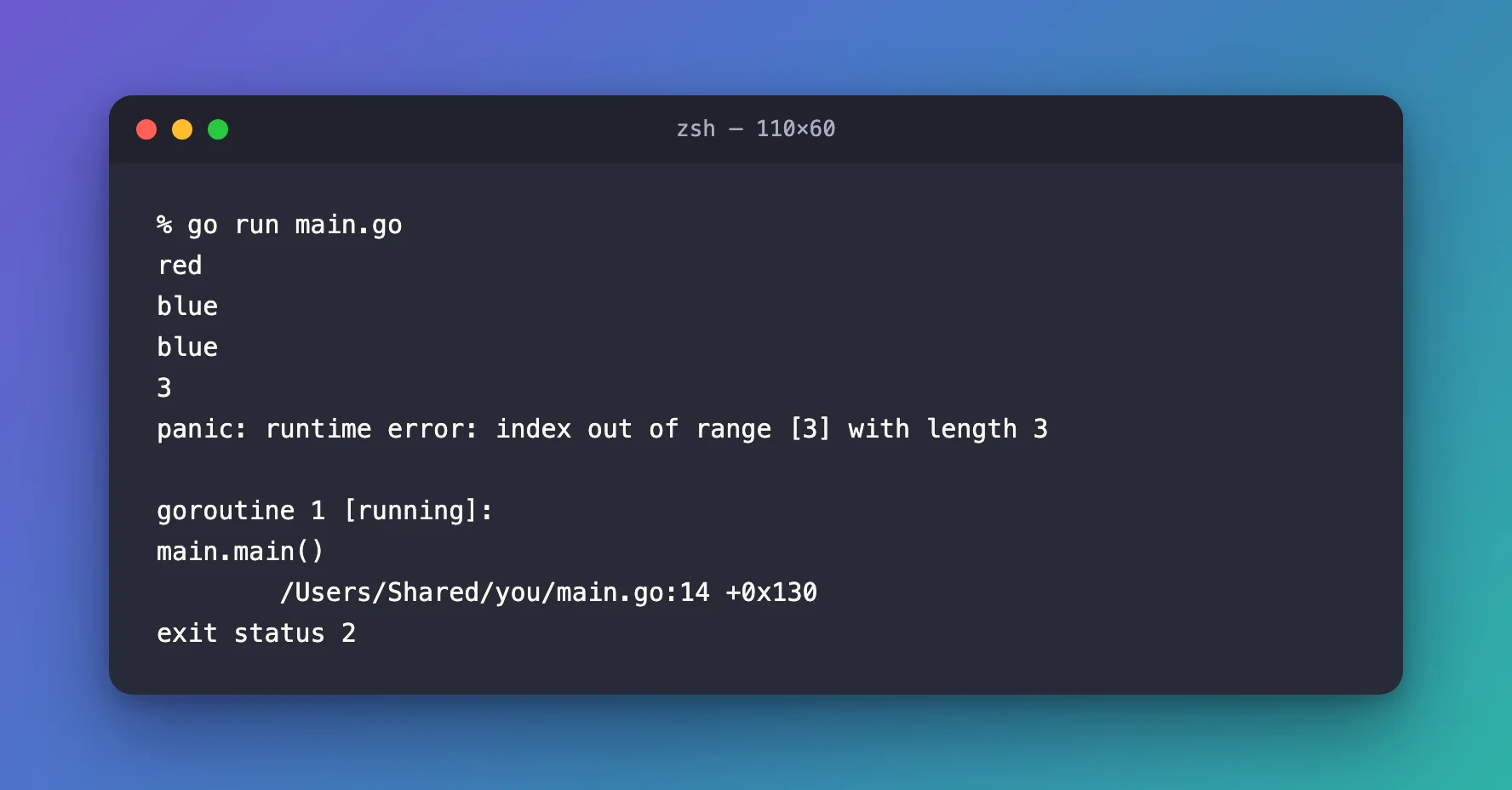
The example reads the first and the third of three colors, the last one with len(colors)-1, the slice's length, and then the element at index 3, held in a variable.
Prerequisites
- Go.
go runcompiles and runs a single file. This guide uses Go 1.27.4.
Step 1: Write the Code
Create a file named main.go:
package main

import "fmt"

func main() {
	colors := []string{"red", "green", "blue"}

	fmt.Println(colors[0])
	fmt.Println(colors[2])
	fmt.Println(colors[len(colors)-1])
	fmt.Println(len(colors))

	i := 3
	fmt.Println(colors[i])
}
Step 2: Run It
go run main.go
red
blue
blue
3
panic: runtime error: index out of range [3] with length 3

goroutine 1 [running]:
main.main()
        /Users/Shared/you/main.go:14 +0x130
exit status 2
The command is the same in zsh, bash and PowerShell.
What Happened
colors[0]is the first element andcolors[2]the third, because counting starts at 0.colors[len(colors)-1]worked out the last index, 2.colors[i]withiset to 3 asked for a fourth element. Go found that out while the program ran and stopped it with a panic that names the index and the length.go runthen printedexit status 2.
Common Mistakes
| Mistake | What happens | Do this instead |
|---|---|---|
Using colors[len(colors)] for the last element | It's one past the end: a panic | Use colors[len(colors)-1] |
Using a negative index, as in colors[-1] | It doesn't compile: invalid argument: index -1 (constant of type int) must not be negative | Count from the end with len(colors)-1 |
| Indexing an empty slice | colors[0] panics when the slice has no elements | Check len(colors) > 0 first |
Troubleshooting
| Symptom | Likely cause | Fix |
|---|---|---|
panic: runtime error: index out of range [N] with length M | The index isn't below the length | Check len before indexing |
exit status 2 after a panic | go run reports the program's exit code | Fix the panic above it |
FAQ
Why did Go not catch colors[3] when compiling?
A slice's length is only known when the program runs, and the index here came from a variable. Go checks constant indexes against arrays at compile time, but a slice index is checked at run time.
Can I change an element by its index?
Yes: colors[1] = "yellow" replaces the second element.
Conclusion
slice[index] reads an element, counting from 0, and len(slice) tells you how many there are. An index outside 0 to len - 1 panics at run time, so check the length when the index comes from data.
Additional Resources
- Index expressions, in the Go language specification.
- Go Slices: usage and internals, on the Go blog.
