How to Get a Dictionary Value or a Default with GetValueOrDefault in C#

Reading a Dictionary with dictionary[key] throws when the key isn't there. When a missing key simply means "nothing", GetValueOrDefault is shorter and safer: it gives you the value if there is one, and a default if there isn't.
Syntax
<ValueType>? <value> = <dictionary>.GetValueOrDefault(<key>);
<ValueType> <value> = <dictionary>.GetValueOrDefault(<key>, <defaultValue>);
| Part | What it does |
|---|---|
GetValueOrDefault(<key>) | The value for the key, or the value type's default when the key isn't there: null for a string, 0 for an int |
GetValueOrDefault(<key>, <defaultValue>) | The same, but returns your <defaultValue> when the key isn't there |
Microsoft's GetValueOrDefault reference describes both: "Tries to get the value associated with the specified key in the dictionary." Without a default, "When the method fails, it returns the default value for TValue." With one, "When the method fails, it returns defaultValue."
The Example
An office keeps who sits at which desk, and how many times each person visited. Ana has a desk and 3 visits; Ben has neither. The program asks for both, with and without a default.
Prerequisites
- The .NET 10 SDK or newer, which runs a single
.csfile withdotnet run. This guide uses .NET SDK 10.0.404.
Step 1: Write the Code
Create a file named main.cs in an empty folder:
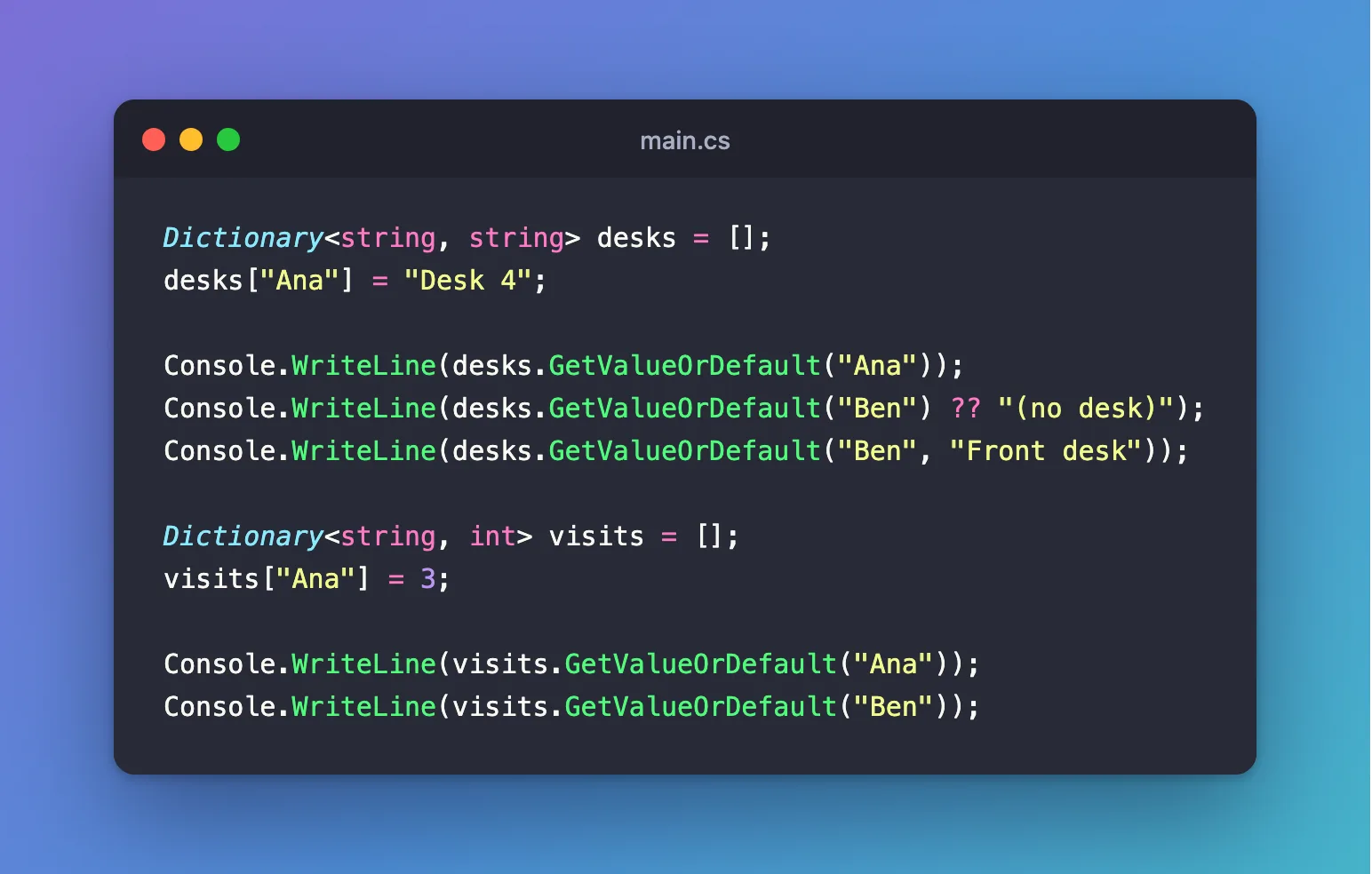
Dictionary<string, string> desks = [];
desks["Ana"] = "Desk 4";

Console.WriteLine(desks.GetValueOrDefault("Ana"));
Console.WriteLine(desks.GetValueOrDefault("Ben") ?? "(no desk)");
Console.WriteLine(desks.GetValueOrDefault("Ben", "Front desk"));

Dictionary<string, int> visits = [];
visits["Ana"] = 3;

Console.WriteLine(visits.GetValueOrDefault("Ana"));
Console.WriteLine(visits.GetValueOrDefault("Ben"));
?? gives the value on its right when the one on its left is null.
Step 2: Run It
dotnet run main.cs
Desk 4
(no desk)
Front desk
3
0
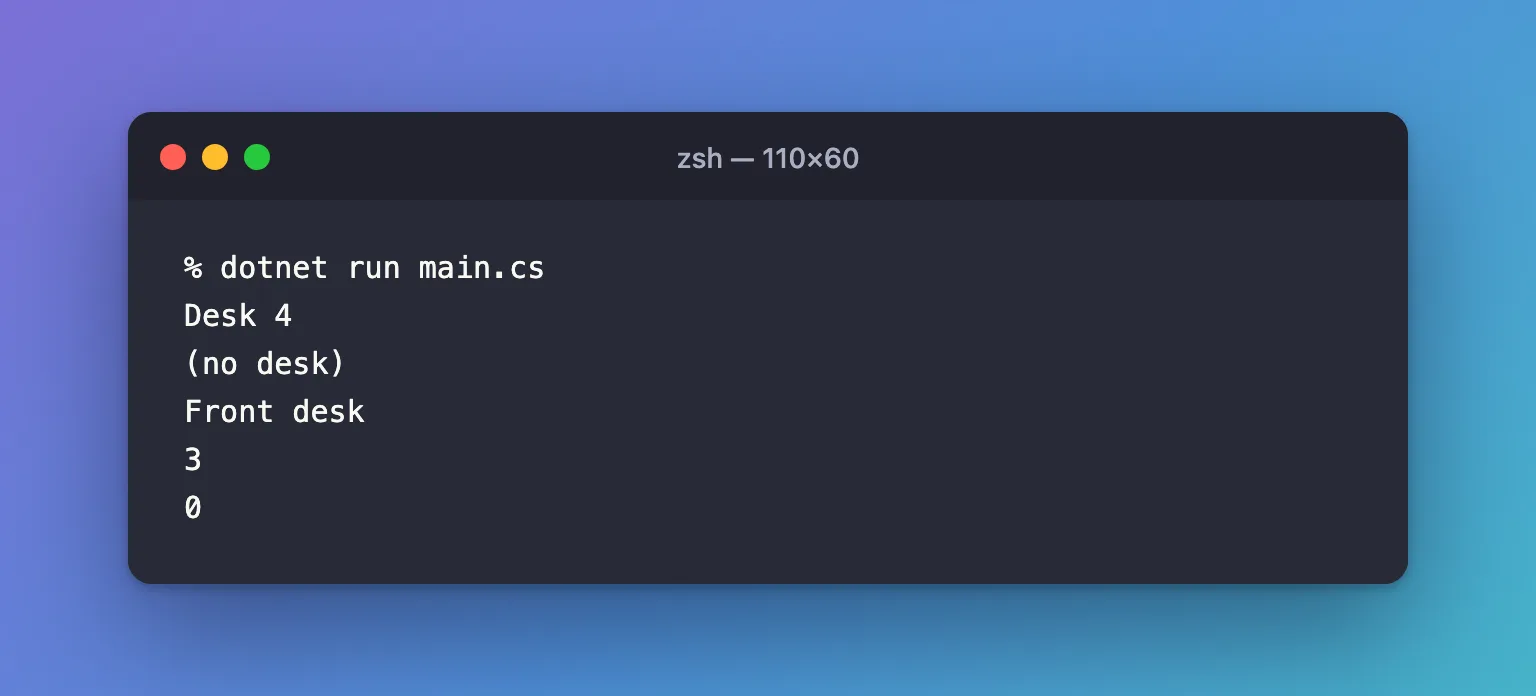
Anais there, so both dictionaries gave her value:Desk 4and3.- Ben's desk came back as
null, astring's default, which??turned into(no desk). - With
"Front desk"as the default, Ben got that instead. - Ben's visits came back as
0, anint's default. Nothing threw.
The command is the same in zsh, bash and PowerShell.
When 0 Is a Real Value
The default and a stored value can look exactly the same. Here Cy really has 0 visits, and Ben isn't in the dictionary at all:
Dictionary<string, int> visits = [];
visits["Cy"] = 0;

Console.WriteLine(visits.GetValueOrDefault("Cy"));
Console.WriteLine(visits.GetValueOrDefault("Ben"));
Console.WriteLine(visits.TryGetValue("Cy", out int cy) ? $"Cy: {cy}" : "Cy: not there");
Console.WriteLine(visits.TryGetValue("Ben", out int ben) ? $"Ben: {ben}" : "Ben: not there");
0
0
Cy: 0
Ben: not there
GetValueOrDefault printed 0 for both. TryGetValue returns true or false as well as the value, so it told them apart. Use it when "missing" and "zero" mean different things.
Common Mistakes
| Mistake | What happens | Do this instead |
|---|---|---|
Using GetValueOrDefault when 0 or null can be a stored value | A missing key and a stored default look the same | Use TryGetValue |
Forgetting that a string value's default is null | The result is null, and reading a member of it throws | Pass a default, or use ?? |
Reading with the indexer, desks["Ben"], for a key that may be missing | KeyNotFoundException | Use GetValueOrDefault |
Troubleshooting
| Symptom | Likely cause | Fix |
|---|---|---|
A missing key gives 0 or nothing at all | That's the value type's default | Pass your own default as the second argument |
error CS0411: The type arguments for method 'CollectionExtensions.GetValueOrDefault...' cannot be inferred from the usage | The variable's type is IDictionary | The fix |
FAQ
Do I need a using directive for GetValueOrDefault?
Not in a project with implicit usings, which includes a file run with dotnet run: the example above has none. The method lives in CollectionExtensions, in the System.Collections.Generic namespace, which those usings include.
Does GetValueOrDefault add the key?
No. It only reads. After desks.GetValueOrDefault("Ben", "Front desk"), the dictionary still had 1 entry, and ContainsKey("Ben") was False.
Conclusion
dictionary.GetValueOrDefault(key) returns the value, or null or 0 when the key is missing, and GetValueOrDefault(key, fallback) returns your fallback instead. When a stored default must be told apart from a missing key, use TryGetValue.
Additional Resources
- CollectionExtensions.GetValueOrDefault method, on Microsoft Learn.
Dictionary<TKey,TValue>.TryGetValuemethod, on Microsoft Learn.
