How to Delete an Alias in MLflow

An alias that no longer means anything, such as a challenger whose trial is over, is worth removing, so nobody loads it by mistake. MlflowClient.delete_registered_model_alias removes the alias and leaves the version it pointed to untouched. Real output from MLflow 3.18.0.
Syntax
MlflowClient().delete_registered_model_alias(name, alias)
| Part | What it means |
|---|---|
name | The registered model |
alias | The alias to remove, such as challenger |
The reference for delete_registered_model_alias: "Delete an alias associated with a registered model." It takes no version, because an alias points to one version at a time.
Prerequisites
- An MLflow tracking server with a database backend at
http://127.0.0.1:8080, such asmlflow server --port 8080with its default SQLite database. The registry needs one. mlflowandscikit-learnin your project, for example withuv add mlflow scikit-learn pandas.
Step 1: Delete the Alias
The example registers an iris classifier as iris-trial, points challenger at its version 1, and prints the registered model's aliases before and after deleting it:
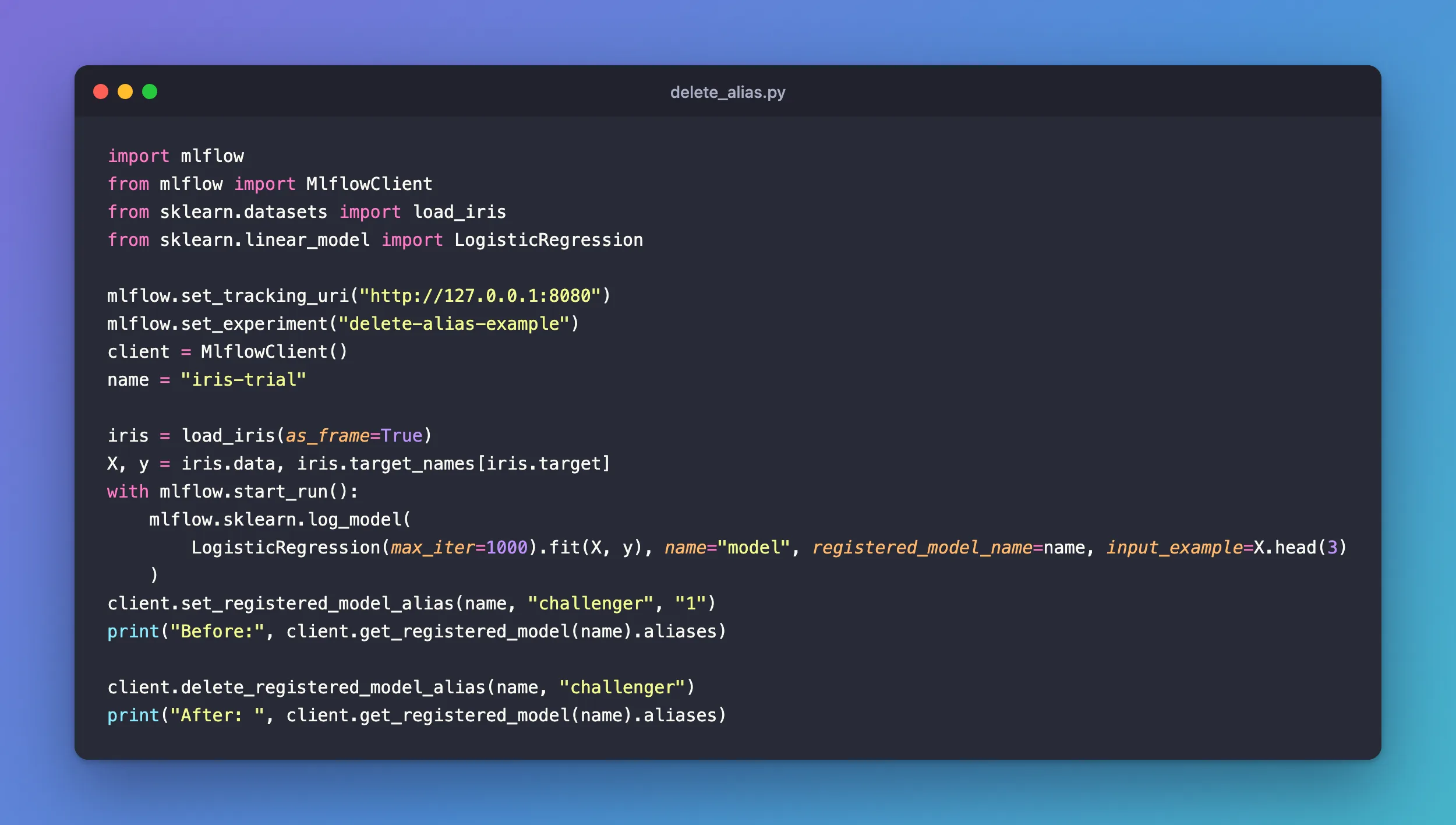
import mlflow
from mlflow import MlflowClient
from sklearn.datasets import load_iris
from sklearn.linear_model import LogisticRegression

mlflow.set_tracking_uri("http://127.0.0.1:8080")
mlflow.set_experiment("delete-alias-example")
client = MlflowClient()
name = "iris-trial"

iris = load_iris(as_frame=True)
X, y = iris.data, iris.target_names[iris.target]
with mlflow.start_run():
    mlflow.sklearn.log_model(
        LogisticRegression(max_iter=1000).fit(X, y), name="model", registered_model_name=name, input_example=X.head(3)
    )
client.set_registered_model_alias(name, "challenger", "1")
print("Before:", client.get_registered_model(name).aliases)

client.delete_registered_model_alias(name, "challenger")
print("After: ", client.get_registered_model(name).aliases)
uv run python delete_alias.py
Before: {'challenger': '1'}
After:  {}
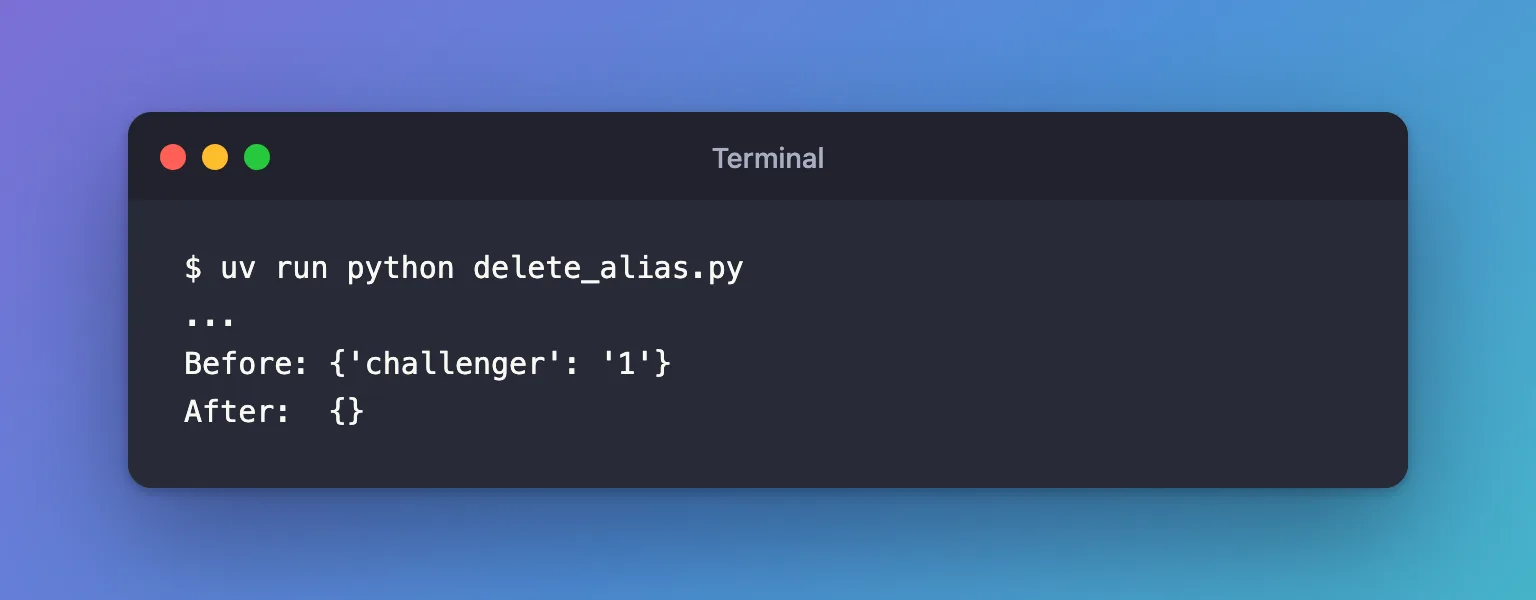
The registered model has no aliases left. Version 1 is still there, ready to load as models:/iris-trial/1: deleting an alias removes only the name.
Common Mistakes
| Mistake | What happens | Do this instead |
|---|---|---|
| Deleting an alias that code still loads | Every load of models:/<name>@<alias> fails | Point that code at another alias or a version number first |
| Deleting the alias to get rid of a version | The version stays in the registry | Delete the version itself |
Troubleshooting
| Symptom | Likely cause | Fix |
|---|---|---|
INVALID_PARAMETER_VALUE: Registered model alias challenger not found. when loading | The alias was deleted | Set it again on the version you want |
| The delete runs without an error, but the alias is still listed | The name of the alias or of the registered model is misspelled; deleting an alias that doesn't exist raises no error | Print get_registered_model(name).aliases and copy the name from it |
FAQ
Do I have to delete an alias before moving it?
No. Setting it on another version moves it in one call: How to Set an Alias on a Model Version in MLflow with Python.
Does deleting a version delete its aliases?
Yes: How to Delete a Model Version in MLflow shows the alias disappearing with the version.
Conclusion
client.delete_registered_model_alias("iris-trial", "challenger") emptied the registered model's aliases, from {'challenger': '1'} to {}, and left version 1 in place.
Additional Resources
- MlflowClient.delete_registered_model_alias — the call and an example.
- Model Registry workflows — setting and deleting aliases in code.
