How to Decode Base64url in Java with jjwt Decoders.BASE64URL

Decoders.BASE64URL.decode(text) from jjwt turns base64url text, such as one piece of a JWT, back into bytes. It's strict: plain base64 with / or = makes it throw a DecodingException instead of guessing.
Syntax
byte[] <bytes> = Decoders.BASE64URL.decode(<text>);
String <decoded> = new String(<bytes>, StandardCharsets.UTF_8);
| Part | What it does |
|---|---|
Decoders.BASE64URL.decode(<text>) | Decodes base64url text, with or without padding, into a byte[]. |
new String(<bytes>, StandardCharsets.UTF_8) | Turns the bytes into text, when they are text. |
DecodingException | Thrown for a character that base64url doesn't use. |
The jjwt API documentation for Decoders: BASE64URL is a "Very fast Base64Url decoder guaranteed to work in all >= Java 7 JDK and Android environments."
The Example
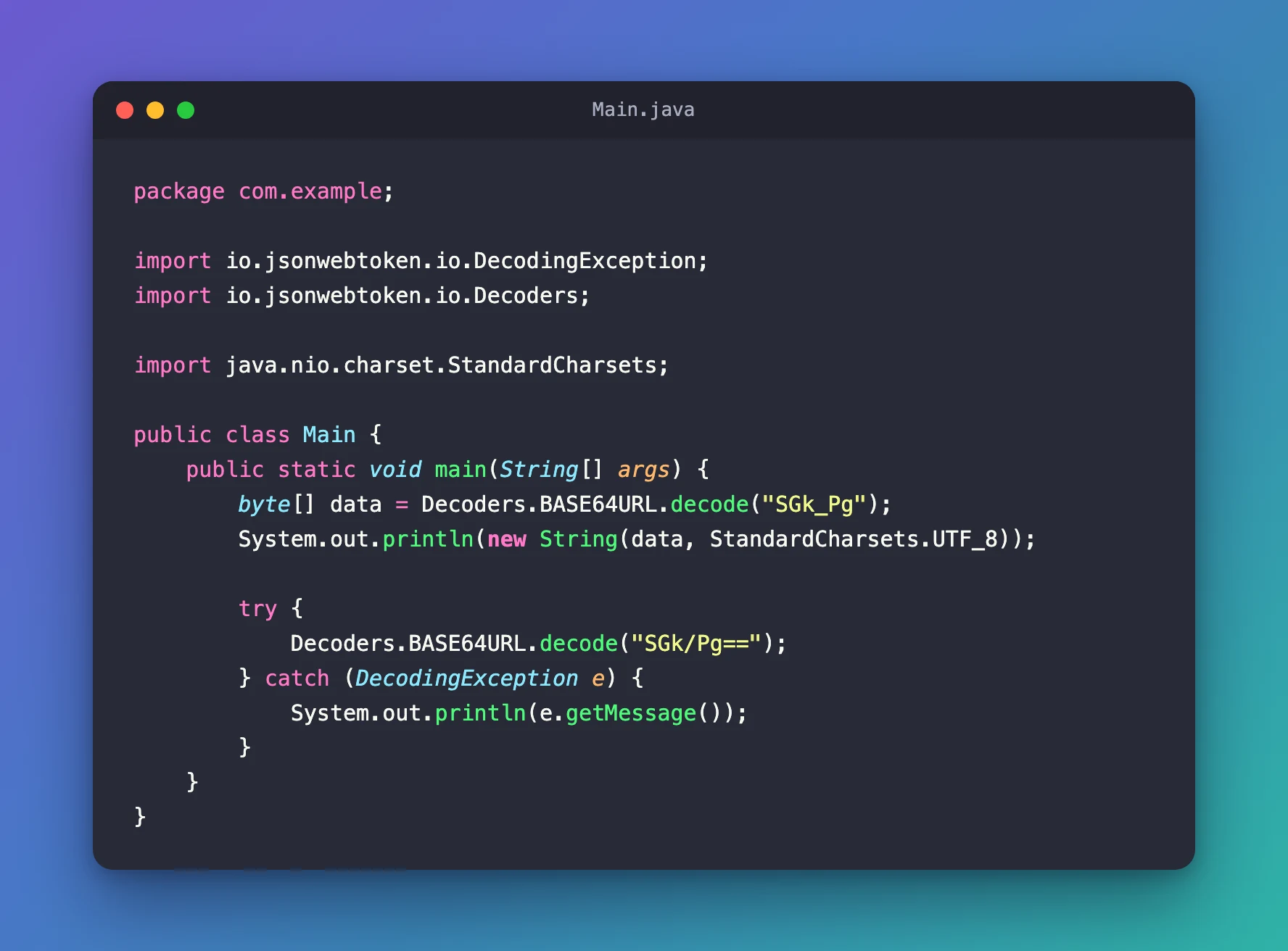
The example decodes SGk_Pg, the base64url form of Hi?>, and prints it as text. Then it tries SGk/Pg==, the plain base64 form of the same text, and prints the error.
Prerequisites
Step 1: Create the Project
Create a folder named demo with this pom.xml:
<?xml version="1.0" encoding="UTF-8"?>
<project xmlns="http://maven.apache.org/POM/4.0.0"
         xmlns:xsi="http://www.w3.org/2001/XMLSchema-instance"
         xsi:schemaLocation="http://maven.apache.org/POM/4.0.0 https://maven.apache.org/xsd/maven-4.0.0.xsd">
  <modelVersion>4.0.0</modelVersion>
  <groupId>com.example</groupId>
  <artifactId>demo</artifactId>
  <version>1.0.0</version>
  <properties>
    <maven.compiler.release>25</maven.compiler.release>
    <project.build.sourceEncoding>UTF-8</project.build.sourceEncoding>
  </properties>
  <dependencies>
    <dependency>
      <groupId>io.jsonwebtoken</groupId>
      <artifactId>jjwt-api</artifactId>
      <version>0.13.0</version>
    </dependency>
  </dependencies>
  <build>
    <plugins>
      <plugin>
        <groupId>org.codehaus.mojo</groupId>
        <artifactId>exec-maven-plugin</artifactId>
        <version>3.7.0</version>
        <configuration>
          <mainClass>com.example.Main</mainClass>
        </configuration>
      </plugin>
    </plugins>
  </build>
</project>
jjwt-api holds the decoders, and exec-maven-plugin lets Maven run the program.
Step 2: Write the Code
Create src/main/java/com/example/Main.java inside demo:
package com.example;

import io.jsonwebtoken.io.DecodingException;
import io.jsonwebtoken.io.Decoders;

import java.nio.charset.StandardCharsets;

public class Main {
    public static void main(String[] args) {
        byte[] data = Decoders.BASE64URL.decode("SGk_Pg");
        System.out.println(new String(data, StandardCharsets.UTF_8));

        try {
            Decoders.BASE64URL.decode("SGk/Pg==");
        } catch (DecodingException e) {
            System.out.println(e.getMessage());
        }
    }
}
Step 3: Run It
cd demo
mvn -q compile exec:java
Hi?>
Illegal base64url character: '/'
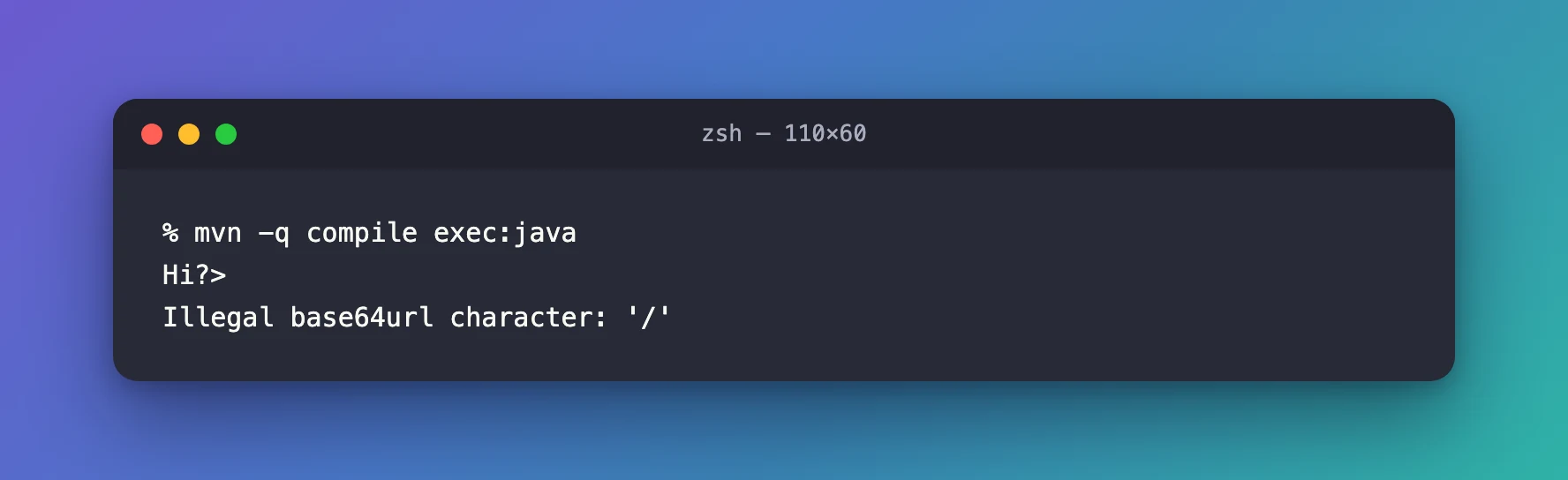
-q keeps Maven quiet, compile builds the code, and exec:java runs the class named in pom.xml.
What Happened
SGk_Pgdecoded to the bytes ofHi?>without any padding.SGk/Pg==stopped at the/, which base64url doesn't use, and the decoder threwDecodingException: Illegal base64url character: '/'.
Common Mistakes
| Mistake | What happens | Do this instead |
|---|---|---|
Decoding plain base64 with BASE64URL | DecodingException: Illegal base64url character: '/' | Use Decoders.BASE64 for plain base64 |
Decoding base64url with Decoders.BASE64 | DecodingException: Illegal base64 character: '_' | Use Decoders.BASE64URL |
Turning binary data, such as a signature, into a String | The bytes aren't text and come out garbled | Keep them as byte[] |
Troubleshooting
| Symptom | Likely cause | Fix |
|---|---|---|
Illegal base64url character: '*' or another character | The input isn't base64url, or has a stray character | Check where the text came from |
cannot find symbol: class DecodingException | The import is missing | Add import io.jsonwebtoken.io.DecodingException; |
FAQ
Can I decode a JWT's payload with this?
Yes: split the token at its dots and decode the middle piece. That only reads the claims; it doesn't verify them, so use it for reading, and verify the token with jjwt's parser before trusting anything in it.
Does it need the padding?
No. SGk_Pg decoded without the = that plain base64 would add.
Conclusion
Decoders.BASE64URL.decode(text) turns base64url into bytes and refuses anything else, and new String(bytes, StandardCharsets.UTF_8) turns text bytes back into a string.
Additional Resources
- Decoders, in the jjwt API documentation.
- RFC 4648, section 5: base64 with the URL and filename safe alphabet.
