How to Decode a JWT Without Verifying It in Go with ParseUnverified

golang-jwt's ParseUnverified reads a JSON Web Token's header and claims without the key. As its name says, it checks nothing, which makes it right for reading a token and wrong for trusting one.
Syntax
<claims> := jwt.MapClaims{}
<token>, <parts>, <err> := jwt.NewParser().ParseUnverified(<tokenString>, <claims>)
| Part | What it does |
|---|---|
jwt.NewParser() | Makes a parser with default settings. |
ParseUnverified(<tokenString>, <claims>) | Fills <claims> from the payload without checking the signature or any claim. |
<token> | The parsed token; <token>.Header holds the header, for example kid. |
<parts> | The token's three pieces as strings. |
<err> | An error when the token can't be read at all. |
The golang-jwt source documents ParseUnverified: "ParseUnverified parses the token but does not validate the signature." And: "WARNING: Don't use this method unless you know what you're doing. It's only ever useful in cases where you know the signature is valid (since it has already been or will be checked elsewhere in the stack) and you want to extract values from it."
The Example
The example reads a token that another service signed with a key this program doesn't have. The token expired on 1 December 2025, and its header names the key that signed it, key-2025-12, in a kid.
Prerequisites
- Go. This guide uses Go 1.27.4.
Step 1: Create the Module
mkdir demo
cd demo
go mod init example.com/demo
go get github.com/golang-jwt/jwt/v5
go mod init creates the module, and go get adds golang-jwt, version 5.3.1 here.
Step 2: Write the Code
Create main.go in the demo folder:
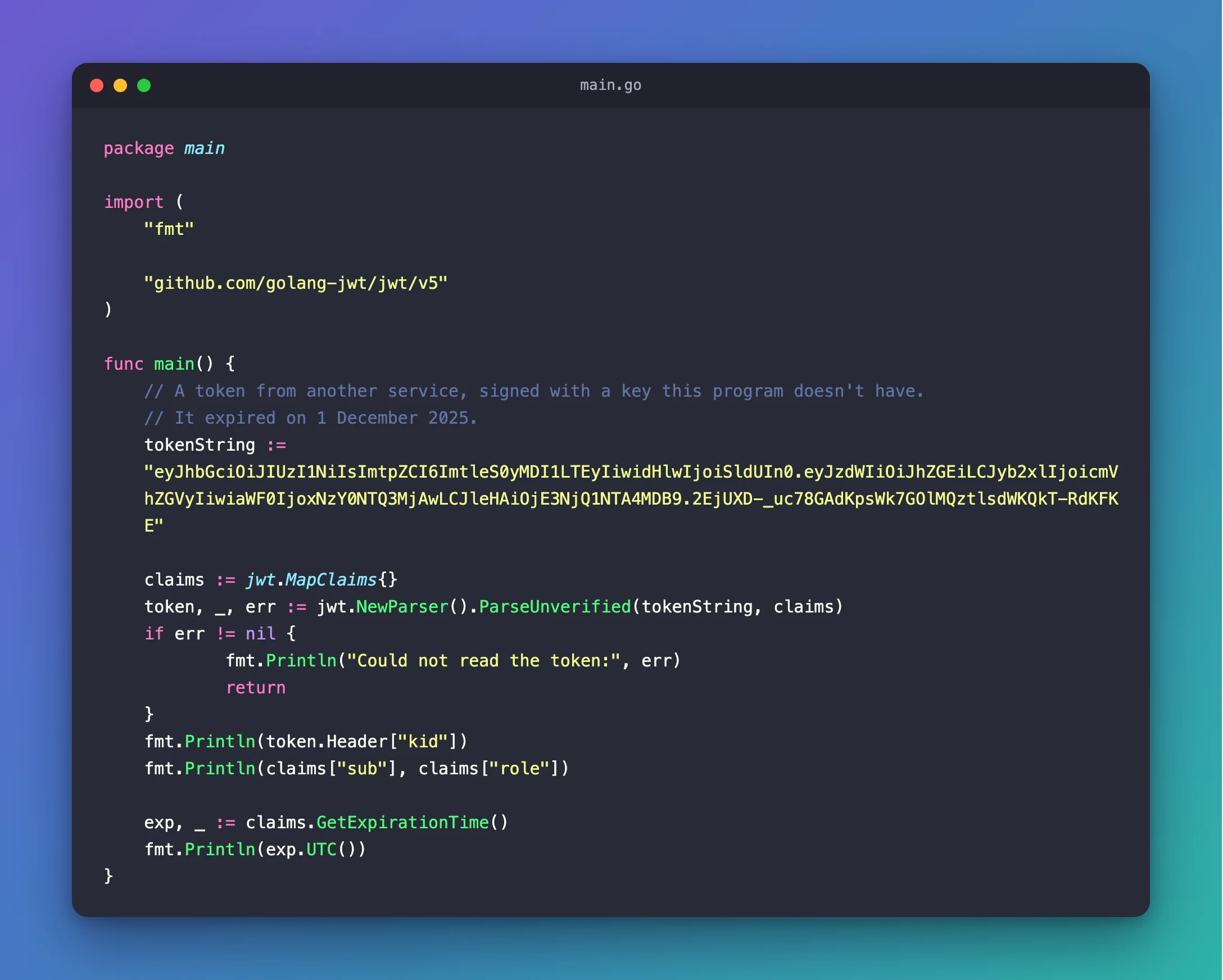
package main

import (
	"fmt"

	"github.com/golang-jwt/jwt/v5"
)

func main() {
	// A token from another service, signed with a key this program doesn't have.
	// It expired on 1 December 2025.
	tokenString := "eyJhbGciOiJIUzI1NiIsImtpZCI6ImtleS0yMDI1LTEyIiwidHlwIjoiSldUIn0.eyJzdWIiOiJhZGEiLCJyb2xlIjoicmVhZGVyIiwiaWF0IjoxNzY0NTQ3MjAwLCJleHAiOjE3NjQ1NTA4MDB9.2EjUXD-_uc78GAdKpsWk7GOlMQztlsdWKQkT-RdKFKE"

	claims := jwt.MapClaims{}
	token, _, err := jwt.NewParser().ParseUnverified(tokenString, claims)
	if err != nil {
		fmt.Println("Could not read the token:", err)
		return
	}
	fmt.Println(token.Header["kid"])
	fmt.Println(claims["sub"], claims["role"])

	exp, _ := claims.GetExpirationTime()
	fmt.Println(exp.UTC())
}
Step 3: Run It
go run .
key-2025-12
ada reader
2025-12-01 01:00:00 +0000 UTC
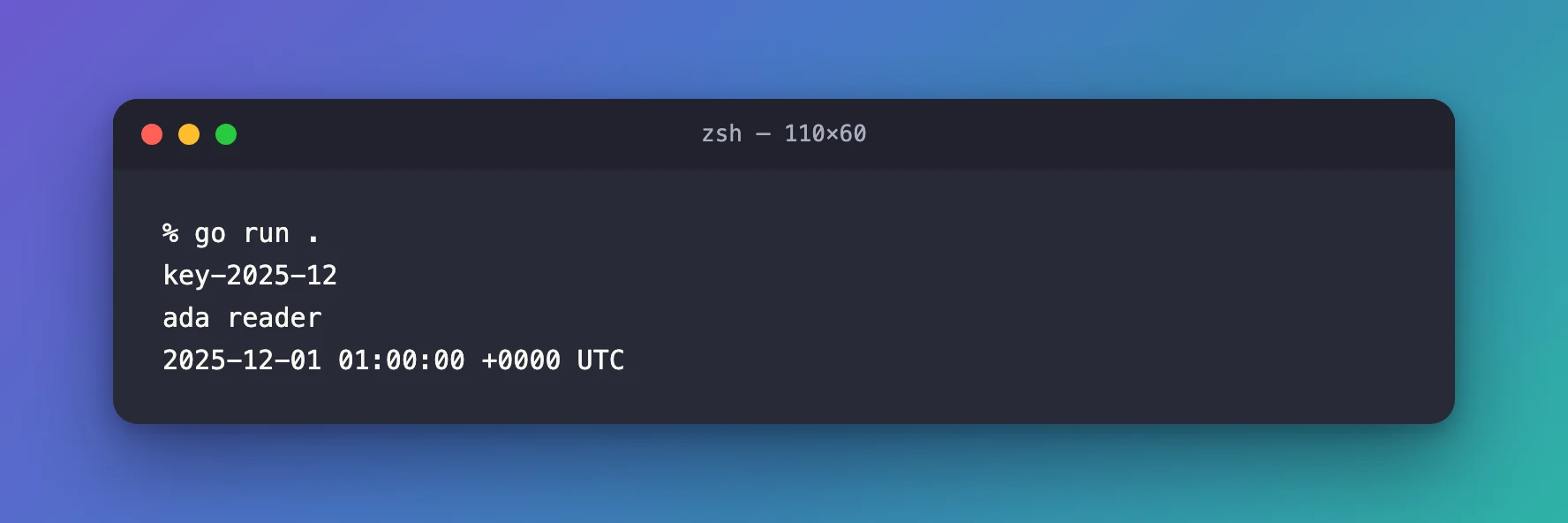
ParseUnverified read the header and every claim without the key, and returned no error even though the token had expired months before.
Decoding Is Not Verifying
Anyone can write a token with any claims, so these claims prove nothing. Use them to read, never to decide who someone is or what they may do. To trust a token, verify it with the key and the algorithm you expect:
token, err := jwt.ParseWithClaims(tokenString, claims, func(*jwt.Token) (any, error) {
	return key, nil
}, jwt.WithValidMethods([]string{"HS256"}))
ParseWithClaims checks the signature and the expiry, and returns an error when either fails.
Reading the header first is the one common server-side use: a service with several keys reads kid and picks that key from its own list. The header is just as forgeable as the claims, so look it up only among keys you already trust.
Common Mistakes
| Mistake | What happens | Do this instead |
|---|---|---|
Trusting claims from ParseUnverified | Anyone can send a token with any claims | Use ParseWithClaims with the key |
Expecting ParseUnverified to reject an expired token | It returned the claims of an expired token with no error | Verify; that checks exp |
Passing the whole Authorization header value | token is malformed: could not base64 decode header: illegal base64 data at input byte 6 | Remove Bearer first |
Troubleshooting
| Symptom | Likely cause | Fix |
|---|---|---|
token is malformed: token contains an invalid number of segments | The string isn't three pieces separated by dots | Check what you passed |
go: downloading github.com/golang-jwt/jwt v3.2.2+incompatible during go get | Go also looks up the module path without /v5 | Nothing to fix; only v5 is added to go.mod |
FAQ
Why MapClaims and not my own struct?
Either works. jwt.MapClaims takes any claims without a type, which suits reading an unknown token. With a struct that embeds jwt.RegisteredClaims, you get typed fields instead.
What does GetExpirationTime return?
The exp claim as a *jwt.NumericDate, which holds a time.Time, plus an error if the claim has the wrong type.
Conclusion
jwt.NewParser().ParseUnverified(tokenString, claims) reads a token's header and claims without a key and without any checks. Use it to look inside a token; use ParseWithClaims with the key before you trust it.
Additional Resources
- Parser.ParseUnverified and MapClaims, in the golang-jwt documentation.
- RFC 8725, section 3.10: Do Not Trust Received Claims.
