How to Convert a &str to a String in Rust

Rust has two main string types. &str is a borrowed view of text, such as a string literal, and String is text your code owns. When a variable, a struct field or a function needs a String, convert the &str with to_owned(), to_string() or String::from().
Syntax
let <owned>: String = <text>.to_owned();
let <owned>: String = <text>.to_string();
let <owned>: String = String::from(<text>);
let <owned>: String = <text>.into();
| Part | What it does |
|---|---|
<text> | A &str, such as "Ada" or a &str variable. |
.to_owned() | Makes an owned copy of borrowed data: for a &str, a String. |
.to_string() | Turns the value into a String. |
String::from(<text>) | Creates a String from the text. |
.into() | Converts into the type the variable declares, here String. |
The standard library's documentation for ToOwned::to_owned: "Creates owned data from borrowed data, usually by cloning." Its own example is let ss: String = s.to_owned();. For String::from, the String documentation says: "Converts a &str into a String. The result is allocated on the heap."
The Example
The example converts the text "Ada" three ways and prints the three String values side by side.
Prerequisites
- Rust, installed with rustup, which comes with Cargo. This guide uses Rust 1.100.0.
Step 1: Create a Project
cargo new demo
cd demo
    Creating binary (application) `demo` package
note: see more `Cargo.toml` keys and their definitions at https://doc.rust-lang.org/cargo/reference/manifest.html
cargo new demo creates a folder named demo with a Cargo.toml file, which describes the project, and src/main.rs, which holds the code. cd demo moves into it.
Step 2: Write the Code
Replace the contents of src/main.rs with:
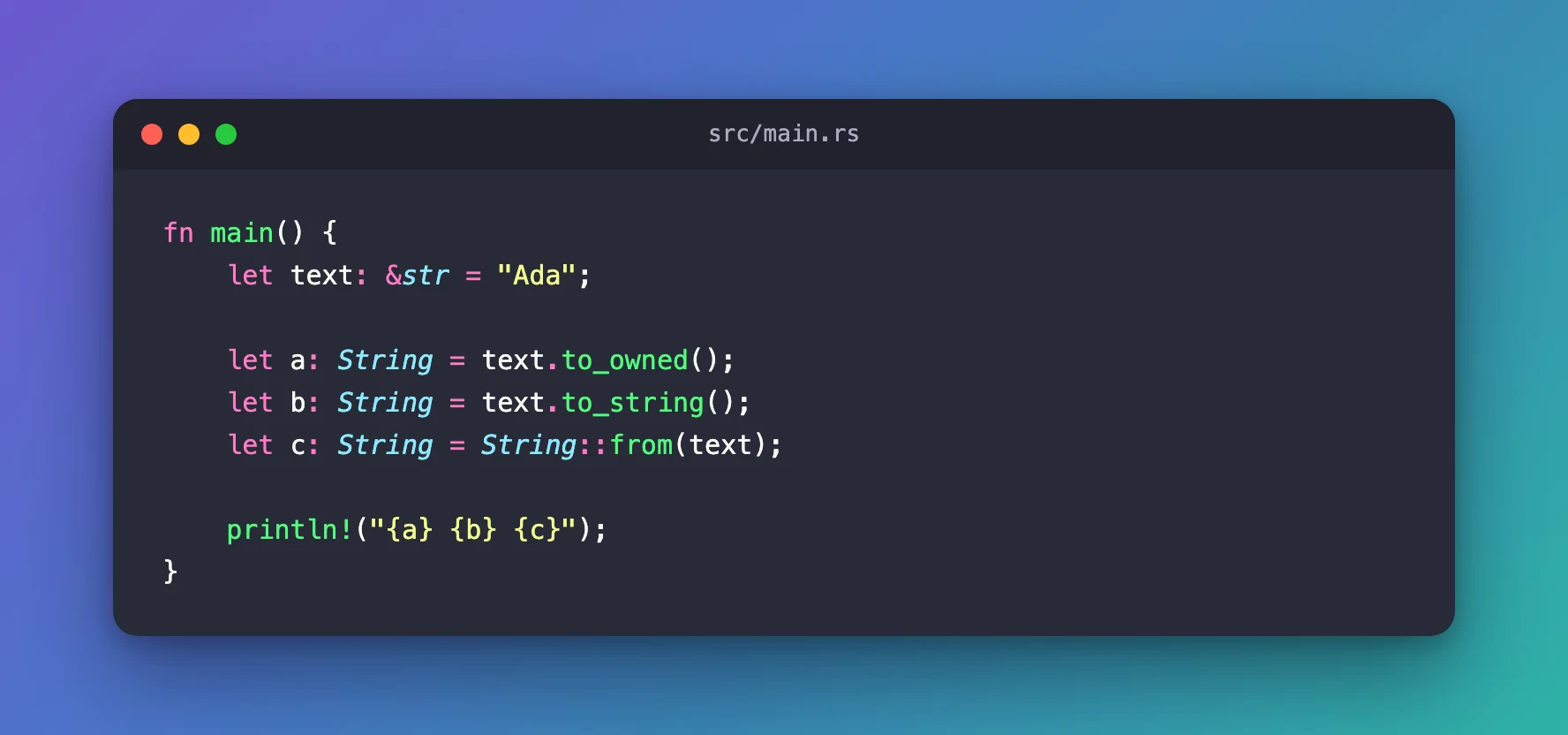
fn main() {
    let text: &str = "Ada";

    let a: String = text.to_owned();
    let b: String = text.to_string();
    let c: String = String::from(text);

    println!("{a} {b} {c}");
}
The type annotations, &str and String, are only there to show the types: the code works without them.
Step 3: Run It
cargo run -q
Ada Ada Ada
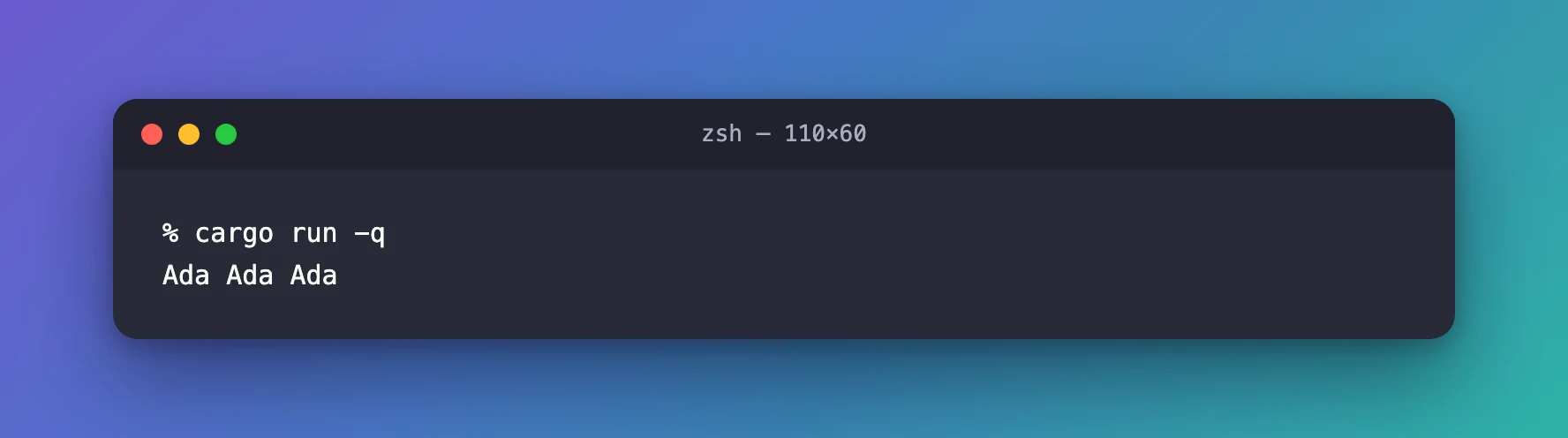
cargo run compiles the program and runs it, and -q hides Cargo's own status lines. All three conversions produced the same String. A fourth, let d: String = text.into();, prints Ada too.
When the Compiler Asks for It
Assigning a &str where a String is expected stops the build, and the compiler suggests a conversion:
fn main() {
    let text: &str = "Ada";
    let name: String = text;
    println!("{name}");
}
error[E0308]: mismatched types
 --> src/main.rs:3:24
  |
3 |     let name: String = text;
  |               ------   ^^^^ expected `String`, found `&str`
  |               |
  |               expected due to this
  |
help: try using a conversion method
  |
3 |     let name: String = text.to_string();
  |                            ++++++++++++

For more information about this error, try `rustc --explain E0308`.
error: could not compile `demo` (bin "demo") due to 1 previous error
Common Mistakes
| Mistake | What happens | Do this instead |
|---|---|---|
Assigning a &str to a String variable or field | error[E0308]: mismatched types, expected `String`, found `&str` | Convert it with to_owned(), to_string() or String::from() |
Using .into() without a declared target type | error[E0283]: type annotations needed: the compiler can't tell what to convert into | Declare the type, as in let d: String = text.into(); |
Converting a &str you only read | An extra copy you don't need | Keep the &str when nothing has to own the text |
Troubleshooting
| Symptom | Likely cause | Fix |
|---|---|---|
expected `String`, found `&str` | A &str where a String is needed | Add .to_string(), as the compiler's help shows |
help: try using a conversion method | The same mismatch | Apply the suggestion |
FAQ
Which one should I use?
They give the same String, so it's a matter of style. to_owned() says "make an owned copy", String::from() reads naturally when you build a String from a literal, and to_string() is what the compiler suggests.
Why does a struct need String and not &str?
A struct that holds a &str only borrows the text, so it needs a lifetime saying how long the text lives. A field written as name: &str without one stops the build with error[E0106]: missing lifetime specifier. A String field owns its text, which keeps the struct simple.
Conclusion
to_owned(), to_string(), String::from() and .into() all turn a &str into an owned String. Convert when something needs to own the text, and keep the &str when you only read it.
