How to Calculate Balanced Accuracy in scikit-learn

When one class is rare, accuracy flatters a model: if 8 emails in 10 are fine, a filter that never flags anything is still 80% accurate. Balanced accuracy averages how well the model does on each class, so the common class can't hide mistakes on the rare one. This guide compares the two on two spam filters, with real output from scikit-learn 1.9.1.
Syntax
from sklearn.metrics import balanced_accuracy_score

score = balanced_accuracy_score(y_true, y_pred)
| Part | What it means |
|---|---|
y_true | The true classes |
y_pred | The classes the model predicted, in the same order |
score | The average of the recall of each class: 1 is perfect, 0.5 is what a model that always gives the same answer gets on two classes |
scikit-learn's user guide defines it: "It is the macro-average of recall scores per class", and "for balanced datasets, the score is equal to accuracy."
Step 1: Compare Accuracy and Balanced Accuracy
Ten emails, two of them spam (1), and two filters: one that catches one of the two spam emails, and one that never flags anything:
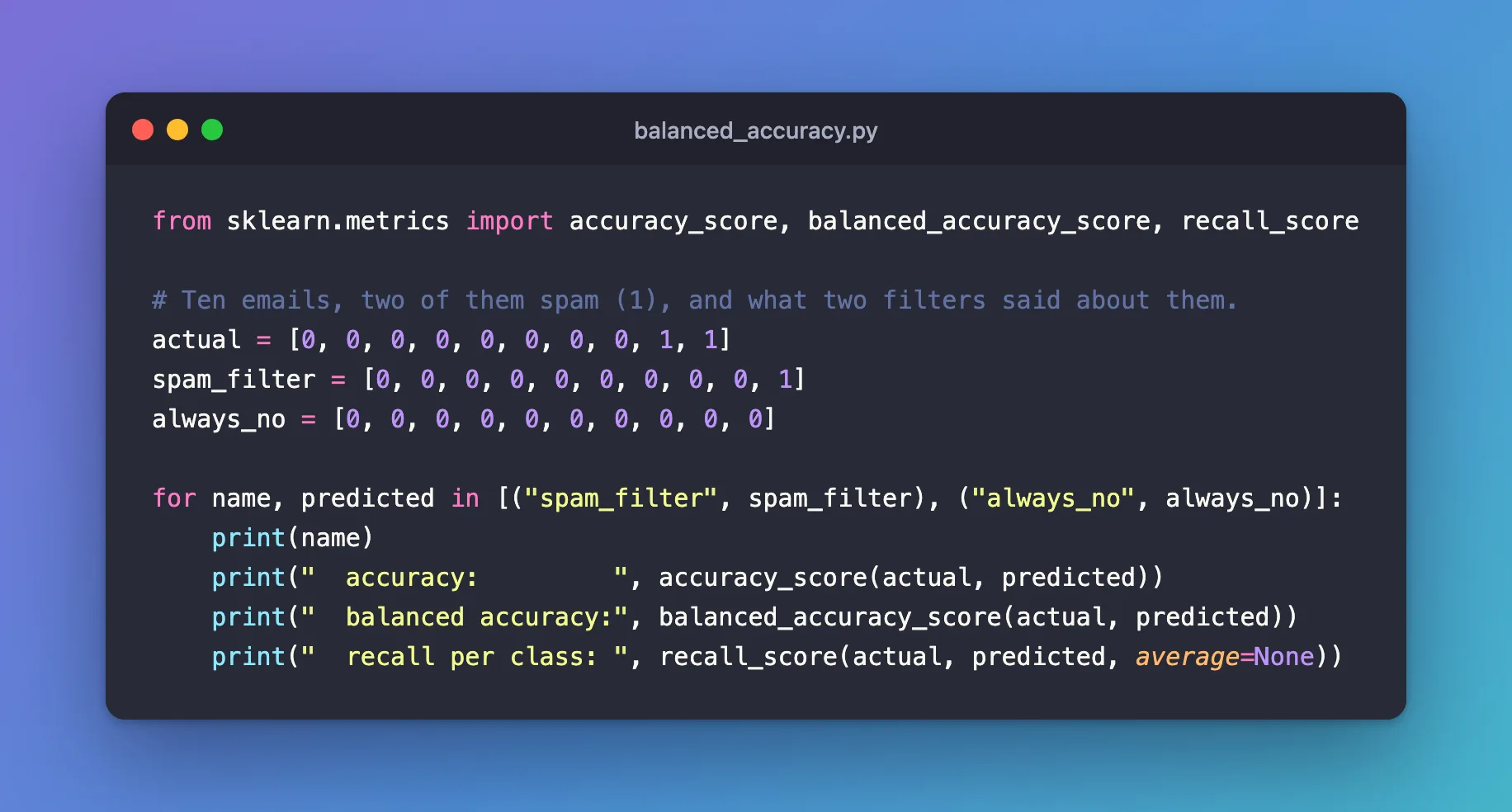
from sklearn.metrics import accuracy_score, balanced_accuracy_score, recall_score

# Ten emails, two of them spam (1), and what two filters said about them.
actual = [0, 0, 0, 0, 0, 0, 0, 0, 1, 1]
spam_filter = [0, 0, 0, 0, 0, 0, 0, 0, 0, 1]
always_no = [0, 0, 0, 0, 0, 0, 0, 0, 0, 0]

for name, predicted in [("spam_filter", spam_filter), ("always_no", always_no)]:
    print(name)
    print("  accuracy:         ", accuracy_score(actual, predicted))
    print("  balanced accuracy:", balanced_accuracy_score(actual, predicted))
    print("  recall per class: ", recall_score(actual, predicted, average=None))
uv run python balanced_accuracy.py
spam_filter
  accuracy:          0.9
  balanced accuracy: 0.75
  recall per class:  [1.  0.5]
always_no
  accuracy:          0.8
  balanced accuracy: 0.5
  recall per class:  [1. 0.]
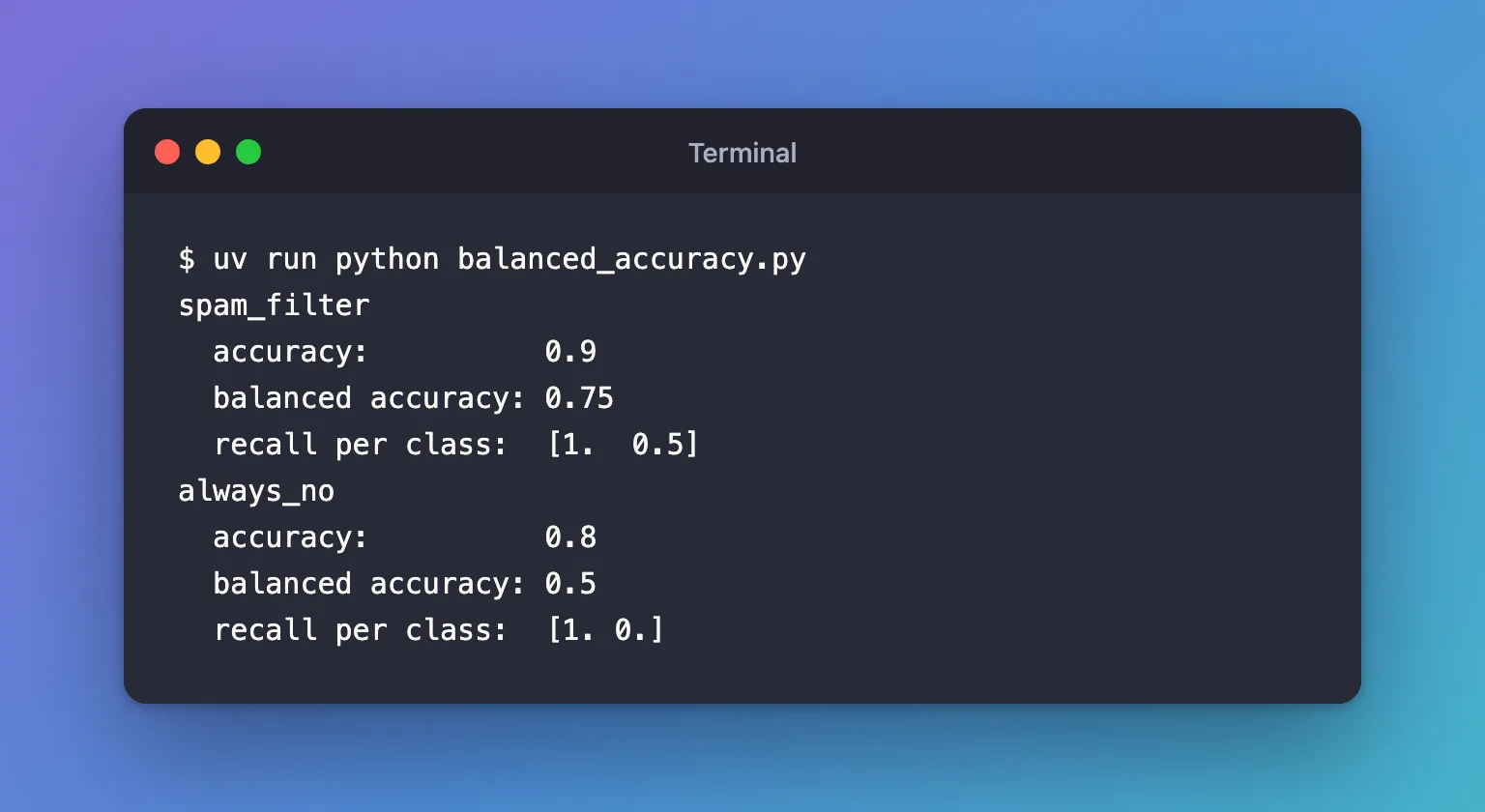
spam_filter: 90% accurate, but it found only half the spam.recall_score(..., average=None)gives each class's recall,[1. 0.5], and balanced accuracy is their average, 0.75.always_no: still 80% accurate without catching a single spam email. Balanced accuracy shows it for what it is: 0.5, the score of a model that ignores its input.
Common Mistakes
| Mistake | What happens | Do this instead |
|---|---|---|
| Judging a model on accuracy when one class is rare | A model that ignores the rare class looks good | Look at balanced accuracy, or each class's recall |
| Reading balanced accuracy like accuracy | 0.5 sounds like "half right", but it's the floor of a do-nothing model on two classes | Compare it with 0.5, not with 0 |
Troubleshooting
| Symptom | Likely cause | Fix |
|---|---|---|
UserWarning: A single label was found in 'y_true' and 'y_pred' | Only one class in the rows scored | Score more rows; inside MLflow's evaluation, see Fixed: A single label was found |
FAQ
Is balanced accuracy the same as macro-averaged recall?
Yes, the user guide defines it that way, and recall_score(y_true, y_pred, average="macro") gives the same number.
When is balanced accuracy equal to accuracy?
When the classes are the same size, as the user guide says.
Conclusion
On imbalanced data, accuracy rewarded a filter that never flagged spam with 0.8. balanced_accuracy_score, the average of each class's recall, gave it 0.5 and gave the filter that caught half the spam 0.75.
Additional Resources
- sklearn.metrics.balanced_accuracy_score — the function and its
adjustedoption. - Balanced accuracy score — the user guide's definition.
