How to Build a List with a List Comprehension in Python

To make a new list from an existing one, such as every number squared or only the even ones, Python has a short form called a list comprehension. It fits the loop and the new list into one line. This guide builds two lists from five numbers, with real output from Python 3.15.2.
Syntax
<new list> = [<expression> for <item> in <list>]
<new list> = [<expression> for <item> in <list> if <condition>]
| Part | What it means |
|---|---|
<expression> | What each item of the new list is, usually built from <item> |
for <item> in <list> | Goes through the items one by one |
if <condition> | Optional. Only items for which it's true go into the new list |
The Python tutorial: "A list comprehension consists of brackets containing an expression followed by a for clause, then zero or more for or if clauses."
Prerequisites
- uv and Python 3. This guide uses uv 0.13.10 with Python 3.15.2, in a project made with
uv init.
Step 1: Write the Script
numbers = [1, 2, 3, 4, 5]

squares = [n * n for n in numbers]
print(squares)

even_numbers = [n for n in numbers if n % 2 == 0]
print(even_numbers)
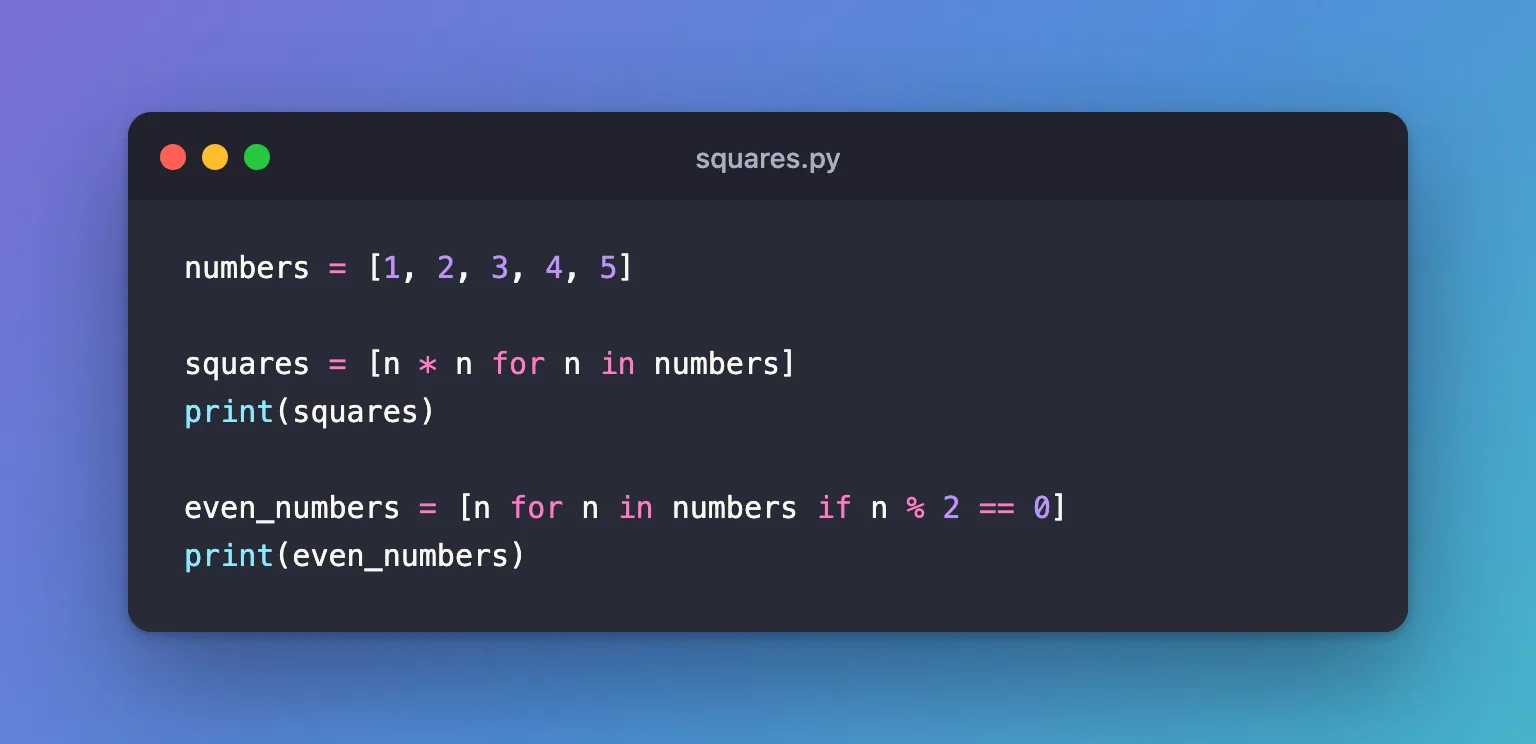
[n * n for n in numbers]: eachnbecomesn * n.if n % 2 == 0: keeps the numbers that leave no remainder when divided by 2.
Step 2: Run It
uv run python squares.py
[1, 4, 9, 16, 25]
[2, 4]
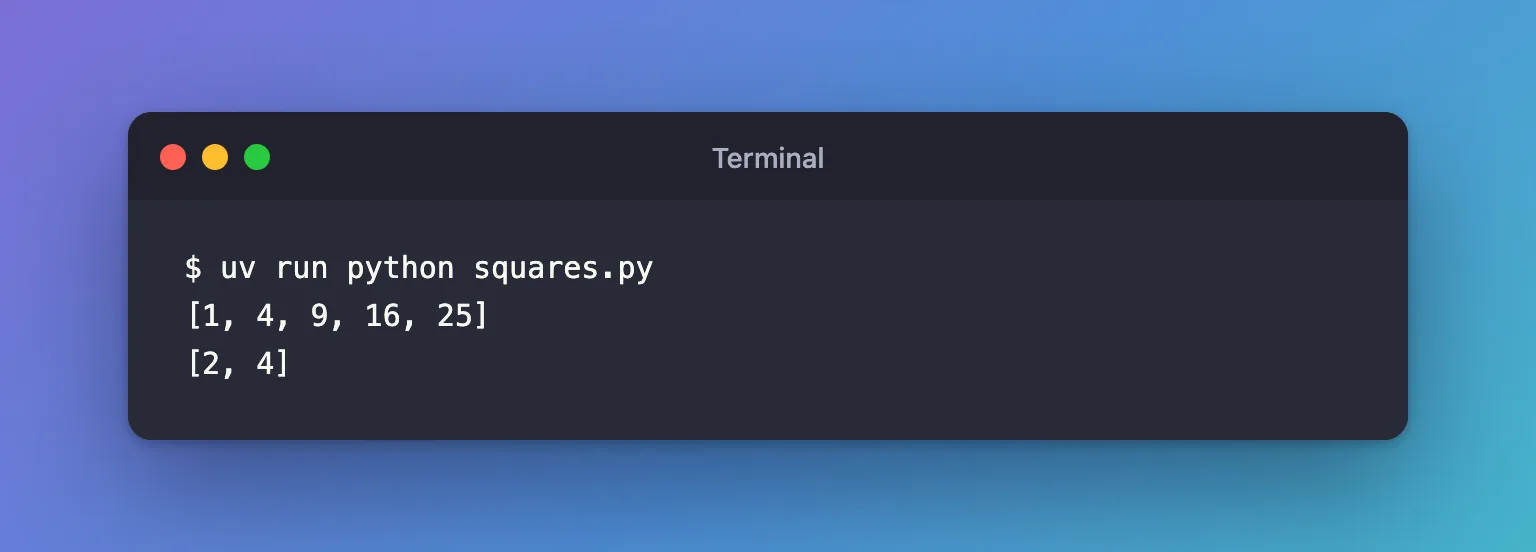
The first list has one square per number; the second has only the even numbers.
Common Mistakes
| Mistake | What happens | Do this instead |
|---|---|---|
| Round brackets instead of square ones | (n * n for n in numbers) printed <generator object <genexpr> at 0x...>, not a list | Square brackets, or list(...) around it: list(n * n for n in numbers) gave [1, 4, 9] |
| Using the loop name after the comprehension | print(n) raised NameError: name 'n' is not defined: n exists only inside the brackets | Keep the work inside the comprehension, or use a for loop |
Troubleshooting
| Symptom | Likely cause | Fix |
|---|---|---|
| The new list is empty | The if condition is never true | Print a few values of the condition, such as n % 2 |
FAQ
Is a comprehension faster than a for loop?
It does the same work with less code; choose it when the line stays easy to read. A long or nested one is often clearer as a loop.
Does it change the original list?
No. numbers is still [1, 2, 3, 4, 5]; the comprehension makes a new list.
Conclusion
[n * n for n in numbers] built [1, 4, 9, 16, 25], and adding if n % 2 == 0 kept [2, 4], each in one line.
Additional Resources
- List comprehensions — the tutorial's section, with nested examples.
- Displays for lists — the language reference.
