How to Accept Only Positive Integers in argparse

type=int makes an argparse option a whole number, but it happily accepts 0 and -5, which make no sense for a count. A small function passed as type does the conversion and the check in one place, and argparse turns its complaint into a proper error message. This guide builds a script that repeats a word a positive number of times, with real output from Python 3.15.2.
Syntax
def positive_int(text: str) -> int:
    value = int(text)
    if value < 1:
        raise argparse.ArgumentTypeError(f"must be 1 or more, got {value}")
    return value


parser.add_argument("--<option>", type=positive_int)
| Part | What it means |
|---|---|
positive_int(text) | argparse calls it with the option's text, such as "3", and uses what it returns |
int(text) | Converts the text; it raises ValueError for text such as "two" |
argparse.ArgumentTypeError(...) | "Raised when something goes wrong converting a command line string to a type"; its message becomes the error the user sees |
type=positive_int | Use the function, without brackets, as the option's type |
The Python documentation explains the rule behind it: "If the function raises ArgumentTypeError, TypeError, or ValueError, the exception is caught and a nicely formatted error message is displayed."
Step 1: Write the Script
The example prints a word several times. Create repeat.py:
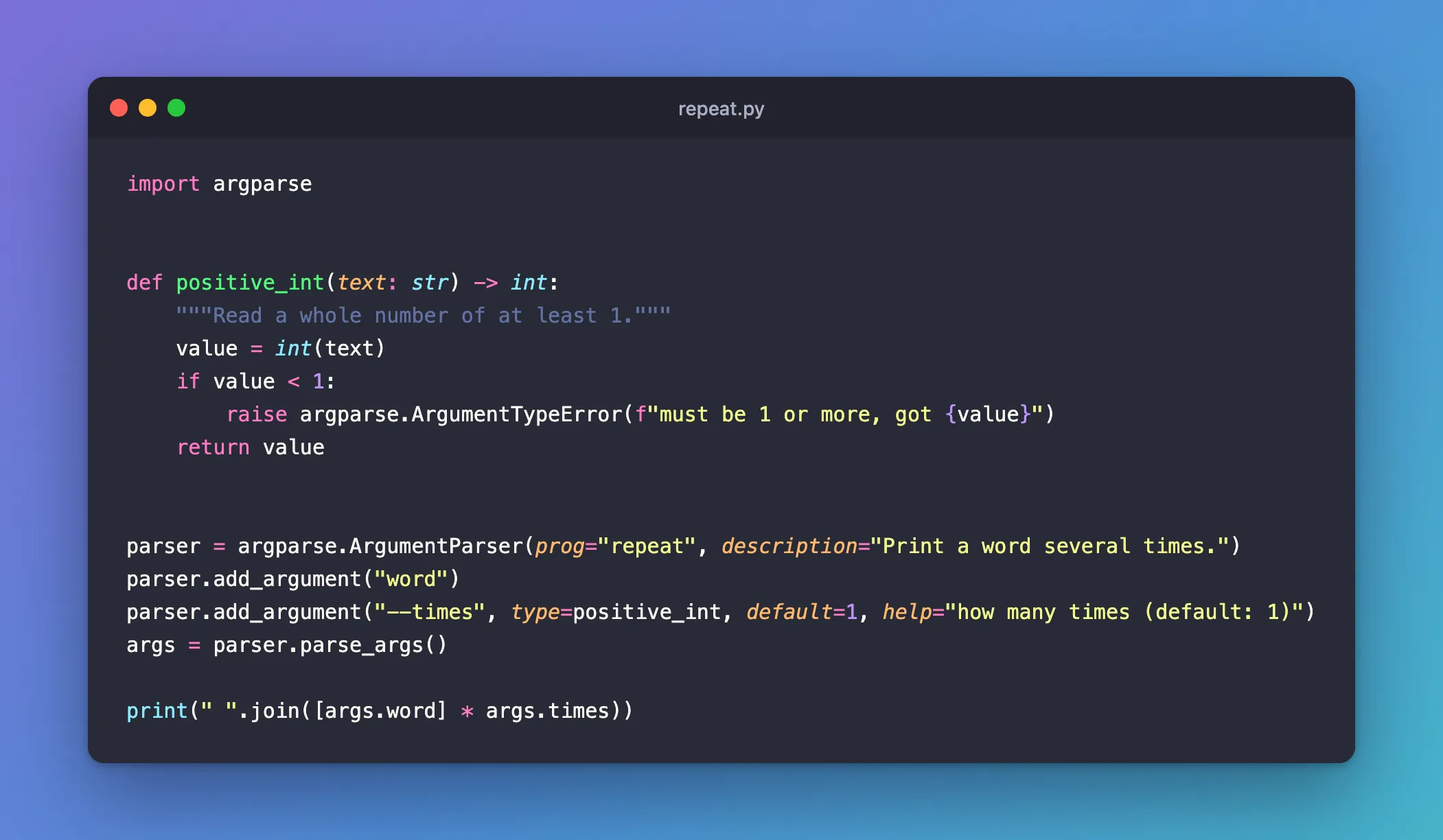
import argparse


def positive_int(text: str) -> int:
    """Read a whole number of at least 1."""
    value = int(text)
    if value < 1:
        raise argparse.ArgumentTypeError(f"must be 1 or more, got {value}")
    return value


parser = argparse.ArgumentParser(prog="repeat", description="Print a word several times.")
parser.add_argument("word")
parser.add_argument("--times", type=positive_int, default=1, help="how many times (default: 1)")
args = parser.parse_args()

print(" ".join([args.word] * args.times))
Step 2: Run It with Good and Bad Values
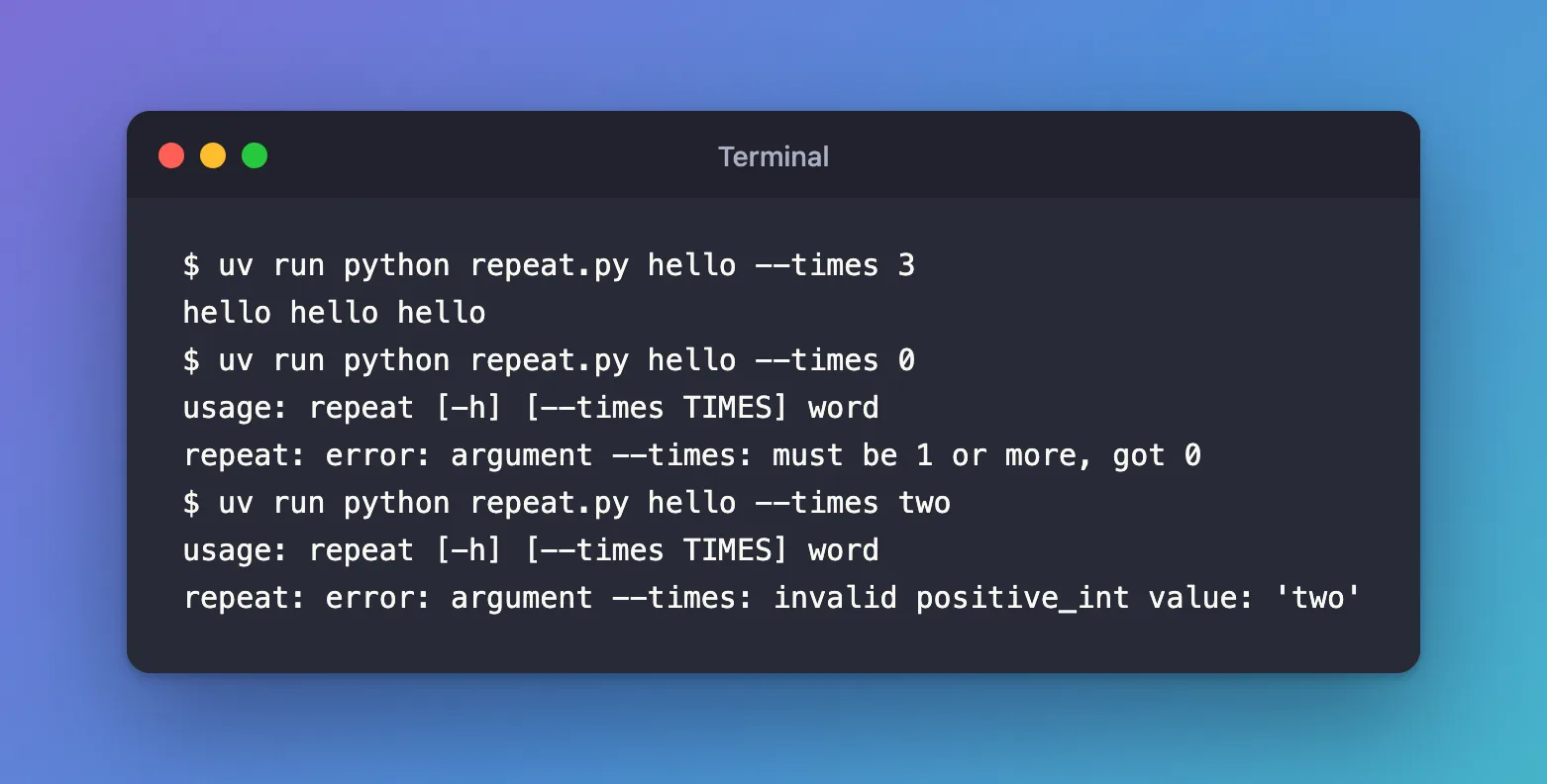
uv run python repeat.py hello --times 3
uv run python repeat.py hello --times 0
uv run python repeat.py hello --times two
hello hello hello
usage: repeat [-h] [--times TIMES] word
repeat: error: argument --times: must be 1 or more, got 0
usage: repeat [-h] [--times TIMES] word
repeat: error: argument --times: invalid positive_int value: 'two'
| Input | What happened |
|---|---|
--times 3 | positive_int returned 3, and the word printed three times |
--times 0 | positive_int raised ArgumentTypeError; argparse printed the usage line and the function's own message |
--times two | int("two") raised ValueError; argparse printed its standard message, naming the function: invalid positive_int value: 'two' |
After an error, argparse stops the script with exit code 2, so shell scripts can tell the run failed.
Step 3: Check the Help
uv run python repeat.py --help
usage: repeat [-h] [--times TIMES] word

Print a word several times.

positional arguments:
  word

options:
  -h, --help     show this help message and exit
  --times TIMES  how many times (default: 1)
Without --times, the default, 1, is used, and the word prints once. A default that isn't text is used as it is, without going through positive_int.
Common Mistakes
| Mistake | What happens | Do this instead |
|---|---|---|
type=positive_int(), with brackets | Python calls the function at once, without text, and stops with a TypeError | Pass the function itself: type=positive_int |
Raising another exception, such as RuntimeError | argparse doesn't catch it, and the user sees a traceback | Raise argparse.ArgumentTypeError |
Checking the value after parse_args() with if and print | The check is far from the option, and the usage line isn't shown | Put the check in the type function |
Troubleshooting
| Symptom | Likely cause | Fix |
|---|---|---|
invalid positive_int value: 'two' | The text isn't a whole number | Pass digits, such as --times 2 |
must be 1 or more, got 0 | The number is below 1 | Pass 1 or more |
The error names the function, positive_int, which users don't know | That's argparse's message for a ValueError | Catch the ValueError inside the function and raise ArgumentTypeError with your own words |
FAQ
Can I use the same function for several options?
Yes. Any option can use type=positive_int, and each error names the option it came from.
What about an upper limit?
Add a second check in the same function, such as if value > 100: raise argparse.ArgumentTypeError("must be 100 or less"). For a short list of allowed values, choices= is simpler.
Does this work for positional arguments?
Yes: parser.add_argument("count", type=positive_int) works the same way.
Conclusion
A positive_int function that converts with int() and raises argparse.ArgumentTypeError below 1, passed as type=positive_int, made --times refuse 0 with the function's own message and two with argparse's, and stop with exit code 2. One small function keeps the conversion and the check together.
Additional Resources
- argparse: type — how argparse uses a type function.
- argparse.ArgumentTypeError — the exception's reference.
