Fixed: Two Requests Buy the Last Item in EF Core (Overselling)

One unit left, five simultaneous orders, and all five answered 201 Created. The order code was in a transaction, and it checked the stock first. It looked correct, and the first time I ran it, it even behaved. The check and the write were two separate steps, and every order did the check before any of them had written.
What I Was Doing
My .NET C# Web API uses EF Core 10.0.14 and MySQL 9.7.4. Each order line loads the product, checks its stock in C#, and changes it, all inside a transaction:
// Read the product, check its stock in C#, then change it.
var product = await db.Products
    .FirstOrDefaultAsync(p => p.Id == line.ProductId && !p.IsArchived, ct);

if (product is null)
{
    return TypedResults.Problem(
        title: "The product doesn't exist.",
        detail: $"There is no product with Id {line.ProductId}.",
        statusCode: StatusCodes.Status400BadRequest);
}

if (product.QuantityOnHand < line.Quantity)
{
    return TypedResults.Problem(
        title: "There isn't enough stock.",
        detail: $"Product {line.ProductId} has {product.QuantityOnHand} on hand, and the order asks for {line.Quantity}.",
        statusCode: StatusCodes.Status409Conflict);
}

product.QuantityOnHand -= line.Quantity;
product.UpdatedAtUtc = now;
Five orders for the last unit arrived at once:
seq 5 | xargs -P 5 -I{} curl -s -o /dev/null -w "%{http_code}\n" -X POST http://localhost:5190/api/v1/orders -H "Content-Type: application/json" -d '{"customerName":"Buyer {}","customerEmail":"buyer{}@example.com","lines":[{"productId":13,"quantity":1}]}'
How to Test a Race Condition in a Web API from the Terminal explains that command, and has a PowerShell version.
What I Expected
One 201, and four 409 Conflict.
What I Got
The first round, right after the API started, looked fine:
201
409
409
409
409
One more unit arrived, and five more orders came in, with the same code:
201
201
201
201
201
The product's quantity should equal the sum of its stock movements, so I compared them:
SELECT p.QuantityOnHand,
       (SELECT COALESCE(SUM(m.QuantityChange),0) FROM stock_movements m WHERE m.ProductId=p.Id) AS SumOfMovements,
       (SELECT COUNT(*) FROM order_lines l WHERE l.ProductId=p.Id) AS OrdersPlaced
FROM products p WHERE p.Id=10;
+----------------+----------------+--------------+
| QuantityOnHand | SumOfMovements | OrdersPlaced |
+----------------+----------------+--------------+
|              0 |             -4 |            6 |
+----------------+----------------+--------------+
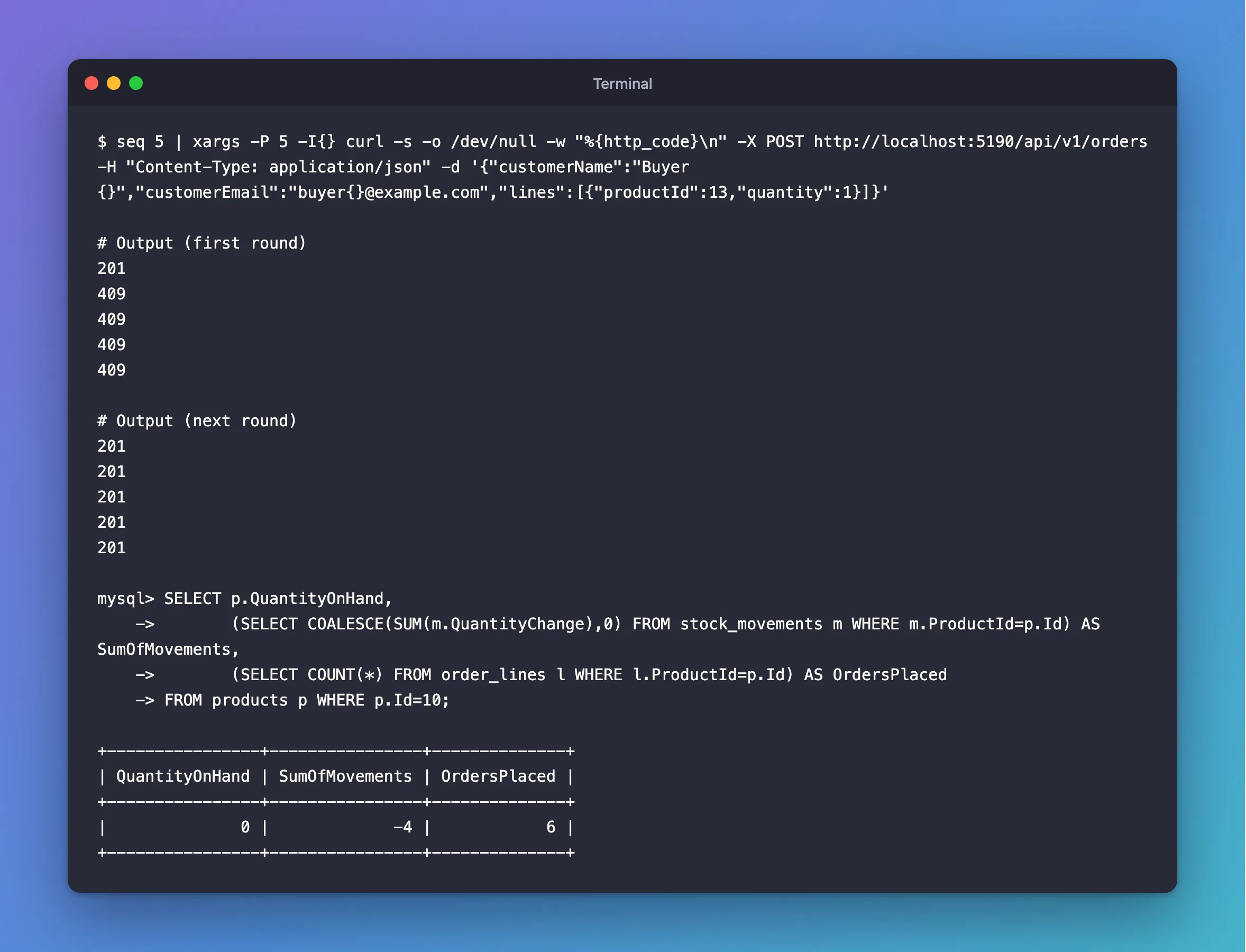
Five orders for the one unit, and the numbers disagree: QuantityOnHand is 0, while the movements add up to -4. OrdersPlaced is 6: the order from the first round, and these five.
What I Checked
What MySQL received. The general query log shows two of the connections:
+------------+--------------------------------------------------------------+
| connection | statement                                                    |
+------------+--------------------------------------------------------------+
|         51 | SELECT `p`.`Id`, `p`.`ArchivedAtUtc`, `p`.`CategoryId`, `p`. |
|         43 | SELECT `p`.`Id`, `p`.`ArchivedAtUtc`, `p`.`CategoryId`, `p`. |
|         51 | UPDATE `products` SET `QuantityOnHand` = 0, `UpdatedAtUtc` = |
|         43 | UPDATE `products` SET `QuantityOnHand` = 0, `UpdatedAtUtc` = |
|         51 | COMMIT                                                       |
|         43 | COMMIT                                                       |
+------------+--------------------------------------------------------------+
Each connection reads, then writes QuantityOnHand = 0. The second UPDATE waits for the first one's row lock, and then sets the same value. It doesn't subtract: EF Core worked out 0 in C# and sent that.
Why the transaction didn't stop it. A plain SELECT in a transaction takes no row lock, under the default isolation level. So every order reads 1.
Why the first round looked fine. A race depends on timing. In that round, right after the API started, the requests didn't overlap between the read and the write. That's why this kind of bug passes a quick test.
Why It Happens
The check happens in C#, and the write happens later, in a separate statement. Between the two, nothing stops another request from doing the same check on the same value.
The Fix
Do the check and the write in one statement, so MySQL does both while it holds the row:
// MySQL locks the row, checks the condition and changes the row in one
// statement. A second buyer waits here, then sees the new quantity.
var taken = await db.Products
    .Where(p => p.Id == line.ProductId && !p.IsArchived && p.QuantityOnHand >= line.Quantity)
    .ExecuteUpdateAsync(
        setters => setters
            .SetProperty(p => p.QuantityOnHand, p => p.QuantityOnHand - line.Quantity)
            .SetProperty(p => p.UpdatedAtUtc, now),
        ct);

if (taken == 0)
{
The second order waits for the row, then sees the new quantity, the WHERE doesn't match, and it gets 0 rows, which becomes a 409. How to Prevent Overselling with a Conditional UPDATE in EF Core goes through it.
After the Fix
201
409
409
409
409
+----------------+----------------+--------------+
| QuantityOnHand | SumOfMovements | OrdersPlaced |
+----------------+----------------+--------------+
|              0 |              0 |            1 |
+----------------+----------------+--------------+
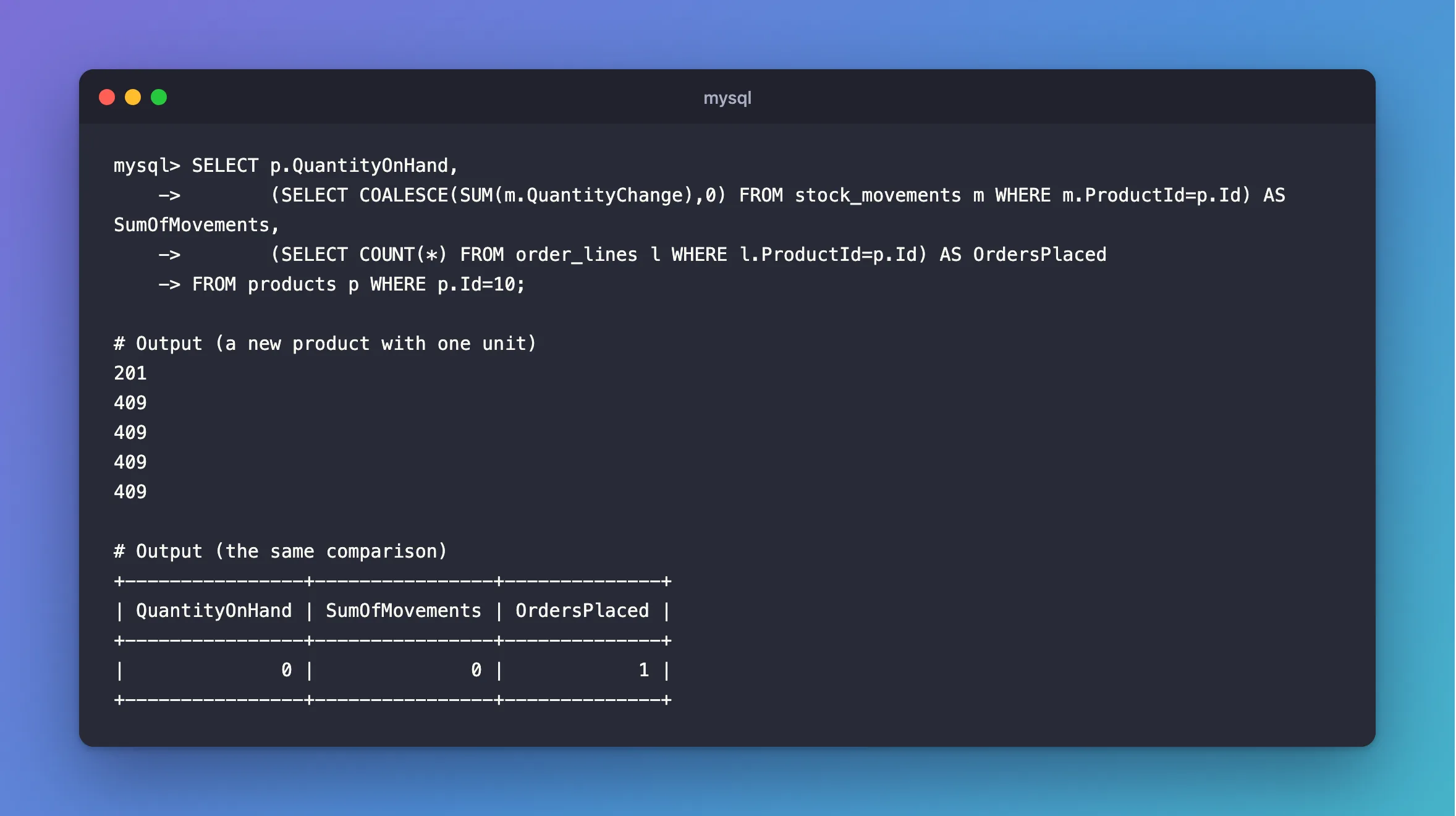
One order, and the numbers agree. It gave the same result on every round.
Common Mistakes
| Mistake | What happens | Do this instead |
|---|---|---|
| Testing with one request, or once | The race doesn't show | Send them at once, several times |
| Thinking a transaction prevents this | A plain read takes no lock | Use a conditional UPDATE, or lock the row |
| Using a concurrency token for stock | Requests fail with stock left | Use a conditional UPDATE |
| Relying on a check constraint alone | Buyers get a 500 | Keep it as a backstop |
Troubleshooting
| Symptom | Likely cause | Fix |
|---|---|---|
QuantityOnHand and the movements disagree | An oversell happened | Check the orders, then fix the code |
| One order, then a long wait for others | They're waiting for the row lock | That's expected, and short |
Lock wait timeout exceeded under load | A transaction holds the row too long | The fix |
Conclusion
Reading a value, checking it in C#, and writing it later is a race, even inside a transaction. Make the check part of the UPDATE's WHERE, and read the row count.
Additional Resources
- ExecuteUpdate and ExecuteDelete — set-based updates.
- Consistent Nonlocking Reads — why a plain
SELECTdoesn't lock.
